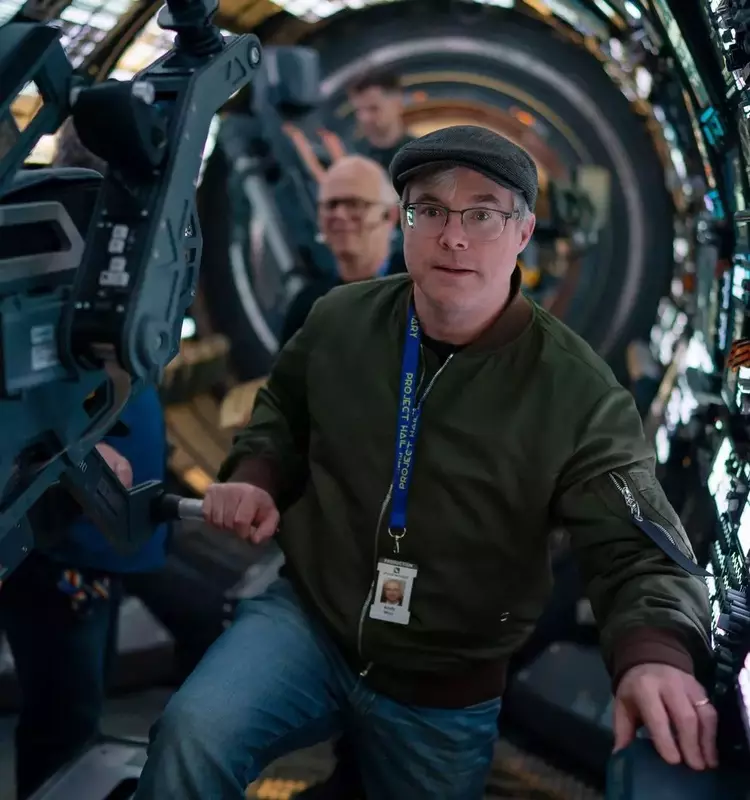
Andy Weir, the acclaimed author behind cinematic hits like "The Martian" and the upcoming "Project Hail Mary" starring Ryan Gosling, reveals the diverse array of science fiction literature and cinema that has profoundly influenced his writing. Weir's work stands out in an era of diminishing original big-budget productions, consistently attracting major studio interest. He attributes this success to his "cinematic" writing style, a direct result of his extensive engagement with films, which has shaped his narrative approach. His storytelling masterfully integrates complex scientific principles into gripping survival narratives, a hallmark that sets him apart in the contemporary sci-fi landscape.
Weir's creative process is deeply rooted in his meticulous attention to scientific detail, transforming intricate calculations into core plot elements. For instance, in "Project Hail Mary," he delves into the specific biology of an alien species and the mechanics of cultivating light-eating space algae to avert an Earth-threatening crisis. This commitment to verisimilitude, where the 'how' is as crucial as the 'what,' differentiates his work. While he modestly distances himself from comparisons to Michael Crichton, another author famed for weaving scientific exposition into thrilling narratives, Weir's doctoral-level exploration of hypothetical scenarios certainly positions him as a successor in spirit. His narratives often feature protagonists who must ingeniously solve problems against formidable natural forces, where the vacuum of space, rather than a conventional antagonist, presents the ultimate challenge.
The fidelity of his book-to-film adaptations, such as "The Martian" and the forthcoming "Project Hail Mary," is a testament to the inherent cinematic quality of his writing. Weir points to Ron Howard's "Apollo 13" as a major inspiration for "The Martian," highlighting how it exemplifies a continuous series of problem-solving scenarios, a concept he expanded into an entire novel. He also deeply admires Isaac Asimov, particularly "I, Robot" and "Caves of Steel," for their innovative exploration of single premises across various narrative directions and for demonstrating that science fiction is a setting, not merely a genre. Asimov's ability to create conflict within established scientific rules resonates strongly with Weir's own approach to crafting believable yet fantastical worlds.
Beyond hard science fiction, Weir's influences stretch to beloved classics like "Back to the Future," which ignited his childhood fascination with time travel and its potential for cross-temporal narratives. He praises its ability to immerse audiences without getting bogged down in scientific explanations, a quality he appreciates in popular storytelling. Iain M. Banks' "The Player of Games" captivated him by successfully crafting compelling conflicts within a post-scarcity utopian society, an intellectual challenge that deeply impressed him. "The Empire Strikes Back" stands out for its unexpected narrative turn where the antagonists triumph, raising the stakes for future installments and leaving a lasting impression on Weir regarding narrative tension.
Furthermore, early works of Robert A. Heinlein, particularly "Tunnel in the Sky" and "Red Planet," fueled Weir's interest in survival narratives and the planet Mars, influencing his depiction of characters overcoming extreme environments through ingenuity. He notes Heinlein's subtle inclusion of a Black protagonist in "Tunnel in the Sky" as a clever subversive act. Arthur C. Clarke's "Rendezvous with Rama" fascinated him with its portrayal of a monumental first contact mystery where the alien intelligence remains utterly indifferent to humanity, a novel concept that challenged conventional sci-fi tropes. While acknowledging his own struggles with character depth, Weir cites "Avatar: The Last Airbender" and Zuko's complex character arc as an exemplary model for character development, a skill he continually strives to improve in his own writing.
Andy Weir's narrative prowess is forged from a deep engagement with both the rigorous logic of science and the captivating art of storytelling. His works, often described as cinematic even before adaptation, invite readers and viewers into worlds where meticulous problem-solving drives the plot. From the survival challenges of "The Martian" to the grand cosmic stakes of "Project Hail Mary," Weir demonstrates a unique ability to make complex scientific concepts accessible and thrilling. His diverse inspirations, ranging from Asimov's foundational robot ethics to the character arcs in "Avatar: The Last Airbender," underscore his commitment to blending intellectual curiosity with compelling human (and alien) drama, continuously pushing the boundaries of what science fiction can achieve.
