The luxury goods industry is currently undergoing a period of complex recovery, as evidenced by the mixed financial outcomes reported for the fourth quarter. While there are glimmers of improvement in key regions and specific product categories, the overall landscape suggests that a full rebound will require sustained effort and strategic adaptation. Major players in the luxury sector are navigating evolving consumer behaviors, economic pressures, and currency fluctuations, all contributing to an uneven path forward.
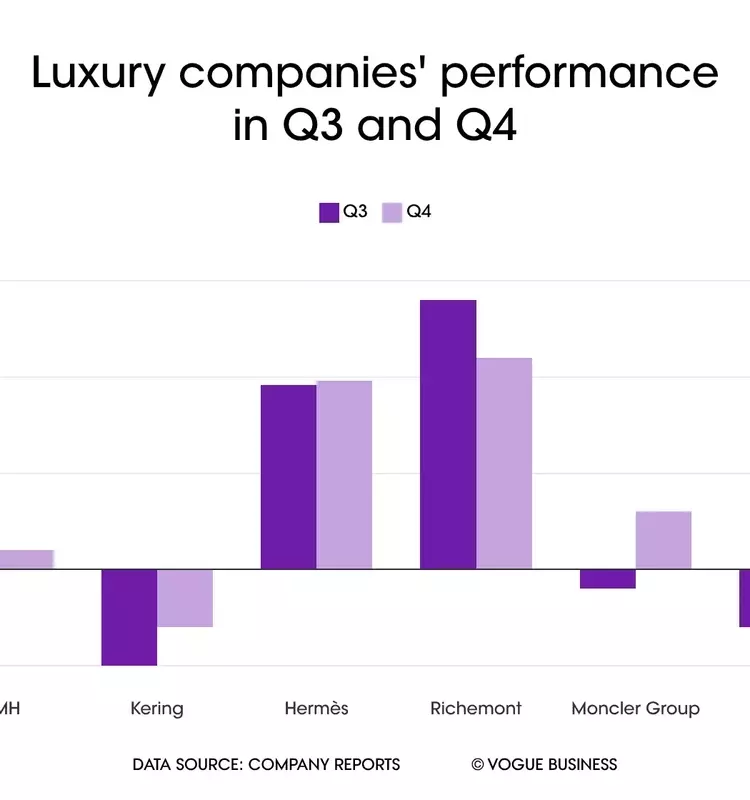
During the fourth quarter, the luxury sector saw a modest growth of 2.2%, aligning with market expectations and following a 2.5% increase in the previous quarter. However, the timing of the Chinese New Year, which occurred later than usual, introduced some uncertainty regarding early performance in China. Additionally, a strong euro negatively impacted profitability for European-based luxury brands when converting sales from other currencies. Bernstein luxury goods analyst Luca Solca noted that Chinese demand has shown gradual improvement, though not as rapidly as many in the market had hoped. He characterized the recovery as potentially U-shaped, suggesting a need for patience from investors and brands alike. Kering's shares, for instance, surged by 11% after reporting a smaller-than-anticipated sales decline of 3% in Q4, signaling investor confidence in its turnaround efforts. CEO Luca de Meo stated these results marked a bottoming out and the initial phase of their revitalization strategy. Conversely, LVMH's stock saw an 8% drop after announcing a modest 1% group sales increase, with its fashion and leather goods division experiencing a 3% decrease. Chairman and CEO Bernard Arnault expressed caution about the future, predicting that 2026 would not be straightforward.
While China's luxury market showed stabilization rather than accelerated growth in Q4, the US market, previously a strong growth driver, began to exhibit a slight deceleration. LVMH's CFO Cécile Cabanis pointed to a "slight slowdown" among American consumers in Q4 compared to Q3, attributing it to challenging comparative figures from a post-election shopping surge in Q4 2024. Despite this, LVMH's US sales grew by 1%, Kering's by 2%, and Hermès recorded robust double-digit growth of 12.1% in the Americas. High-end brands like Ralph Lauren and Tapestry also reported strong performances, with Ralph Lauren's sales up 10% and Tapestry's, boosted by Coach, increasing by 14%. Luxury brands are making significant investments in the US, with Dior opening a new store in LA, Moncler expanding its Grenoble concept, and Hermès planning a larger flagship on Rodeo Drive. Hermès executive chair Axel Dumas emphasized a long-term vision, focusing on "better" rather than simply "more" stores.
The disparity between top-tier and mid-range luxury brands, often referred to as the K-shaped economy, showed signs of narrowing in Q4. Morgan Stanley's Édouard Aubin noted that while brands catering to ultra-wealthy consumers continue to excel, the gap with brands targeting middle-income customers is closing. Luca Solca observed that the performance gap in organic growth reduced to 24 percentage points, down from 38 points a year prior. High-end brands such as Hermès, Loro Piana, Brunello Cucinelli, and Cartier maintain strong sales due to the resilience of affluent consumers. Encouragingly, brands with a larger middle-income customer base, including Burberry, Gucci, and Ferragamo, are showing early signs of recovery. Jewellery remains a shining star in the luxury market. LVMH's watches and jewellery division saw an 8% sales increase, while Hermès's 'other sectors,' which include jewellery, grew by 12.9%. Richemont's jewellery maisons, including Cartier and Van Cleef & Arpels, exceeded expectations with a 14% sales rise. Kering, which generated approximately €1 billion from its jewellery business in 2025, acquired Raselli Franco to strengthen its industrial capabilities, aiming to reduce dependence on fashion cycles. The demand for jewellery, particularly gold, is driven by its perceived investment value and the relative insulation of high-net-worth individuals from economic downturns.
Regarding pricing strategies, Hermès implemented a global price increase of 5% to 6% in January 2026, building on previous hikes. Unlike many competitors, Hermès had not raised prices immediately after the pandemic, granting it more flexibility. Other luxury brands have generally kept price adjustments minimal, focusing on low-single-digit percentage increases to offset inflation. Analysts suggest that enhancing perceived value will be crucial before further price hikes, given current sales volumes. A significant development is the positive outlook for Dior. LVMH's Arnault expressed optimism about Dior's performance under new creative director Jonathan Anderson, whose initial collections launched in January. Following a challenging period in 2024 and 2025, analysts are bullish on Dior's potential for a strong rebound. HSBC analysts anticipate Dior's sales to turn positive in Q1 and accelerate throughout 2026, projecting a 10% growth for the year. This resurgence is vital, as Dior is LVMH's second-largest fashion and leather goods brand, and its recovery could significantly bolster the group's overall performance.
The luxury sector's path to full recovery is characterized by regional variations, category-specific strengths, and strategic investments. While challenges persist, particularly in the Chinese market's gradual improvement and a slight slowdown in the US, the strong performance of ultra-luxury brands and the potential for revitalization in key houses like Dior offer optimistic signals for the industry's future.
