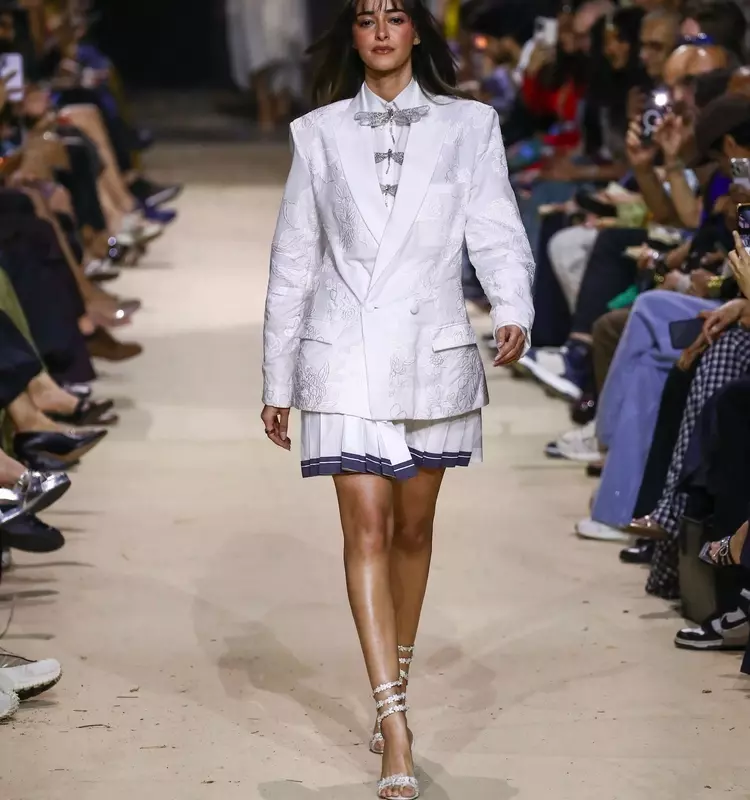
Designer Rahul Mishra unveiled his latest collection, 'White Gold,' at Lakmé Fashion Week in Mumbai, signaling a thoughtful return to the foundational elements of Indian textile artistry. This collection diverges from his signature elaborate embroideries, opting instead for a more understated yet profound exploration of handloom and cotton. Mishra's vision, deeply rooted in tradition and refined through two decades of experience, presents a harmonious blend of heritage and contemporary design, emphasizing the intrinsic beauty and cultural significance of natural fibers.
Rahul Mishra's "White Gold" Collection: A Homage to Indian Textiles
On a significant date, March 23, 2026, at the prestigious Lakmé Fashion Week in Mumbai, acclaimed designer Rahul Mishra presented his latest collection, dubbed "White Gold." This event marked a notable shift in Mishra's design philosophy, moving away from his often-seen elaborate embellishments towards a more restrained and focused aesthetic. The inspiration behind this collection, as explained by Mishra himself, was a "return home to handloom, and to cotton."
A pivotal aspect of this collection involved a renewed collaboration with master weaver Hukum Kohli in Chanderi. Together, they developed an exquisite Supima cotton-silk blend, renowned for its extraordinary lightness, softness, and fine texture. Mishra poetically described this fabric as being "close to that elusive idea of 'woven air,'" highlighting its delicate and ethereal quality.
The collection also carried a sentimental undertone, with Mishra reflecting on the 20th anniversary of his debut as a student at NID Ahmedabad and his memorable "Gen Next" moment at Lakmé in 2006. This milestone underscores a journey of growth and refinement, where the core textile vocabulary that defined his early career now resurfaces with considerably enhanced sophistication.
Cotton, a fabric often celebrated for its versatility and resilience, was elevated to an almost philosophical status within the "White Gold" collection. Mishra portrayed it not merely as a material but as a enduring cultural thread woven through the fabric of life across the Indian subcontinent. From the simple dhoti worn daily to Mahatma Gandhi's iconic khadi, cotton embodies both profound historical weight and remarkable lightness. In this collection, it received an elaborate, radiant transformation.
The silhouettes showcased a masterful equilibrium between structured forms and flowing fluidity. Designs were architectural yet never rigid, featuring sari-inspired drapes gracefully integrated with corsetry. Chanderi techniques were expertly employed, creating effects that ranged from subtle transparency to rich, intricate textures. Even denim, traditionally a robust fabric, was reinterpreted with a softer, more lyrical quality.
Regarding adornment, Mishra exercised remarkable discipline. The primary decorative motif was the dragonfly, delicately embroidered or appliquéd, appearing to flutter across the garments. This choice was not merely aesthetic; dragonflies are known to be beneficial allies in cotton cultivation, serving as a natural form of pest control, thus symbolizing a harmonious relationship with nature and sustainable practices.
Mishra encapsulated the essence of his collection as "an ongoing conversation between past and present, craft and innovation, substance and air." Indeed, "White Gold" functions as a moment of contemplation, allowing the work to communicate its narrative with clarity, intentionality, and a profound sense of lightness.
Rahul Mishra's "White Gold" collection is a powerful reminder that true innovation often lies in revisiting and reinterpreting fundamental principles. In an era dominated by rapid fashion cycles and fleeting trends, Mishra's deliberate return to handloom and cotton, coupled with his deep reverence for traditional craftsmanship, offers a refreshing perspective. It challenges us to appreciate the enduring beauty and cultural depth of textiles, suggesting that sustainability and ethical production are not just buzzwords but essential components of meaningful design. This collection inspires a contemplation of how heritage can inform and elevate modern aesthetics, providing a serene yet impactful statement in the vibrant world of fashion.
