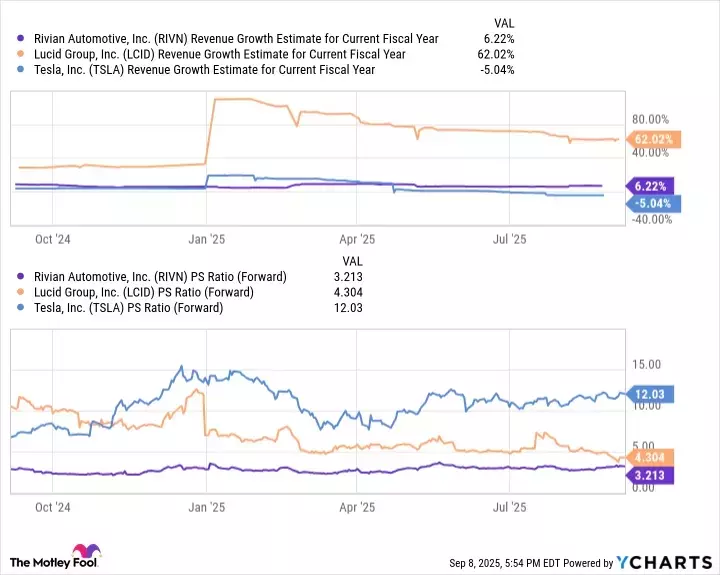
While Lucid Group's stock might initially seem overvalued when compared to direct rivals like Rivian based on its current price-to-sales ratio, a detailed analysis suggests a more nuanced picture. The market's expectations for Lucid's impressive sales growth in the coming fiscal year, significantly outpacing both Rivian and Tesla, transform its valuation into a more competitive one. However, despite this promising growth outlook, the company is still navigating substantial financial and operational challenges that warrant caution from investors.
Lucid Group, a contender in the electric vehicle (EV) market, has a current valuation that might raise eyebrows, with its shares trading at a price-to-sales ratio of 6. This figure places it seemingly above competitors such as Rivian, which is valued at just three times its sales, indicating a 50% valuation difference. However, this superficial comparison may not fully capture the underlying value and future prospects of Lucid.
The disparity in valuation multiples among companies often stems from varying growth expectations. For the current fiscal year, analysts forecast an impressive sales growth of approximately 62% for Lucid. In stark contrast, Rivian is projected to achieve only a 6.2% sales increase, while Tesla's sales are expected to contract by about 5%. When these growth projections are factored in, Lucid's valuation becomes considerably more attractive. Its forward price-to-sales ratio, which accounts for anticipated sales growth, drops to a more modest 4.3 times revenue. This revised figure positions Lucid at a notable discount compared to Tesla's 12 times revenue and only a slight premium to Rivian's 3.2 times revenue multiple.
Beyond immediate growth forecasts, long-term growth potential also plays a crucial role in valuation. Tesla, for instance, maintains a premium valuation due to optimistic long-term projections, particularly in emerging sectors like robotaxis. The global robotaxi market is predicted by some experts to reach an astounding $10 trillion. Tesla has already launched a pilot robotaxi service in Austin, Texas, after more than a decade of development, with some analysts believing this segment alone could add $1 trillion to Tesla's market capitalization. While Rivian has not disclosed extensive plans for robotaxis, Lucid Group recently announced a significant partnership with Uber Technologies. This collaboration involves a $300 million investment from Uber into Lucid, along with a substantial order for Lucid's vehicles to power Uber's future self-driving taxi service. Although Tesla currently holds a significant lead, owning its self-driving taxi operations entirely while Lucid acts as a vehicle supplier, this partnership offers Lucid a strategic entry into a potentially multi-trillion dollar opportunity.
Lucid also benefits from its smaller scale relative to its larger counterparts. With a market capitalization under $6 billion and sales below $1 billion, Lucid has more substantial room for growth. It is generally easier for smaller enterprises to double in size compared to giants with hundreds of billions in market value. Lucid's sales would need to quintuple to match Rivian's current sales volume and then expand another 18 times to reach Tesla's sales base. This inherent advantage of being a smaller player grants Lucid a longer potential trajectory for expansion compared to both Tesla and Rivian.
However, investors must acknowledge several significant risks associated with Lucid. Both Rivian and Tesla boast superior financial backing, a critical advantage in the capital-intensive EV industry. Furthermore, the departure of Lucid's long-standing CEO earlier this year introduces an element of uncertainty regarding the company's future growth trajectory. While the Uber partnership is exciting, its immediate financial impact on Lucid may be limited. For instance, the $300 million investment from Uber barely covers a single quarter's losses for Lucid, and the revenue opportunities from this deal are not expected to materialize fully for several years, with the contract extending until late 2026 at the earliest.
Ultimately, while Lucid Group's stock is indeed more attractively priced than it first appears, the lingering operational challenges and financial vulnerabilities suggest that a cautious approach is warranted for most investors, advising them to remain on the sidelines for now.