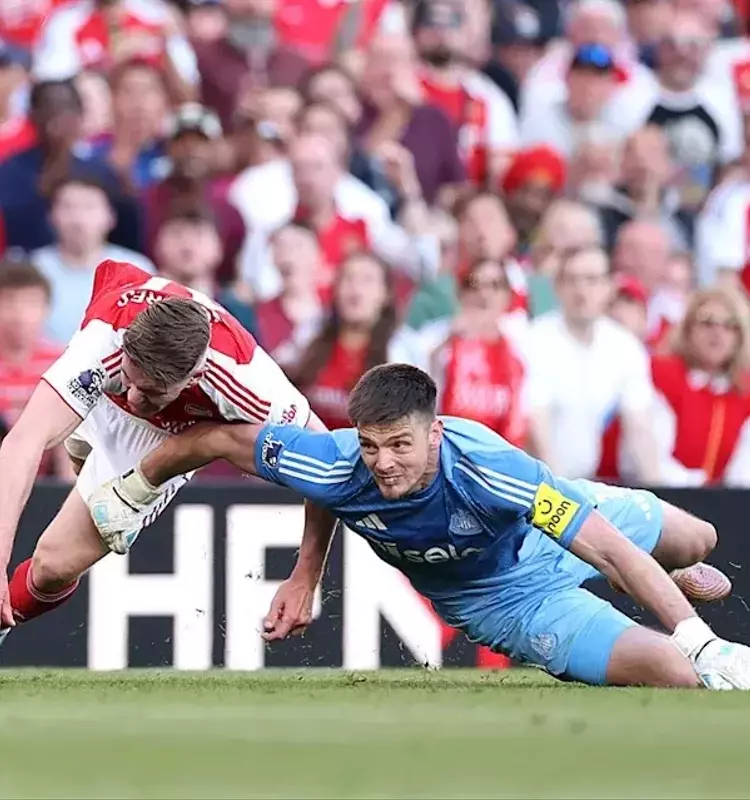
Arsenal's manager, Mikel Arteta, voiced strong disapproval regarding officiating decisions in his team's last two encounters, specifically pointing to two instances where he believes opposing players should have been sent off. He highlighted challenges by Nick Pope of Newcastle United and Abdukodir Khusanov of Manchester City, asserting that these unpunished fouls could significantly alter match results and potentially the league championship race. Arteta's remarks came after Arsenal's victory against Newcastle, underscoring his conviction that these were clear red-card offenses.
Referees Under Scrutiny: Key Decisions Spark Controversy in Arsenal's Recent Fixtures
In a compelling post-match statement following Arsenal's narrow 1-0 triumph over Newcastle United on Saturday, April 26, 2026, Mikel Arteta, the passionate manager of Arsenal, openly criticized what he perceived as critical refereeing errors. The primary incident in question occurred in the 74th minute when Newcastle goalkeeper Nick Pope, having rushed out of his penalty area, failed to connect with the ball and subsequently brought down Arsenal's Viktor Gyokeres. Arteta firmly stated that this action, which prevented Gyokeres from pursuing a clear scoring opportunity, merited a red card, not the yellow card issued by the referee. He passionately argued, "If you have ever played football, it is a red card."
Arteta also recalled a similar controversial moment from Arsenal's previous match against Manchester City, where he contended that Abdukodir Khusanov's foul on Kai Havertz, with the score tied at 1-1, was another undeniable red-card offense. He lamented that such decisions could dramatically shift the momentum and outcome of crucial games, especially in a title race scenario. Former referee Keith Hackett supported Arteta's view on the Khusanov incident, indicating that the denial of an obvious goalscoring opportunity should indeed have led to a dismissal for the Manchester City player.
These back-to-back contentious decisions have left Arsenal fans with a sense of frustration, drawing parallels to past instances where Arsenal players, such as William Saliba against Bournemouth or Myles Lewis-Skelly against West Ham, were given no such leniency. The ongoing debate centers on the consistency of refereeing standards and the profound impact such calls can have on a team's performance and league standing. The hope remains that these controversial rulings will not ultimately hinder Arsenal's pursuit of their seasonal objectives.
This sequence of events compels us to reflect on the pivotal role refereeing plays in modern football. The precision and impartiality of decision-making are paramount, as every call can bear immense consequences for teams, players, and the integrity of the sport. While human error is an undeniable aspect of the game, the consistent application of rules, particularly those concerning match-altering offenses like red cards, is crucial. It underscores the need for continuous evaluation and improvement in officiating standards to ensure fairness and maintain confidence in the sport's competitive balance.