Beneath the Surface: AI's Volatility Shadow Over a Resilient Market
Finance

Beneath the Surface: AI's Volatility Shadow Over a Resilient Market

authorBy Strive Masiyiwa
DateJul 22, 2026
Read time3 min
This article delves into the intriguing paradox of a stable general stock market coexisting with extreme volatility in the artificial intelligence (AI) sector, specifically within semiconductor companies. It examines the factors contributing to this divergence, analyzing market indicators and recent stock performance to understand the underlying anxieties among investors.

Unveiling the Hidden Turbulence in the AI Investment Landscape

The AI Hype Versus Market Reality: A Tale of Two Trends

While the AI industry maintains its compelling cultural appeal, as exemplified by the remarkable sale of Jensen Huang's autographed leather jacket, the financial markets tell a more complex story. The very same day saw semiconductor stocks enter a bear market, highlighting a growing chasm between public enthusiasm and investor apprehension.

Decoding the Discrepancy: Volatility in Chip Stocks Soars

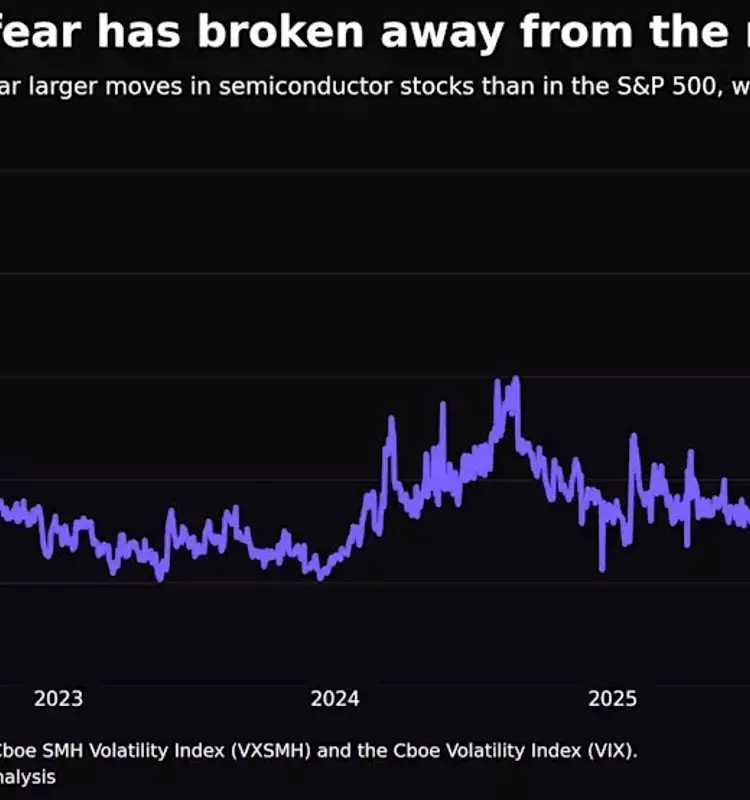
A stark contrast is evident when comparing the volatility in chip stocks to the broader market. The Cboe SMH Volatility Index, which gauges expected price movements in the VanEck Semiconductor ETF, shows a significantly higher level of anticipated turbulence compared to the S&P 500's Cboe Volatility Index. This disparity suggests that investors are bracing for much larger swings in the semiconductor sector.

Historical Context: A Shift in Market Fear Dynamics

Historically, broad market panics, such as the one triggered by the 2025 tariffs, saw widespread fear. However, current market conditions reveal a concentrated anxiety specifically within the chip industry. The volatility premium for semiconductors, currently near record highs, was less than half its present level during the widespread market turmoil of 2025, indicating a unique and targeted concern among traders today.

The Financial Impact: Trillions Erased from Chip Valuations

The recent downturn has been substantial, with global chip stocks shedding approximately $3.3 trillion from their peak values. The PHLX Semiconductor Index (SOX) breached a critical support level of 12,000, underscoring the severity of the sell-off. While the index has since recovered above this threshold, the rebound lacks conviction, and the elevated volatility premium persists, signaling ongoing investor caution.

Broader Market Resilience Amidst Sectoral Stress

Despite the intense pressure on the semiconductor sector, the wider market has demonstrated remarkable resilience. A significant majority of stocks across the S&P 500, S&P 400, and S&P 600 indices remain above their 200-day moving averages, indicating overall market strength. Furthermore, the S&P 500 advance-decline line, a key breadth indicator, recently hit a record high, suggesting healthy market participation beyond the troubled tech segment.

Navigating the Future: Key Indicators for Market Stability

The stability of the broader market hinges on the ability of the SOX to maintain its position above the 12,000 mark and for widespread market participation to remain robust. If the SOX were to fall below this crucial level again, it could signal that the stress currently confined to the chip trade is beginning to spread, potentially impacting the wider market's resilience.

More Articles
Finance
Vipshop: A Reassessment to 'Hold' Amidst Valuation Floor and Market Dynamics
Vipshop's rating has been elevated from 'Sell' to 'Hold.' This adjustment is primarily due to the company's valuation reaching a low point, suggesting minimal further downside. Despite facing stagnant revenue growth, intense domestic competition from major e-commerce players like Alibaba, JD, and PDD, and limited success in international expansion, its current forward earnings multiple of 5.4x presents a more balanced risk-reward profile. The pivotal role of Super VIP members, who contribute significantly to GMV, is a key focus for near-term growth, though their loyalty remains a consideration. Potential integration with WeChat AI Agent could offer new avenues for user engagement.
By Lisa JingJul 22, 2026
Finance
Market Dynamics: Tech Gains, Energy Concerns, and Geopolitical Risks
Today's market activity saw technology stocks surge, leading to a recovery in major indices after a three-day downturn. However, this bullish sentiment in tech was contrasted by a rise in the dollar, bond yields, and commodity prices, indicating growing investor apprehension about a potential escalation in global energy supply disruptions and wider conflicts. This divergence suggests markets are factoring in geopolitical instability.
By Suze OrmanJul 22, 2026
Finance
UNFI's Q3 FY2026: Profit Growth Amidst Revenue Decline and Future Prospects
United Natural Foods (UNFI) demonstrated robust profitability in Q3 FY2026, even as revenue dipped by 4.2%. This was primarily due to strategic network optimization and enhanced margins. The company's AI-driven supply chain improvements led to higher fill rates, timely deliveries, increased throughput, and reduced operational costs, culminating in a 75% surge in adjusted EPS. With net debt reduced and a lower leverage ratio, UNFI's financial health has improved, minimizing shareholder risk and laying the groundwork for future earnings expansion. I rate UNFI a "buy" at $49, anticipating further growth as it fills its newly freed capacity with profitable natural and organic product lines.
By Mariana MazzucatoJul 22, 2026
Finance
UK Inflation Slowdown: Implications for Monetary Policy
Recent inflation data from the UK indicates a deceleration, particularly in food and services sectors. This development eases pressure on the Bank of England to raise interest rates, despite projections for a modest increase in overall inflation later in the year. The core CPI for June stood at 2.6%, slightly above forecasts, suggesting a nuanced picture for future monetary policy decisions. Current expectations lean towards stable interest rates throughout 2026, with potential rate cuts commencing next spring.
By Robert KiyosakiJul 22, 2026
Finance
FERC's Data Center Order Reshapes Utility and Infrastructure Income
The Federal Energy Regulatory Commission's recent order is poised to significantly influence the utility and infrastructure sectors. With projected US utility capital expenditures reaching $1.3 trillion by 2030 and data center power demand expected to triple, the industry faces substantial investment needs in transmission, generation, and distribution. This directive aims to streamline interconnection processes, providing greater regulatory clarity for multi-year capital planning and offering attractive opportunities for income-focused investors.
By Suze OrmanJul 22, 2026