BigBear.ai, a company operating in the AI-driven data analysis space, is attempting to emulate the successful trajectory of Palantir, which saw its stock value surge dramatically. Both companies initially targeted government clients before Palantir diversified into the commercial sector. However, BigBear.ai faces distinct challenges that may hinder its ability to replicate Palantir's impressive growth. Key issues include its strategy of developing tailored solutions for each client, which negatively impacts its gross margins, and a concerning lack of substantial revenue growth, especially when contrasted with the overall expansion of the AI market and Palantir's accelerating performance.
Ultimately, BigBear.ai's current operational model and financial performance raise questions about its potential to become a leading player in the AI industry. The company's lower profitability and stagnant growth, particularly in a booming sector, suggest it may not offer the same lucrative opportunities as other AI investment options. Investors are therefore encouraged to explore more established or rapidly expanding AI enterprises and diversified AI ETFs rather than focusing on BigBear.ai as a high-growth prospect.
The Profitability Gap: Why BigBear.ai's Margins Lag Behind
BigBear.ai's business model, centered on crafting unique AI solutions for each government client, inherently leads to higher operational costs and, consequently, lower gross margins. This bespoke approach differs significantly from Palantir's strategy, which leverages a foundational product adaptable to various client needs, allowing for greater efficiency and scalability. The custom development cycle for projects like the U.S. Army's Global Force Information Management-Objective Environment and airport screening systems means that each contract requires substantial, individualized resource allocation, preventing the cost efficiencies typically associated with a standardized platform. This fundamental difference in operational strategy is a major contributor to BigBear.ai's struggle to achieve the robust profitability seen in its more established counterparts within the AI sector.
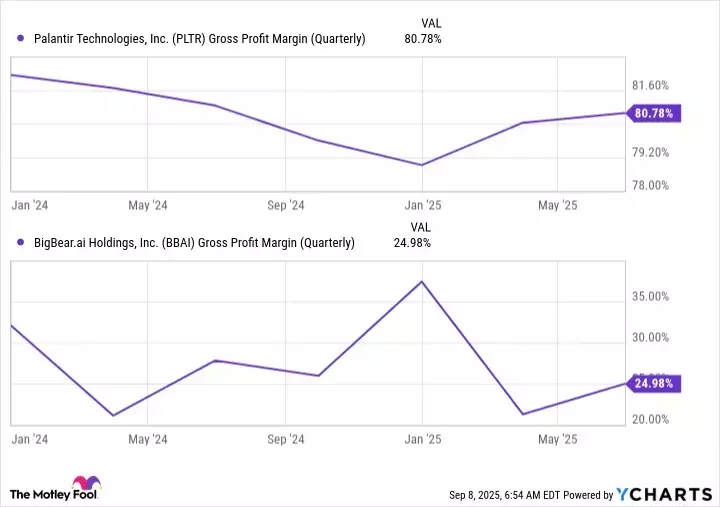
The financial implications of BigBear.ai's tailor-made approach are clearly reflected in its gross margins, which fluctuate between 20% and 35%. In stark contrast, Palantir has consistently maintained gross margins in the 80% range, demonstrating the superior profitability of its scalable product-based model. This significant disparity highlights a core challenge for BigBear.ai: its current method of delivering services is not conducive to maximizing profit potential. The continuous need to build solutions from the ground up, rather than adapting existing intellectual property, limits the company's ability to drive down costs and improve its bottom line. For investors, this lower margin profile signals a less efficient business operation and potentially restricted long-term profitability, making it a less attractive option compared to companies with more scalable and cost-effective delivery models in the burgeoning AI market.
Growth Discrepancy: BigBear.ai's Stagnant Revenue in a Booming AI Market
Despite being in an era of unprecedented AI investment and innovation, BigBear.ai has demonstrated a concerning lack of growth, a critical red flag for potential investors. In the second quarter, the company experienced an 18% year-over-year revenue decline, which it attributed to efficiency initiatives within the U.S. government. However, this explanation appears to be inconsistent with the broader market trend, as Palantir, operating within the same government sector, reported a substantial 49% increase in government revenue during the same period. This stark contrast suggests that BigBear.ai's challenges may stem from internal factors or its specific market positioning rather than a widespread government spending slowdown, raising questions about its competitive viability and ability to capitalize on current AI market opportunities.
The modest scale of BigBear.ai, with Q2 revenue of just $32.5 million, further accentuates its growth struggles. In a rapidly expanding AI landscape where companies are expected to deliver significant growth, BigBear.ai's revenue contraction paints a picture of a business unable to keep pace with industry advancements and demands. This performance contrasts sharply with Palantir's accelerating growth rates across its operations, including government contracts. The discrepancy implies that while the AI market is robust and opportunities abound, BigBear.ai is not effectively converting these into revenue expansion. This raises serious concerns about its future potential, leading to the conclusion that more dynamic and growth-oriented AI investment alternatives are likely to offer superior returns and align better with the expectations for companies operating in such a high-growth technological domain.