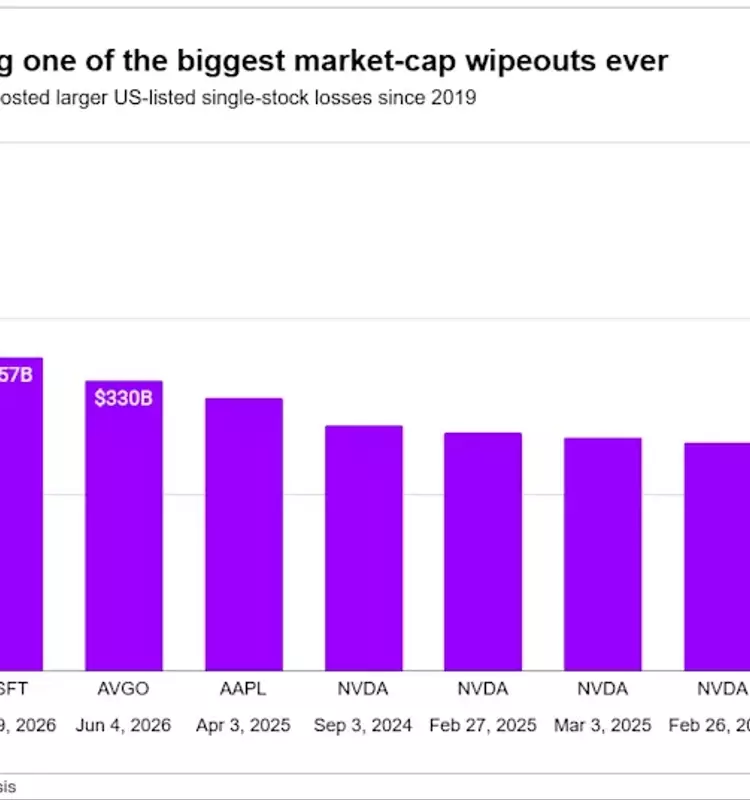
Broadcom's recent stock decline, resulting in a substantial loss of market capitalization, serves as a stark reminder of the intense scrutiny and high expectations placed upon major technology companies in today's dynamic market. Despite reporting favorable quarterly earnings, the semiconductor giant faced a significant sell-off due to investor dissatisfaction with its artificial intelligence chip sales projections. This event underscores the delicate balance between robust performance and market anticipation, particularly within the booming AI sector.
Broadcom's Market Value Decline
In a notable market development on Thursday, June 4, 2026, Broadcom (AVGO) witnessed an approximately 15% reduction in its share value, translating to a staggering loss of roughly $320 billion in market capitalization. This dramatic downturn occurred following the company's earnings report, where, despite exceeding overall quarterly profit expectations, its forward-looking forecast for AI chip sales fell short of the lofty benchmarks set by investors. The market's reaction positioned this event among the most substantial single-stock value erasures in the megacap technology sector since 2019, surpassed only by similar drops experienced by industry titans Nvidia (NVDA) and Microsoft (MSFT).
Historically, Broadcom's stock has shown resilience after sharp declines. An analysis spanning from 2009 reveals that in 39 instances where the stock dropped 6% or more in a single day, it rebounded significantly. The stock was higher one month later nearly 80% of the time, three months later close to 90% of the time, and a year later in all but one recorded case. The median returns for investors buying after such dips were approximately 8% after one month, 20% after three months, 35% after six months, and an impressive 61% after one year. This historical trend suggests that while initial reactions can be severe, patience has often rewarded Broadcom investors.
This market event profoundly illustrates the current landscape of the AI trade, where companies, even with strong underlying growth, are vulnerable to market adjustments if their future projections do not align with aggressive investor expectations. It emphasizes that the sheer scale of megacap companies means even minor disappointments can lead to hundreds of billions in value shifts within a single trading session.
The significant market correction for Broadcom serves as a vital lesson for investors in the fast-paced technology sector. While the immediate aftermath of such a dramatic stock plunge can trigger panic, historical data often provides valuable context. Broadcom's past performance suggests that substantial single-day drops have frequently evolved into opportune buying moments for those with a long-term perspective. However, this does not imply an automatic recovery. It highlights the importance of discerning investor behavior and observing whether buying interest materializes in the wake of the earnings shock, rather than making immediate, impulsive decisions. The incident reinforces the notion that in high-growth, high-expectation markets like AI, even leading companies are subject to intense scrutiny and volatility, making informed and patient investment strategies paramount.
