Casey's General Stores, a prominent convenience retailer, has carved out a unique and highly successful niche, particularly within rural American communities. Despite its seemingly conventional business model, the company has consistently delivered impressive financial results and substantial shareholder value over many years. Its strategic focus on integrating fresh food offerings, most notably its popular pizza, alongside traditional convenience store amenities and fuel sales, has proven to be a powerful differentiator. This approach has not only fostered strong customer loyalty but also enabled robust profit margins, setting it apart from many competitors in the fragmented convenience store sector. The narrative of Casey's mirrors that of early retail giants like Walmart, demonstrating how a well-executed strategy, even in an \"unexciting\" industry, can lead to outsized growth and returns.
With a vast untapped market potential still available within its operational footprint and a commitment to operational efficiency through vertical integration and technology adoption, Casey's continues to exhibit characteristics of a \"wonderful company\" destined for continued success. For investors with a long-term vision, the company's established track record, combined with its clear growth trajectory, suggests that it remains a compelling investment opportunity, even after decades of remarkable performance.
The Ascent of a Rural Retail Powerhouse
Casey's General Stores, a long-established convenience chain, demonstrates remarkable similarities to the early days of retail behemoth Walmart. Operating primarily in small towns across the Midwest, Casey's has forged a distinctive business model by seamlessly integrating fuel sales, traditional convenience store items, and an unexpected yet highly successful fresh food service, prominently featuring pizza. This strategy has allowed the company to consistently achieve double-digit profit growth, defying conventional expectations for a mature business in the consumer staples sector. Over several decades, Casey's has delivered exceptional returns to investors, significantly outperforming broader market indices. This sustained success underscores the effectiveness of its specialized approach in catering to underserved rural markets and leveraging high-margin internal sales.
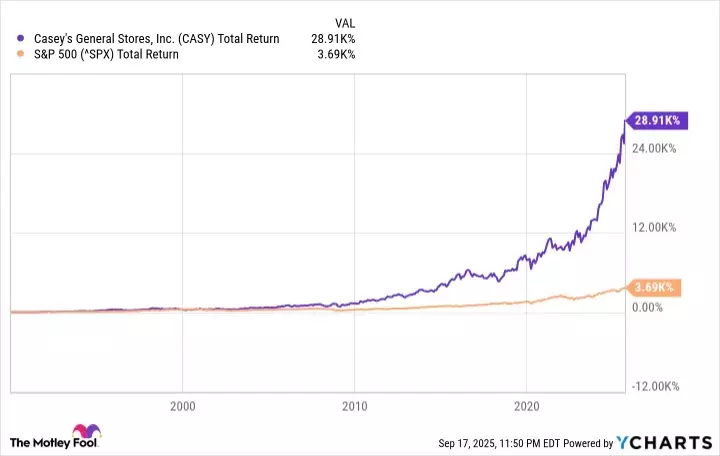
Founded in 1959 in Ankeny, Iowa, and going public in 1983, Casey's General Stores has expanded its footprint across the central United States, boasting nearly 2,900 locations by July. A key aspect of its strategy is its focus on communities with fewer than 20,000 residents, where two-thirds of its stores are situated. This deliberate concentration in small towns has not hindered its growth; rather, it has been a catalyst for its impressive performance. Since 1990, the company's stock, including dividends, has surged nearly 289-fold, dwarfing the S&P 500 Index's 37-fold total return over the same period. This eight-fold outperformance highlights Casey's unique ability to thrive by serving local communities effectively and efficiently. Its commitment to fresh food, notably becoming the fifth-largest pizza chain in the U.S., has been instrumental in generating higher-margin sales, making it a highly profitable enterprise compared to its peers.
Strategic Advantages and Future Growth Prospects
Casey's General Stores distinguishes itself through a highly effective business model that capitalizes on fresh food offerings within a convenience store format. While fuel sales attract customers, the higher-margin 'inside the store' purchases, especially pizza and other prepared foods, are crucial for profitability. This approach generates substantial gross profits, allowing Casey's to offer competitive fuel prices and drive increased traffic. The company's strategic vertical integration, including ownership of distribution centers and fuel tankers, further enhances cost efficiency and operational control. These advantages, combined with investments in technology, reward programs, and data analytics, solidify customer loyalty and reinforce its market position, demonstrating a sophisticated operational execution that belies its simple storefronts.
Looking ahead, Casey's General Stores still possesses significant room for expansion and continued value creation. Despite its extensive growth, management has identified that a considerable portion of small towns within a 500-mile radius of its existing distribution centers currently lack a Casey's location. This indicates a robust pipeline for organic expansion and strategic acquisitions, particularly in a fragmented convenience store industry where smaller, independent operators remain prevalent. The company's ability to acquire and convert existing stores in proven locations allows for efficient market penetration. While the stock's valuation might appear elevated, reflecting its consistent performance, its strong foundation, proven growth strategy, and ample opportunities for future market capture suggest that Casey's remains a compelling investment for those focused on long-term capital appreciation, echoing the wisdom that enduring companies reward patient shareholders.