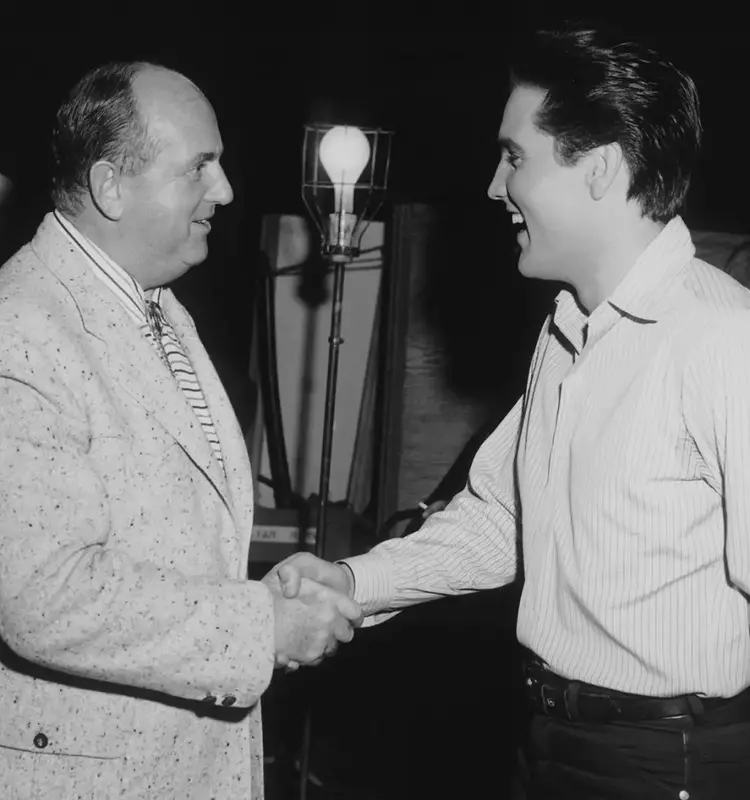
This article commemorates a pivotal moment in music history: the 70th anniversary of Elvis Presley's monumental transition from Sun Records to RCA, a move meticulously engineered by his manager, Colonel Tom Parker. Drawing insights from Peter Guralnick's latest book, "The Colonel and the King: Tom Parker, Elvis Presley, and the Partnership that Rocked the World," this piece sheds light on Parker's often-misunderstood genius. While frequently criticized for his hefty commission and questionable artistic decisions for Elvis, Guralnick's work presents a more complex narrative, emphasizing Parker's unparalleled business acumen that propelled Presley from a regional sensation to a global phenomenon.
Colonel Tom Parker's journey in the music industry began long before Elvis Presley entered the scene. His early career saw him managing pop sensation Gene Austin in the late 1930s. Austin, a genuine star of the 1920s, faced a downturn in 1939, arriving in Tampa with a self-financed film and few prospects. Parker, observing Austin's predicament, stepped in to manage his career, demonstrating an early flair for turning around struggling acts. Despite having no prior experience in the music business, Parker brilliantly revitalized Austin's shows, rescuing him from obscurity and laying the groundwork for a lifelong friendship, even as Austin's financial woes persisted.
Parker's foray into country music management began with Roy Acuff in the early 1940s. During this period, Parker also held a position as a field agent and animal control officer, a role he reportedly cherished due to his love for animals. Under the mentorship of showman J.L. Frank, Parker promoted several of Acuff's shows and even marketed 'Roy Acuff's Own Flour.' Although Acuff invited Parker to become his full-time manager, Parker's ambition had already shifted towards nurturing new talent, specifically the emerging artist Eddy Arnold.
Before fully committing to Eddy Arnold, Parker briefly managed Ernest Tubb in early 1945, again through J.L. Frank. Parker's role extended beyond management; he acted as a tour manager, advance man, and even performed as a comedian during shows. Accounts from Nelle Poe, one of the featured acts, describe Parker's playful antics on stage, sweeping people's shoulders with a small broom while Tubb looked on in feigned confusion. Parker's confident pronouncements about future Hollywood success for himself hinted at his unwavering ambition. Throughout these early ventures, Parker maintained enduring friendships with both Tubb and Acuff.
The mid-1940s marked a significant period for Parker as he propelled Eddy Arnold to unprecedented heights in country music. By late 1947, Parker had earned his honorary 'Colonel' title from the governor of Louisiana, signifying his growing influence. Under his guidance, Arnold dominated country charts for 53 consecutive weeks in 1948. Arnold's success wasn't limited to country; he also became one of RCA's top pop stars, a fact Parker shrewdly leveraged in contract renegotiations. Despite their eventual professional parting, Parker's strategic management laid the foundation for Arnold's enduring superstardom.
Following his unceremonious firing by Eddy Arnold after nearly a decade, Colonel Parker quickly pivoted. He orchestrated the RCA Records Country & Western Caravan, an all-star tour featuring RCA's top country artists. It was during this time that he began managing Hank Snow, whose song 'I Don't Hurt Anymore' was a number one country hit. Crucially, it was on one of these early tours with Snow that Parker introduced a then-unknown Elvis Presley to the wider music world, setting the stage for one of the most iconic collaborations in music history.
The signing of Elvis Presley to RCA, exactly 70 years ago, was a game-changer. Mae Axton, a long-time associate of Parker's, presented Elvis with 'Heartbreak Hotel,' a song she co-wrote. Elvis was captivated, immediately declaring it would be his first single for RCA. Despite skepticism from RCA executives like Steve Sholes, Parker staunchly supported Elvis's choice, asserting his artist's unerring musical instincts. The single soared to number one on both pop and country charts and reached number three on the R&B charts, solidifying Elvis's crossover appeal and validating Parker's faith in his talent.
Colonel Parker famously maintained a hands-off approach to Elvis's musical selections, often proudly stating he had no input on his artist's creative choices. However, Elvis's decision to record 'Hound Dog' after being impressed by Freddie Bell and the Bellboys performing it in Las Vegas was a nuanced one. Initially, Elvis doubted if the live energy could be replicated in the studio. Guitarist Scotty Moore encouraged him, and though subtle, Parker's support was present. In a humorous, yet telling, memo to RCA Vice President Larry Kanaga, Parker playfully predicted the song's success, suggesting 'Hound Dog' might even replace the 'Victor Dog' as RCA's emblem, showcasing his confident foresight.
During the production of Elvis's fourth film, 'King Creole,' a debate arose within RCA about re-recording the New Orleans-style soundtrack in a more conventional rock format for album release. Colonel Parker, however, conveyed Elvis's firm commitment to preserving the original sound, arguing that the instruments perfectly complemented the film's narrative. Despite the recordings not being Elvis's typical style, Parker fully backed his artist's artistic decision, recognizing the importance of authenticity to the film's integrity and Elvis's vision for his work.
Remarkably, 'Are You Lonesome Tonight?' stands out as the sole song Colonel Parker ever explicitly requested Elvis to sing. It was a personal favorite of Parker's wife, Marie, particularly Gene Austin's version (though Austin never officially recorded it). Parker believed it would appeal to Elvis's burgeoning audience, especially considering Elvis's recent foray into more operatic sounds like 'It's Now or Never.' In a 1993 interview, Parker recalled Elvis doing him a favor by recording it. However, unbeknownst to Parker, Elvis had already been singing the song with deep emotion in Germany, making its recording a serendipitous, rather than solely obliging, choice.
Between 1964 and 1966, Elvis was deeply engrossed in spiritual studies and had released only soundtrack albums, falling behind on his RCA contractual obligations. Colonel Parker relentlessly worked to get Elvis back into the studio. A significant turning point came in late 1965 when Parker negotiated a $2.1 million deal with RCA, a crucial move given Elvis's declining single sales. Central to this agreement was a commitment to record a new gospel album, a project Parker knew would resonate with Elvis. Embracing this, Elvis enthusiastically began rehearsing with Red West and Charlie Hodge. His duet on 'If the Lord Wasn't Walking by My Side' with his childhood idol, Jake Hess of the Statesmen Quartet, perfectly captures the joy and freedom Elvis found in this spiritual endeavor.