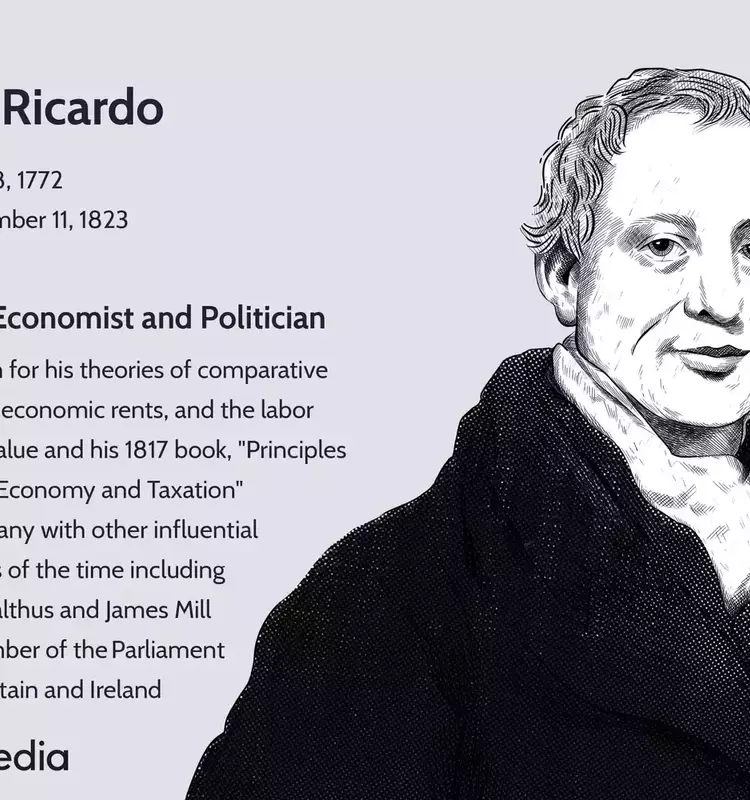
David Ricardo, a key figure in classical economic thought, is renowned for his significant theoretical contributions, including comparative advantage, the labor theory of value, economic rents, and Ricardian equivalence. His ideas continue to influence contemporary economic discourse and policy formulation. Ricardo’s framework for international trade, based on specialization and opportunity costs, provided a powerful argument for free trade, while his analysis of value and rent offered deeper insights into wealth distribution and asset ownership. Beyond his academic work, Ricardo actively participated in politics, serving in Parliament and advocating for economic reforms.
Born in England in 1772, David Ricardo was one of 17 children. He began his professional life at 14, working alongside his father as a stockbroker. At 21, he was disowned by his family due to his marriage outside their faith. Undeterred, Ricardo established his own successful venture in government securities, accumulating a substantial fortune. His financial acumen was particularly evident when he retired at 41, having amassed approximately £1 million through astute speculation on the outcome of the Battle of Waterloo.
Following his retirement from finance, Ricardo transitioned into politics, purchasing a parliamentary seat for £4,000. As a Member of Parliament, he engaged with influential thinkers of his era, such as Adam Smith, James Mill, Jeremy Bentham, and Thomas Malthus, further shaping his economic perspectives. His engagement with these luminaries underscored his commitment to advancing economic understanding and public policy.
Ricardo's major economic contributions include the theory of comparative advantage, which posited that nations should specialize in producing goods where they incur the lowest opportunity cost, even if they don't hold an absolute advantage in any particular good. This theory laid the groundwork for modern international trade policies, advocating for free trade over protectionism. Another significant concept was the labor theory of value, which proposed that the value of a good is determined by the amount of labor required for its production, a principle that later influenced Marxist thought. Additionally, Ricardo introduced the concept of economic rents, illustrating how asset owners could derive benefits simply from their ownership, rather than through productive effort, a concept later extended to rent-seeking behavior in political economy. Finally, his theory of Ricardian equivalence suggested that government financing methods—whether through taxation or borrowing—have equivalent economic outcomes if taxpayers anticipate future tax liabilities, leading to a net-zero impact on aggregate spending.
Ricardo's published works further solidified his legacy. His 1815 "Essay on the Influence of a Low Price of Corn on the Profits of Stock" introduced the law of diminishing returns concerning labor and capital. His first economics article, published in The Morning Chronicle, argued for the Bank of England to reduce its note-issuing activities. However, his most celebrated ideas are detailed in his 1815 masterpiece, "Principles of Political Economy and Taxation." In this work, Ricardo also advanced his theory on wages, known as the "Iron Law of Wages," which argued that wages would naturally revert to subsistence levels, making attempts to raise them futile.
David Ricardo’s theories have left an indelible mark on economic thought, providing profound insights into international trade, value, and the mechanics of public finance. His analytical rigor and pioneering ideas continue to be essential for understanding economic systems and policy implications today.
