A Cosmic Misfire: When More Mario Means Less Magic
The Introduction of New Faces and Familiar Foes in a Haphazard Universe
In the expansive universe of 'The Super Mario Galaxy Movie,' audiences are introduced to a menagerie of characters, both new and returning. Among them is Yoshi, depicted as a charming, almost toy-like green dinosaur, whose vocalizations by Donald Glover lend him a childlike innocence. The film also features a multitude of Lumas, the sparkling, multi-colored star-creatures. While reminiscent of Lumalee from the previous installment, these Lumas lack the distinctive charm, serving primarily as generic, adoring mascots. Princess Rosalina, voiced by Brie Larson, emerges as the Lumas' adoptive mother and the sister of Princess Peach, played by Anya Taylor-Joy. The narrative quickly propels Rosalina into a space odyssey after her abduction by a formidable shape-shifting droid. This event sets the stage for a film almost entirely confined to the cosmic void, which, paradoxically, struggles to establish any memorable sense of place or consistent environment.
Bowser's Diminished Presence and the Absence of Musical Flourishes
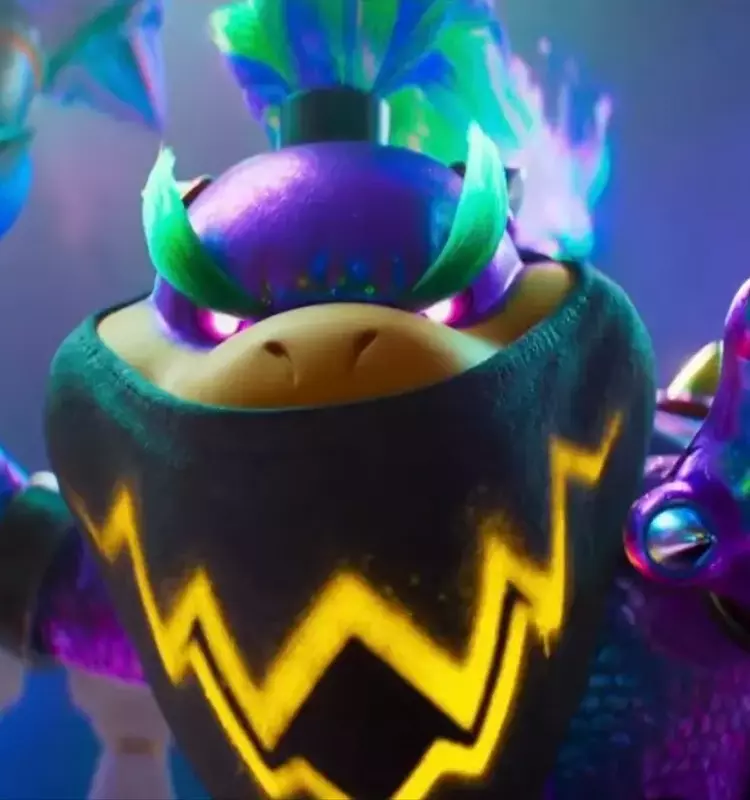
The central antagonist, Bowser Jr., a miniature replica of his formidable father, is portrayed by Benny Safdie with the demeanor of a high-pitched, childish tyrant, grappling with paternal issues. Despite his initial defeat and subsequent miniaturization from the first film, Bowser, voiced by Jack Black, makes a return, albeit in a significantly less imposing form. His transformation leads to an unexpected, albeit temporary, alliance with the heroes, a period notably devoid of his iconic musical numbers, a stark departure from the beloved 'Peaches' song. This altered dynamic, where a rejuvenated, larger Bowser eventually reunites with his son to pursue universal domination, strangely diminishes his overall impact, rendering the combined force of two Bowsers less formidable than one.
A Star-Studded Ensemble Lost in a Cluttered Narrative
The film boasts a rich cast of characters from the Mushroom Kingdom, including the perpetually grumpy Toad, brought to life by Keegan-Michael Key. New additions like the regal Honey Queen, voiced by Issa Rae, who presides over the Honeyhive galaxy, and Wart, voiced by Luis Guzmán, who resembles a frog monarch, expand the universe. The narrative also features a community of artisanal residents from a desert village, an enormous bee, the comically malfunctioning Rob the Robot, and a formidable duo of a T. rex and a colossal purple dragon. Glen Powell lends his voice to Fox McCloud, a swashbuckling pilot reminiscent of a fusion between Han Solo and Rocket from 'Guardians of the Galaxy.' In this sprawling ensemble, Mario, voiced by Chris Pratt, and Luigi, voiced by Charlie Day, despite being the titular heroes, often feel marginalized. Their valiant quest to thwart the Bowsers and rescue Princess Peach's sister, alongside a budding but underdeveloped romance between Mario and Peach, serve as mere subplots within a narrative that lacks a cohesive core. The film's relentless barrage of video-game references, while aimed at captivating young gamers, inadvertently transforms it into a chaotic and ultimately unsatisfying experience, diverging significantly from the engaging and transformative storytelling of its predecessor.
The Shift from Cinematic Brilliance to Overstimulated Chaos
'The Super Mario Galaxy Movie' marks a notable decline from the critical success of its predecessor. Despite retaining the same directorial team of Aaron Horvath and Michael Jelenic, and screenwriter Matthew Fogel, the sequel falls short, suggesting a creative shift possibly influenced by external pressures. The film is characterized by an incessant series of high-octane sequences—running, leaping, aerial pursuits, falls into lava, and continuous combat—yet none of these moments resonate or build a sustained narrative. It emerges as a disorienting amalgamation, a transparent marketing tool overflowing with overt video-game allusions that feel more like superficial adornments than integral plot elements. This approach stands in stark contrast to the first 'Super Mario Bros. Movie,' which, like 'A Minecraft Movie,' demonstrated that video-game adaptations could be both wildly entertaining and possess a classic narrative depth. The concern now looms that 'The Super Mario Galaxy Movie' could signal a regrettable return to an era where video-game films were synonymous with spectacular yet overstimulated disarray.
The Loss of a Central Vision and the Impact on Fan Expectations
The original 'Super Mario Bros. Movie' was grounded by a strong narrative core, primarily revolving around Bowser's character, masterfully voiced by Jack Black. His portrayal as a menacing yet romantically obsessed supervillain, whose motivations were deeply intertwined with his affection for Princess Peach, provided the film with its emotional depth and structural integrity. Black's vocal performance was a nuanced blend of obsession and vulnerability, making Bowser a memorable antagonist. While filmmakers may have sought to avoid repetition in the sequel, the decision to diminish Bowser's role and, notably, to omit any new musical performances by Black, is likely to disappoint a vast segment of the fanbase. Instead, the two Bowsers in the sequel become relatively innocuous figures, mere cogs in a spectacle driven by visual overload rather than compelling storytelling. This shift ultimately deprives the film of the thematic richness and character-driven engagement that defined its predecessor.
A Commercial Strategy Over Creative Cohesion
The frenetic and impersonal nature of 'The Super Mario Galaxy Movie' suggests a production that prioritizes commercial viability over artistic integrity. This approach, designed to appeal to gamers through an abundance of Easter eggs and recognizable elements, risks alienating viewers seeking a more substantive cinematic experience. The film's narrative, reduced to a "threadbare adventure" and a "mere throwaway," indicates a singular focus on achieving immediate recognition from its target audience, rather than crafting a compelling story. This strategic choice represents a significant downgrade from the creative triumphs of its predecessor and other successful video-game adaptations like 'A Minecraft Movie.' The critical reception of 'The Super Mario Galaxy Movie' thus raises questions about the future direction of video-game cinema, and whether it will succumb once again to the allure of spectacular but ultimately hollow entertainment.
