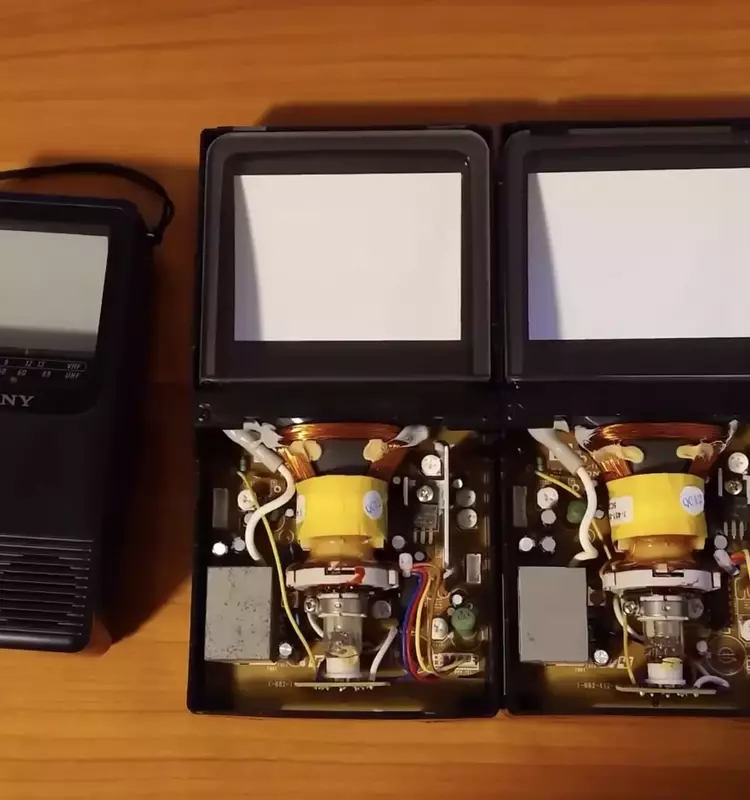
A content creator on YouTube has ingeniously assembled a virtual reality headset by repurposing mini Cathode Ray Tube (CRT) displays, a creative endeavor sparked by a desire to overcome the 'screen door effect' prevalent in today's high-resolution VR systems. This project revisits an older display technology, utilizing screens from classic Sony Watchman devices, to craft a functional VR unit. The undertaking involved significant technical challenges, including converting modern digital signals to analog for the CRTs and integrating custom electronics, resulting in a lightweight, self-made VR system that delivers a surprisingly smooth, albeit monochrome and lower-resolution, visual experience. This innovative build serves as a fascinating proof-of-concept, demonstrating how vintage components can be reimagined for cutting-edge applications.
Despite its technical achievements, the homemade VR headset, constructed primarily from cardboard, ultimately proved to be more of a curious experiment than a practical replacement for existing commercial VR devices. While it successfully eliminates the screen door effect due to the inherent nature of CRT technology, its limitations in color, contrast, and refresh rate, alongside an unexpectedly blurry image, make it less suitable for long-term immersive gaming. However, the project stands as a testament to the maker's ingenuity and the potential for creative problem-solving outside conventional technological paths, offering a unique perspective on the evolution and possibilities within virtual reality.
Reimagining VR: The Vintage CRT Approach
In a fascinating technological experiment, a dedicated YouTuber embarked on the ambitious journey of constructing a virtual reality headset using repurposed miniature Cathode Ray Tube (CRT) displays. This unconventional project was driven by a specific goal: to mitigate the 'screen door effect,' a common visual artifact in contemporary VR headsets caused by the visible gaps between pixels on high-resolution panels. By reverting to CRT technology, known for its continuous image display rather than discrete pixels, the creator aimed to provide a smoother, more integrated visual experience within a VR environment. The core components for this retro-futuristic device were primarily extracted from vintage Sony Watchman portable televisions, illustrating a clever blend of old and new technologies to address modern VR challenges.
The development process involved overcoming several intricate engineering hurdles. A key challenge was adapting modern digital video signals to the analog input requirements of the CRTs, necessitating the use of a Field-Programmable Gate Array (FPGA) for real-time signal conversion. Additionally, a custom-designed Printed Circuit Board (PCB) was developed to integrate the FPGA, a head-tracking system, and a low-power supply for the CRTs, all while maintaining a compact and lightweight form factor. The final assembly, remarkably housed within a makeshift cardboard chassis, weighed in at a mere 544 grams—comparable to many commercially available VR headsets. This meticulous attention to detail and innovative problem-solving underscores the ingenuity behind transforming historical display technology into a functional, if experimental, VR system.
Performance and Practicality of the Homebrew Headset
Upon its completion, the custom-built VR headset underwent extensive testing across a diverse range of virtual environments, from high-octane driving simulators to intricate puzzle games and first-person shooters. The most striking observation was the complete absence of the dreaded 'screen door effect,' a direct benefit of the CRTs' continuous phosphor display. Despite this advantage, the visual fidelity presented a mixed bag. The extreme viewing angle inherent to the CRTs, combined with their native focusing capabilities, resulted in an image that was blurrier than anticipated, even for older display standards. Furthermore, the monochrome nature of the Watchman CRTs, along with their effective 60 Hz refresh rate, highlighted significant trade-offs when compared to the vibrant colors and higher refresh rates of modern VR displays.
Ultimately, the creator concluded that while the homemade CRT VR headset offered a uniquely smooth visual aesthetic that modern displays struggle to replicate, it wasn't a practical long-term replacement for current commercial VR solutions. The lack of color and the compromised image clarity, despite the absence of the screen door effect, were significant drawbacks for immersive gaming experiences. Nevertheless, this project stands as an exceptional demonstration of homebrew engineering and the creative application of readily available technology. It showcases how dedicated individuals can push the boundaries of what's possible, even if the result is more of a fascinating curiosity than a revolutionary product. The endeavor provides valuable insights into display technology and the ongoing quest for enhanced virtual reality immersion.
