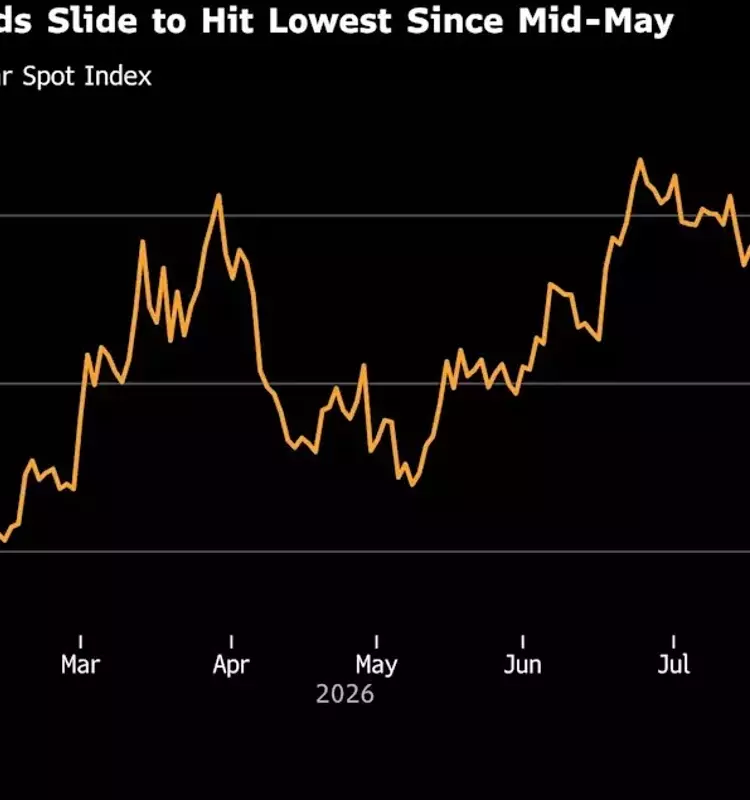
The US dollar has recently experienced its most significant decline in three months, largely due to a recalibration of market expectations regarding future interest rate adjustments by the Federal Reserve. This shift is primarily driven by a succession of US economic reports that have indicated a softening trend, prompting traders to scale back their forecasts for further monetary tightening. The Bloomberg Dollar Spot Index has reflected this change, recording a third consecutive day of losses and reaching its lowest valuation since mid-May. This development signals a potential inflection point in global currency markets, as investors adjust their strategies in response to evolving economic outlooks and central bank policy anticipations.
As the market absorbs these new economic signals, the dollar's trajectory is under intense scrutiny. While short-term pressures suggest a continued weakening of the currency, the medium to long-term outlook remains subject to a delicate balance of economic indicators and the Federal Reserve's communication. The upcoming release of the FOMC meeting minutes will be crucial in shaping future market sentiment, providing further clarity on the central bank's stance and potentially influencing the dollar's rebound potential. The interplay between economic performance, policy expectations, and market positioning will continue to define the dollar's strength in the evolving global financial landscape.
Dollar's Retreat Amid Shifting Fed Expectations
The US dollar has recently reached its lowest valuation in three months, a significant movement primarily influenced by a noticeable shift in market expectations concerning the Federal Reserve's future interest rate decisions. Following a series of economic reports indicating a less robust US economy than previously anticipated, traders have begun to reduce their projections for additional monetary tightening. This reassessment is directly linked to recent employment, inflation, and retail sales data, all of which have come in softer than expected. Consequently, the probability of a Fed rate hike next month has sharply decreased from approximately 75% in late July to merely one-in-three, signaling a significant change in market sentiment and putting downward pressure on the dollar.
This sustained decline, marked by the Bloomberg Dollar Spot Index's third consecutive daily fall, underscores a broader market reaction to the emerging economic narrative. The current environment is characterized by a cautious approach from investors, who are less convinced about the necessity or likelihood of aggressive rate increases. While no major economic releases are scheduled this week to immediately trigger a substantial dollar rebound, upcoming global Purchasing Managers' Index (PMI) data on Friday could serve as the next significant test for the currency. Experts suggest that a stronger dollar might emerge if future US data decisively reasserts America's growth advantage. However, with market pricing currently factoring in only a modest 36 basis points of further tightening, and short-term options turning bearish on the dollar for the first time since February, the immediate outlook points to continued challenges for the greenback.
Crucial FOMC Minutes and Market Outlook
A pivotal event on this week's economic calendar is the impending release of the Federal Open Market Committee (FOMC) meeting minutes from July, which are expected to offer critical insights into the Federal Reserve's deliberations. These minutes will be closely scrutinized by investors seeking to understand the nuances of the central bank's policy stance and the extent of internal debate surrounding future rate adjustments. The market's current dovish leaning, influenced by recent soft economic indicators, suggests that any language within the minutes hinting at a divided opinion or a closer call on maintaining unchanged rates could further solidify the view that aggressive tightening is less probable, thereby sustaining pressure on the dollar.
Market analysts are particularly attuned to any signals that might deviate from a consistently hawkish tone, which could prevent a rapid shift back to aggressive rate hike expectations. The ongoing uncertainty regarding the Fed's path, coupled with the latest economic data, has created a complex environment for currency traders. While longer-dated contracts for the dollar still reflect some positive sentiment, the immediate-term indicators suggest that the currency faces headwinds. The FOMC minutes will therefore play a crucial role in clarifying the Fed's forward guidance, either reinforcing current market expectations or introducing new variables that could alter the dollar's short-to-medium term trajectory in the intricate landscape of global finance.
