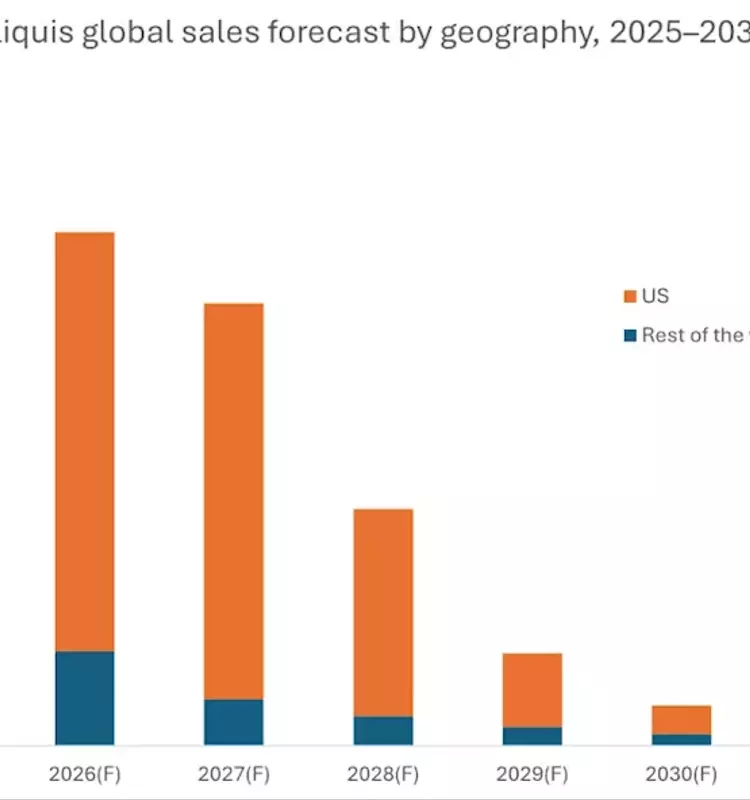
Bristol Myers Squibb's highly successful anticoagulant, Eliquis, is on the precipice of a dramatic revenue decline, with projections indicating a loss of approximately $14.2 billion by 2031. This impending financial shift is primarily attributed to the expiry of its key patents, first in Europe this year, followed by the United States and Japan in 2027. Eliquis, a collaborative effort between BMS and Pfizer, has been a dominant force in the global oral anticoagulant market, but its substantial commercial success now makes it a prime example of the pharmaceutical industry's vulnerability when facing major patent cliffs.
The Impending Decline: Eliquis's Patent Expiry and Market Repercussions
Eliquis, known generically as apixaban, secured its initial approval in the European Union in May 2011, with subsequent clearance from the FDA in December 2012. This direct factor Xa inhibitor is a cornerstone treatment for various conditions, including stroke prevention in atrial fibrillation patients, as well as deep vein thrombosis and pulmonary embolism. However, the drug's exclusivity is rapidly approaching its end. Global sales, which were robust at $14.4 billion in 2025, are anticipated to plummet to a mere $205 million by 2031, representing an astonishing 98.6% reduction. This dramatic drop signifies one of the most substantial single-asset loss-of-exclusivity (LOE) events in recent pharmaceutical history.
The revenue erosion is not a uniform process but rather a geographically staggered one. Europe will experience the initial impact with its patent expiry in May 2026. This will trigger a significant decline in ex-US markets, with revenues expected to decrease by nearly 75% between 2025 and 2027. This rapid shift is driven by the swift adoption of generic alternatives within European tendering systems and formulary switches. In contrast, the US market is expected to remain largely unaffected during this initial phase, with its share of Eliquis's total portfolio revenues projected to rise to almost 90% by 2027, as the brand consolidates its presence in its last high-value region.
The US market will begin to feel the financial strain even before generic entry. Under the provisions of the Inflation Reduction Act, a Medicare maximum fair price of $231 per 30-day supply was implemented in January 2026, which will reduce net revenues two years prior to the patent cliff. Once US exclusivity officially ends in 2028, the impact is expected to be both immediate and severe. A nearly 50% single-year decline is projected, largely due to the rapid generic substitution dynamics prevalent in the US market, where formulary changes and direct substitution at the pharmacy level can quickly shift patient volume to generic alternatives. By 2031, US revenues are forecast to have fallen by an astounding 99% from their 2025 peak, accounting for over $10 billion of the total losses throughout this period.
This unprecedented patent cliff for Eliquis is serving as a critical benchmark for the pharmaceutical industry. It underscores the speed and magnitude of revenue compression that can occur following generic entry in major markets. In response to this looming challenge, Bristol Myers Squibb has strategically diversified its portfolio through significant acquisitions, such as Karuna Therapeutics ($14 billion) and RayzeBio ($4.1 billion). These investments are deliberate efforts to cultivate new growth platforms in neuroscience and radiopharmaceuticals. The acquisition of Karuna has already yielded positive results, with Cobenfy (formerly KarXT) receiving FDA approval in September 2024 as a pioneering new class of schizophrenia treatment and launching commercially in the US in late 2024. This proactive repositioning indicates BMS's strategic foresight in mitigating the profound impact of Eliquis's patent expiration.
From an industry perspective, the Eliquis case offers a stark reminder: heavy reliance on a single blockbuster drug, even one as successful as Eliquis, carries inherent risks. The projected fall from approximately $14.4 billion in 2025 to well under $1 billion within a span of five years vividly illustrates this point. Therefore, early and aggressive diversification of a company's drug pipeline becomes not merely an option, but an essential strategy for large-cap pharmaceutical companies to safeguard their value and ensure long-term sustainability in the face of inevitable patent expirations.
