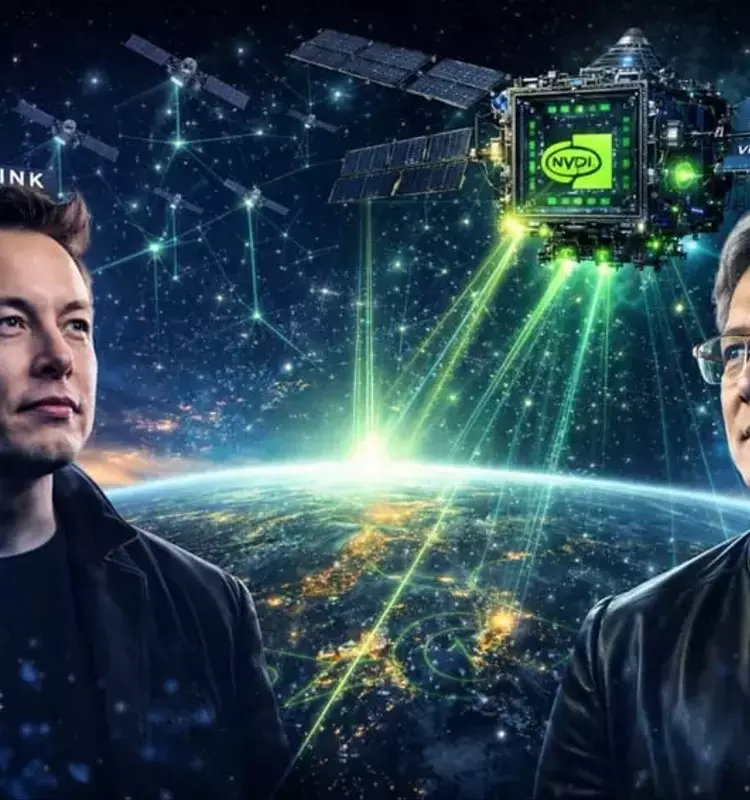
The next frontier for artificial intelligence is rapidly expanding beyond Earth's atmosphere, as tech titans like Nvidia and Elon Musk's SpaceX set their sights on establishing computing infrastructure in orbit. This burgeoning competition signifies a critical shift in how AI capabilities will be developed and deployed, driven by the constraints of terrestrial data centers and the unique advantages offered by space. The race to master orbital AI is not merely about technological advancement but also about overcoming unprecedented engineering challenges and redefining the economic landscape of high-performance computing.
As companies vie for supremacy in this new domain, the implications for global connectivity, data processing, and defense systems are profound. The strategic deployment of AI in space promises to unlock new possibilities for real-time data analysis, enhanced communication, and sophisticated orbital applications. However, this ambition is tempered by the immense technical hurdles, particularly in managing extreme environmental conditions and the substantial financial investments required. The outcomes of this orbital AI battle will undoubtedly shape the future of technology and space exploration, influencing industries far beyond the traditional confines of aerospace.
The Unprecedented Challenges of Space Computing
Nvidia, under the visionary leadership of CEO Jensen Huang, is embarking on an audacious endeavor with its 'Vera Rubin Space-1' project. The core objective is to extend high-performance AI computing into the vacuum of space, fundamentally altering the paradigm of data center operations. This move is necessitated by the inherent limitations of Earth-bound infrastructure, which grapples with issues such as power consumption, land availability, and latency. By relocating computing power to orbit, Nvidia aims to circumvent these earthly constraints and leverage the unique advantages of a space-based environment, including near-global coverage and direct connectivity to critical systems. The transition from terrestrial to orbital data centers, however, introduces a myriad of complex engineering problems, most notably the efficient dissipation of heat from powerful Graphics Processing Units (GPUs).
The challenges associated with cooling high-density GPU clusters in space are formidable. Unlike on Earth, where conventional cooling methods like liquid systems and airflow are readily available, the orbital environment offers only radiation as a means of heat transfer. This absence of conduction and convection necessitates a complete overhaul of current data center designs, demanding innovative solutions in thermal management, power efficiency, and chip-level optimization. The hostile conditions of space, characterized by extreme temperatures, radiation exposure, and microgravity, compel engineers to rethink every aspect of hardware and system architecture. Consequently, the development of orbital AI is not merely an incremental improvement on existing infrastructure but a fundamental redesign from first principles, pushing the boundaries of material science and engineering ingenuity.
Musk's Strategic Edge in Orbital Deployment
While Nvidia is intensely focused on pioneering the design of AI computing systems tailored for the orbital environment, Elon Musk's ventures, specifically SpaceX and Starlink, already possess a substantial head start in space infrastructure. Musk's integrated ecosystem, which now includes the AI research firm xAI linked with Tesla's broader technological ambitions, benefits from an existing, expansive satellite network in low Earth orbit. This established infrastructure provides a critical advantage, granting Musk unparalleled deployment capabilities in space at an industrial scale. The ability to launch and maintain a vast constellation of satellites offers a ready-made platform that could serve as the foundational backbone for future orbital AI operations, effectively bypassing many of the initial logistical and deployment hurdles faced by competitors.
The strategic positioning of Starlink's network presents a compelling vision for the future of space-based computing. Should the trend of moving compute resources into orbit accelerate, Starlink is poised to become the indispensable connective tissue, facilitating communication and data transfer between orbital data centers and ground stations. This ready-to-deploy infrastructure not only reduces the time and cost associated with establishing a space presence but also offers a tested and proven method for operating in the harsh orbital environment. Musk's proactive approach in building out this robust space-based network means that while others are still grappling with conceptual designs and initial deployments, his enterprises are already laying the groundwork for a new era of AI, effectively turning a theoretical advantage into a tangible reality.
