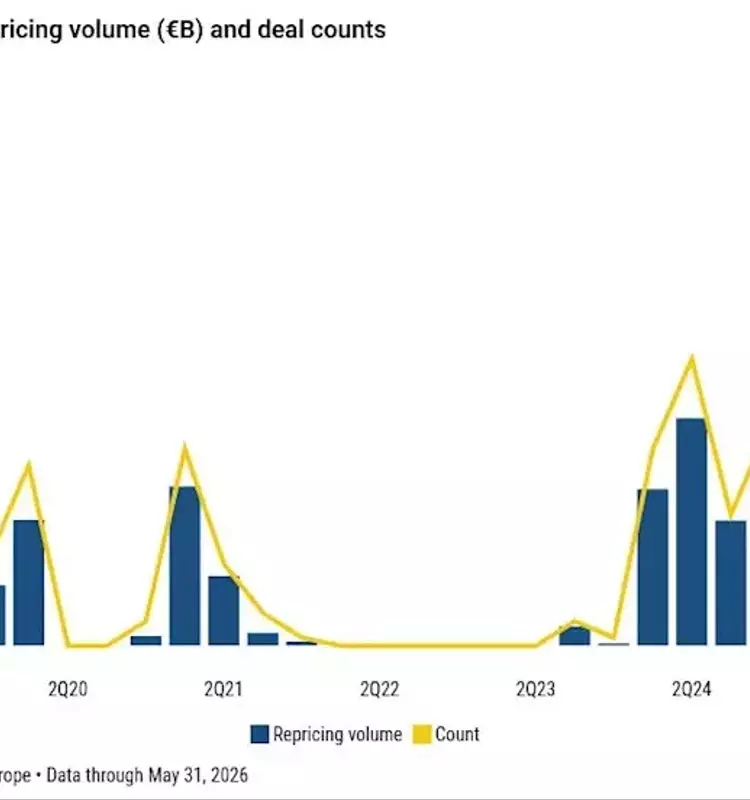
The European loan market is currently experiencing a period of extraordinary tightening in loan spreads, reaching levels not seen in nearly a decade. This phenomenon is largely attributable to a "technical tidal wave" of demand from Collateralized Loan Obligations (CLOs) that has far outstripped the available supply of new loans. Consequently, borrowers are seizing the opportunity to aggressively reduce their borrowing costs, as both new and repriced loan margins converge. As the market approaches the late-summer lull with limited new issuance expected, questions are arising about the sustainability of current pricing levels and the extent of investor appetite.
Details of the European Loan Market Reshaping
In the vibrant financial landscape of Europe, particularly as of Wednesday, June 17, 2026, a significant shift has occurred within the loan market. Driven by an insatiable hunger for Collateralized Loan Obligations (CLOs), European loan spreads have dramatically compressed, reaching their most constrained point in nine years. This surge in demand, coupled with a constrained supply, has handed a distinct advantage to borrowers. They are actively capitalizing on this environment to slash their debt servicing expenses, as the cost of both refinancing existing loans and securing new capital has converged.
A prime illustration of this trend was CVC-backed Mehilainen's recent repricing of its €1.86 billion term loan. Initially targeting a more aggressive E+275, the deal ultimately settled at E+300, a 50 basis point reduction, but still shy of the tightest ambitions. This pattern is consistent across the late spring, with many B/B2 rated borrowers, like Colosseum Dental, hitting the E+300 benchmark. Only a select few, such as Ivirma, have managed to achieve the tighter E+275 spread seen earlier in the year.
The underlying force behind this market dynamic is a persistent supply imbalance. Institutional loan supply has been negative on a rolling six-month basis since the autumn of 2021, with particularly severe shortages noted in February and March of this year, each registering a €22 billion deficit. This acute scarcity of primary market offerings has led to numerous warehouses actively seeking loans, highlighting a significant gap between market needs and available supply.
On the demand side, CLO issuance continues its robust trajectory, slightly outpacing last year's figures with €26.4 billion year-to-date. The number of CLO managers launching new deals has also expanded considerably, from 20 in late 2023 to 34 in the first quarter of 2026. This burgeoning demand is what one investor eloquently described as an inescapable "technical tidal wave."
The impact of repricing is evident in the convergence of spreads across different deal vintages. Repricing transactions completed this year have seen average starting margins of 361 basis points fall to an average of 307 basis points, effectively aligning with the clearing levels for new money from standard B2 rated entities. The new-issue market mirrors this narrative, with recent deals like Trench Group's €1.4 billion recapitalisation and Smiths Detection's €560 million tranche clearing at E+300, often tighter than initial expectations. Even above-par prints, though costly for CLOs, have been observed.
While the secondary market has demonstrated resilience, it has not been without turbulence. The ELLI average bid experienced a decline in January due to repricing risks, followed by further losses in February partly attributed to software-related concerns. The conflict in the Persian Gulf in late February further exacerbated the downturn, pushing the index to a trough of 94.44 by March 9. However, a swift recovery ensued, with the index reclaiming its January levels by mid-May, showcasing the market's underlying strength.
The scarcity of new supply also poses challenges for CLO managers in meeting diversity requirements. Despite total year-to-date activity reaching €101.63 billion, a significant portion comprises repricings, extensions, and refinancings. Non-refinancing new-money supply has actually decreased by 12% compared to the previous year. This means CLO managers are competing for a larger pool of debt spread across a relatively static number of issuers, putting pressure on portfolio construction.
Looking ahead, new money opportunities before the August break remain limited, with major transactions expected only in the autumn. However, substantial future supply, such as Iliad's €6.5 billion package for its acquisition of SFR, and Ryan's debut euro term loan, is on the horizon. The market eagerly awaits this influx, though likely not before the August recess.
In this environment, managers are actively seeking "pockets of value." Domestic chemical producers, for instance, have become the best-performing sector in the ELLI this year, benefiting from trade disruptions that have reduced the inflow of lower-cost Chinese products. Similarly, some software names, such as Unit4 and SUSE, have seen their values rebound as managers differentiate between essential and 'nice-to-have' business models in the age of AI. Conversely, despite strong financials, Think Cell has experienced a drop in its secondary price, leading its sponsor to buy back a portion of its debt.
However, there are emerging indicators that the market might be approaching a "technical ceiling." BofA Securities noted in early June that pressure is mounting on CLO weighted average spreads (WAS), with the median WAS for reinvestment-period European CLOs declining to below 360 basis points. While CLO liabilities have also decreased, they haven't kept pace with the faster compression of loan spreads, consequently narrowing the equity spread. Despite this, managers are reluctant to shed repriced assets, fearing an erosion of portfolio quality, and instead are seeking higher-yielding opportunities, such as Ineos Group's refinancing, to rebuild WAS and barbell their portfolios.
Market bifurcation persists, with a portion of the index still trading below 90, and defaults are beginning to tick upwards, particularly in sectors like Building Materials. The ongoing conflict in the Persian Gulf adds a layer of uncertainty, making it challenging to predict consumer and discretionary sector reactions, further complicating the market outlook.
This current climate in the European loan market underscores a powerful interplay of supply, demand, and geopolitical factors. For investors, it highlights the need for astute decision-making and a careful search for value in an increasingly tight and complex environment. The robust demand for CLOs, while driving spreads down, also creates a challenging landscape for sourcing and diversifying quality assets. The market's resilience in the face of various shocks, from software sell-offs to geopolitical tensions, demonstrates its underlying strength, yet also suggests that the current tight conditions might be testing the limits of its capacity. The upcoming months, particularly post-August, will be crucial in determining whether the anticipated increase in new supply can alleviate some of the current pressures and rebalance the market dynamics.
