Examining the Effectiveness of International Diversification in Investment Portfolios
Stocks

Examining the Effectiveness of International Diversification in Investment Portfolios

DateSep 02, 2025
Read time2 min

While the concept of portfolio diversification is widely accepted as a fundamental principle for sound investment, the extent to which one should diversify, especially into global markets, warrants careful consideration. Many investors instinctively equate market performance with the S&P 500, a key indicator representing a substantial portion of the U.S. stock market's total valuation. Indeed, when this index performs robustly, a significant number of investors typically observe positive returns in their portfolios, reinforcing the notion that domestic equities remain a powerful engine for capital appreciation.

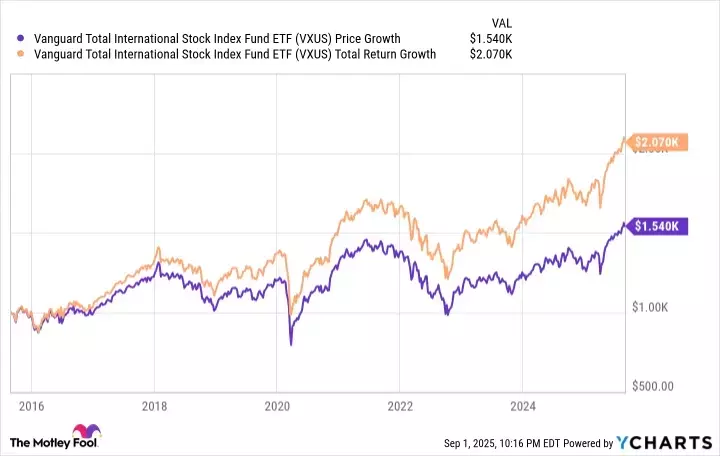
However, the global investment landscape offers a multitude of opportunities beyond the U.S. borders, prompting some investors to explore international diversification. For instance, the Vanguard Total International Stock Index Fund ETF (VXUS), designed to mirror the performance of all global stocks excluding those listed in the U.S., provides comprehensive exposure to a diverse array of international companies. A historical analysis of this ETF reveals a notable disparity: a $1,000 investment in VXUS a decade ago would currently be valued at $1,540, or $2,070 with dividend reinvestment, translating to an annualized growth rate of 4.4% and 7.6% respectively. In stark contrast, an identical investment in the SPDR S&P 500 ETF Trust (SPY) over the same period would have surged to $3,263, or $3,875 with reinvested dividends, yielding impressive annualized growth rates exceeding 12.5% and 14.5%.

This comparative performance underscores a critical insight: while international exposure can be beneficial, the past decade has uniquely favored U.S. markets, particularly American technology firms, which have driven significant innovation. The extensive diversification offered by VXUS, encompassing thousands of companies across 47 nations, might include many entities that do not align with individual investment objectives or risk profiles. Therefore, rather than adopting a broad-brush approach to international indexing, a more strategic and selective method, focusing on robust U.S. market exposure supplemented by carefully chosen foreign equities, could provide American investors with more targeted and ultimately more rewarding diversification, balancing growth potential with manageable risk.

Embracing a thoughtful investment strategy, one that balances ambition with prudence, is key to achieving financial well-being. The journey of investment is not merely about accumulating wealth, but also about understanding market dynamics and making informed choices that align with one's personal financial goals and risk tolerance. It teaches us discipline, patience, and the value of continuous learning, empowering individuals to navigate the complexities of the financial world with confidence and to build a secure future, not just for themselves but for generations to come.

More Articles
Navigating the Oil Market: Investment Strategies for Crude Price Rebounds
Despite recent declines in oil prices, several catalysts could ignite a rally. This article explores strategic investments in the oil sector, focusing on three companies: Chevron, Diamondback Energy, and ExxonMobil. These firms offer diverse approaches to capitalize on potential crude price upturns, from Chevron's stable, diversified operations and consistent dividends to Diamondback Energy's high-growth, free cash flow model, and ExxonMobil's expansive growth plans and shareholder returns. Each presents a unique opportunity for investors looking to benefit from a rebound in energy markets.
Sep 02, 2025
Alibaba's Market Disconnect: Soaring Sales, Plunging Stock, and a Potential Value Opportunity
Despite consistent revenue growth since 2020, Chinese e-commerce giant Alibaba (BABA) has seen its stock price plummet by over 60% from its pandemic peak. This divergence between strong financial performance and a sharply depreciated market valuation presents a compelling case for contrarian investors, as the company's price-to-earnings ratio has fallen significantly below the S&P 500 average, signaling a potential undervalued asset.
Sep 02, 2025
Examining Michael Burry's Investment in Lululemon Amidst Market Downturn
Renowned investor Michael Burry has recently acquired a significant stake in Lululemon Athletica, including call options, signaling a bullish outlook for the activewear company despite its recent struggles. Lululemon, currently trading at its lowest-ever valuation, faces challenges such as increased competition and shifting consumer behaviors. However, its strong international growth, particularly in China, and continuous product innovation suggest potential for a rebound, making Burry's investment a noteworthy contrarian move.
Sep 02, 2025
Unlocking Electric Vehicle Potential: Rivian's Path to Growth
Electric vehicle manufacturer Rivian Automotive, with a current market capitalization of $16 billion, is poised for significant long-term growth. The company aims to emulate Tesla's success by introducing more affordable models, starting with the R2 in 2026, priced around $45,000, and followed by even cheaper R3 and R3X models in 2027. While building a successful EV company is capital-intensive and requires patience, Rivian's strategic shift to lower-priced vehicles could attract a much wider consumer base, potentially transforming small investments into substantial returns for long-term investors.
Sep 02, 2025
Demographic Shift and Investment Opportunity: UnitedHealth Group's Promising Future
This article explores the investment potential of UnitedHealth Group, particularly in light of significant demographic shifts in the United States. Despite recent stock performance, the aging population presents a substantial growth opportunity for the healthcare insurer. The article highlights that influential investors like Warren Buffett and Michael Burry have shown confidence in UnitedHealth Group, suggesting it may be currently undervalued. The core argument is that the increasing proportion of older Americans will naturally drive demand for healthcare services and insurance, benefiting market leaders like UnitedHealth Group.
Sep 02, 2025