Exploring Growth Stocks: Characteristics, Risks, and Comparison with Value Stocks
Finance

Exploring Growth Stocks: Characteristics, Risks, and Comparison with Value Stocks

authorBy David Rubenstein
DateJul 21, 2026
Read time2 min

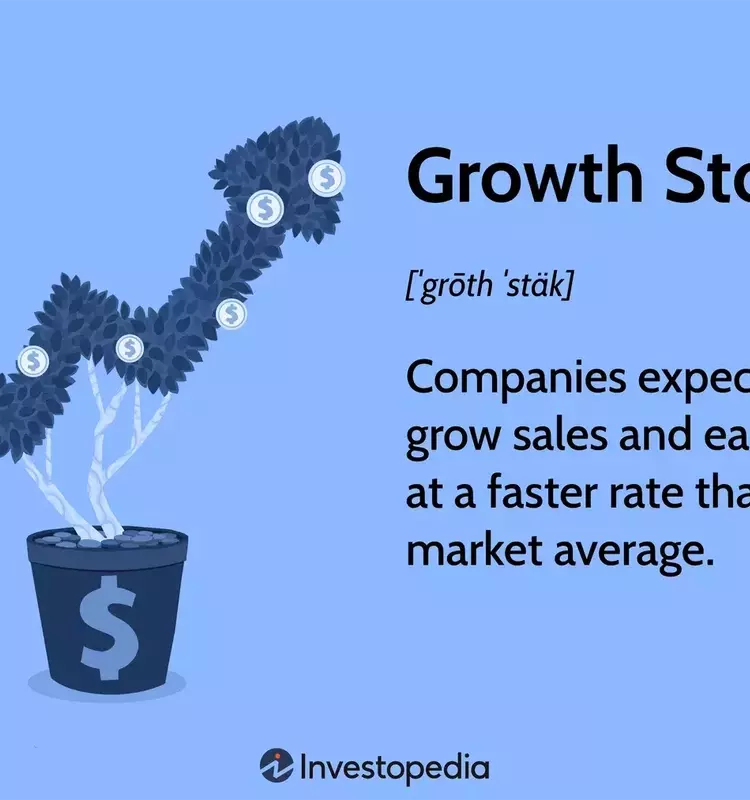
Growth stocks are shares in companies expected to achieve revenue and profit growth far beyond the general market rate. These firms typically forgo dividend payments, choosing instead to reinvest their earnings to accelerate short-term expansion. Investors in these stocks aim to profit from capital appreciation when they eventually sell their shares.

These companies can emerge from any industry but are frequently found in rapidly evolving sectors like technology or biotechnology. They often possess distinctive product lines, patents, or advanced technologies, providing a competitive edge. To maintain their leadership, they continuously reinvest profits into research and development. Growth stocks often have a devoted customer base or a substantial market share, secured through innovation and early market entry. While many small-cap companies are classified as growth stocks, larger enterprises can also fall into this category.

A notable example is Amazon Inc. (AMZN), which has consistently been regarded as a growth stock. Despite its substantial market capitalization, Amazon has historically traded at a high price-to-earnings (P/E) ratio, reflecting investor confidence in its future growth. However, this high valuation based on future expectations carries a risk: if the anticipated growth does not materialize, the stock price can decline sharply. This inherent volatility distinguishes growth stocks from value stocks, which are typically undervalued by the market, often pay dividends, and are chosen for their stable fundamentals and lower P/E ratios. Investors might combine both growth and value stocks in their portfolios for diversification, or they might choose to specialize in one category based on their risk tolerance and investment goals.

Investing in growth stocks demands a forward-looking perspective and an acceptance of higher risk for the potential of significant future gains. While the allure of substantial returns is strong, diligent research and a clear understanding of the company's growth trajectory are essential to mitigate the inherent risks. Ultimately, successful growth stock investing is about identifying innovative companies that can consistently outperform market expectations and contribute to a dynamic and prosperous economy.

More Articles
Finance
Dollar General's Persistent Value Amidst Market Shifts
Despite a recent stock surge, Dollar General (DG) remains an attractive investment, trading below its intrinsic value of $143. The company’s latest financial report showcased encouraging growth in customer traffic and comparable-store sales. However, potential market saturation and heightened competition from major retailers like Walmart, Amazon, and discounters such as Aldi pose notable risks. Investors should consider a measured approach to position sizing, acknowledging these evolving market dynamics and competitive pressures.
By Mariana MazzucatoJul 21, 2026
Finance
AMD: Open-Source AI is the Catalyst, But Valuation Suggests Caution
Advanced Micro Devices (AMD) is strategically positioned to gain from the rise of open-source AI workloads, leveraging its ROCm software stack. The recent MEXT acquisition is expected to mitigate memory cost inflation and bolster gross margins. While the server CPU division is set to benefit from agentic AI growth, intense competition from Nvidia's Vera CPU looms. Despite strong fundamentals, AMD's current valuation, at a 56.1x forward PE, is significantly higher than its semiconductor peers, suggesting a cautious short-term outlook due to fading technical momentum.
By Michele FerreroJul 21, 2026
Finance
Greenwich LifeSciences: Assessing Progress Amidst Lingering Doubts
This article analyzes Greenwich LifeSciences (GLSI), a microcap biotechnology company developing a breast cancer immunotherapy. Despite recent clinical trial updates and potential market expansion, skepticism persists due to limited robust data. The article maintains a 'Sell' rating, highlighting the unproven efficacy of GLSI-100 and ongoing dilution risks.
By David RubensteinJul 21, 2026
Finance
Unlocking Investment Potential: A Guide to Investment Analysis
Investment analysis is the crucial process of evaluating potential investments, industries, and economic trends. It aims to predict future performance and determine an investment's suitability for an individual investor's financial goals and risk tolerance. This comprehensive approach considers entry price, holding duration, and portfolio integration to optimize financial strategies. Both fundamental and technical analyses, alongside top-down and bottom-up methods, provide diverse perspectives for making informed investment decisions.
By Strive MasiyiwaJul 21, 2026
Finance
Google's AI Chip: Fueling Growth and Overcoming Constraints
Google's new AI chip, Frozen v2, is poised to revolutionize its cloud computing capabilities. With a massive $462 billion backlog in Google Cloud, the company faces significant compute constraints. Frozen v2, by embedding Gemini's architecture directly into silicon, aims to deliver substantially more tokens per watt, addressing the current demand-supply imbalance and potentially unlocking massive revenue growth. This strategic innovation highlights Google's full-stack approach to AI.
By Fareed ZakariaJul 21, 2026