Federal Reserve's Unwavering Commitment to 2% Inflation Target Under Chairman Warsh
Finance

Federal Reserve's Unwavering Commitment to 2% Inflation Target Under Chairman Warsh

authorBy Nouriel Roubini
DateAug 14, 2026
Read time3 min
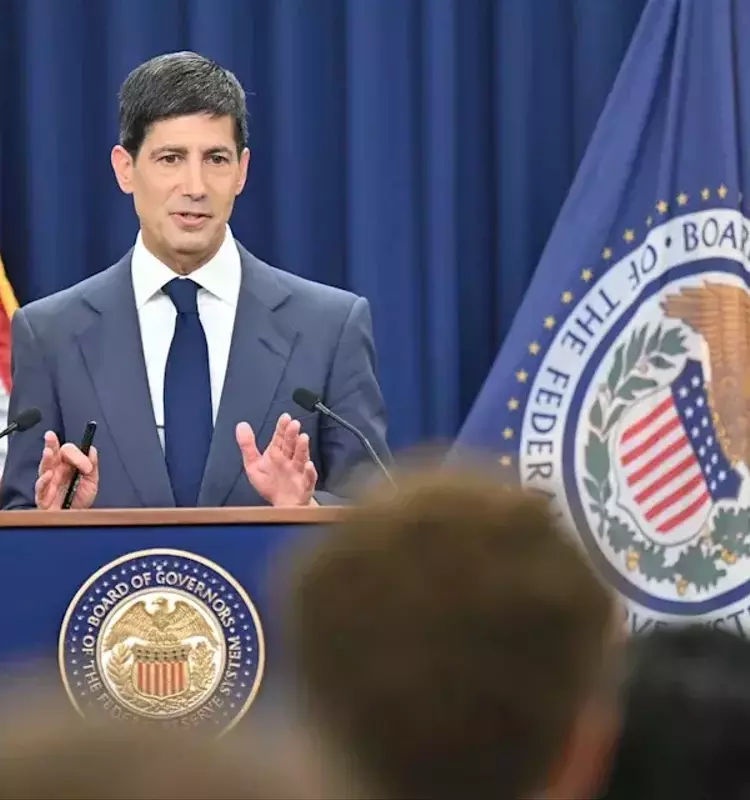
The Federal Reserve's new chairman, Kevin Warsh, has introduced a notable shift in the central bank's communication strategy, moving away from extensive commentary and detailed forward guidance. This change has prompted financial markets to scrutinize his every word for insights into future monetary policy. At the core of Warsh's minimalist approach is an explicit and firm commitment to a 2% inflation target, a stance that has profound implications for investors and the broader economy.

Warsh's Concise Communication: A New Era for Federal Reserve Guidance

A Shift in Federal Reserve's Public Pronouncements

Since taking the helm in mid-May, Federal Reserve Chairman Kevin Warsh has ushered in a more streamlined and less verbose approach to communicating the central bank's intentions. Unlike his predecessors who often provided ample commentary and forward guidance, Warsh has intentionally adopted a concise style, leaving financial analysts and investors to delve deeply into his limited public statements for clues about future monetary policy directions. This deliberate reduction in "Fed speak" means that every word Warsh utters carries significant weight, forcing markets to interpret his less frequent pronouncements with heightened attention.

The Market's Muted Reaction to New Leadership

In the initial period following Chairman Warsh's appointment, the S&P 500 experienced a modest gain of 4.2%. This relatively subdued market response suggests that investors are still adjusting to the new leadership and its implications. The absence of detailed forecasts and hypothetical interest rate paths has created an environment where the market must infer policy directions from subtle signals rather than explicit statements, reflecting a cautious wait-and-see attitude among market participants.

Warsh's Firm Stance on Price Stability

A pivotal moment in Warsh's early tenure occurred during a press conference on July 29, following his second major policy meeting. Addressing speculation about the Fed's tolerance for inflation exceeding its stated goal, Warsh unequivocally declared, "There is no soft inflation target, there is no soft implicit target -- not on this Committee's watch. There is only a target, and it is 2%." This resolute statement underscores his unwavering commitment to achieving and maintaining price stability at the 2% level, rejecting any notion of flexibility or temporary acceptance of higher inflation. This principle echoes his earlier public remarks during confirmation hearings, where he asserted that "inflation is a choice."

Implications for Future Monetary Policy

Warsh's firm and consistent messaging indicates that the Federal Reserve, under his leadership, considers the 2% inflation target non-negotiable. This stance significantly increases the probability of more restrictive monetary policies should inflationary pressures persist. The market's interpretation of this commitment suggests that any future decisions regarding interest rates will be primarily driven by the imperative to achieve price stability, potentially overriding short-term growth concerns. Smart investors are already factoring this into their strategies, as evidenced by climbing longer-term bond yields that reflect an expectation of a lower tolerance for sustained inflation. The scarcity of Warsh's words amplifies the impact of his clear statements, making his declaration on the 2% inflation target a critical anchor for market expectations.

The Path Forward: Discipline or Volatility?

Warsh's communication style, characterized by its brevity and emphasis on a unified message, is a deliberate attempt to differentiate the central bank's actions from market interpretations. While internal deliberations may involve intense debate, the public message remains cohesive and measured. This approach, combined with his insistence on a strict inflation target, signals to Wall Street that the Fed's credibility is intrinsically linked to delivering exactly 2% inflation, rather than merely managing expectations through rhetoric. The ultimate success of this approach and whether it ushers in a more disciplined era of monetary policy or leads to increased market volatility will depend on how consistently the committee follows through on this commitment in forthcoming meetings.

More Articles
Finance
Vicor's AI Power Surge: Growth Trajectory and Valuation Check
Vicor Corporation (VICR) is experiencing a significant uplift in product revenue, backlog, and licensing, primarily fueled by the escalating demand for power solutions in AI infrastructure. The company's innovative second-generation vertical power delivery technology positions it for substantial long-term expansion, with ambitious targets of $2.5 billion in revenue and a 70% gross margin. While a recent EPS beat was influenced by a one-time tax benefit, the underlying operational strength remains solid. However, the current valuation, trading at 65x 2026 earnings and 16.5x sales after a remarkable 358% surge, suggests a highly optimistic market outlook, leading to a 'Hold' rating.
By Strive MasiyiwaAug 14, 2026
Finance
Nebius Group Faces Valuation Challenges Amidst Strong AI Cloud Growth
Nebius Group N.V. (NBIS) is currently rated "Sell" despite impressive Q2 revenue growth of 454% year-over-year, largely driven by its AI cloud services, which now account for 98% of sales and contribute to an annual recurring revenue (ARR) of $3 billion. Customer prepayments covering 50-60% of contract costs have boosted operating cash flow to $2.3 billion, mitigating immediate funding concerns. However, the company's valuation metrics, such as a GAAP P/E of 1,552.63 and EV/EBITDA of 887.44, significantly surpass those of its competitors, raising questions about the sustainability of its accounting practices and overall market value.
By Strive MasiyiwaAug 14, 2026
Finance
Goldman Sachs to Acquire NEOS Investments: A Strategic Move in the ETF Market
Goldman Sachs has announced its acquisition of NEOS Investments, a strategic move poised to significantly impact the ETF market. The deal, valued at up to $2.25 billion, focuses on NEOS's impressive $30 billion portfolio of high-yield, index-linked option ETFs. This acquisition is expected to bolster Goldman's presence in the actively managed ETF sector, leveraging NEOS's successful QQQI and SPYI funds, which are known for offering superior yields compared to Goldman's existing products. The integration aims to maintain continuity, with NEOS's co-founders and team joining Goldman. However, the future of NEOS's higher-risk, boosted funds remains uncertain.
By Nouriel RoubiniAug 14, 2026
Finance
S&P 500 Experiences Minor Dip After Reaching New Heights
The S&P 500 index saw a slight decline recently, yet remains poised to conclude the week near its all-time peak. This positive trajectory follows encouraging inflation data and strong performance from artificial intelligence-related companies. Despite opening with gains, the benchmark U.S. index experienced a modest downturn after hitting its 27th record high this year in the prior trading session.
By Lisa JingAug 14, 2026
Finance
Creative Planning, Transamerica Sued Over Retirement Plan Selections
A class-action lawsuit has been filed against Creative Planning and Transamerica, alleging that these entities, acting as fiduciaries for a hospital's retirement plan, neglected their duties of prudence and loyalty. The complaint, initiated by an All Children's Hospital employee, claims that plan assets were improperly directed into a single, underperforming target date fund series for a decade, and that more expensive share classes were chosen when cheaper alternatives were available, resulting in significant losses for participants.
By Lisa JingAug 14, 2026