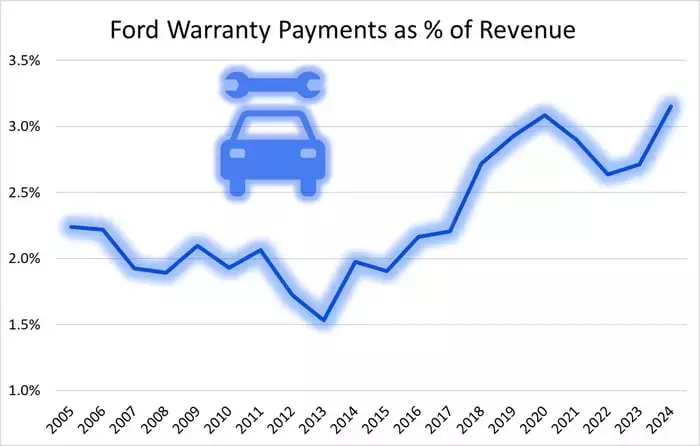
Ford Motor Company faces the critical challenge of narrowing a substantial cost gap relative to its competitors. The automaker is strategically focusing on two major areas to bolster its bottom line: mitigating rising warranty expenses, exacerbated by a record number of vehicle recalls, and transforming its electric vehicle business into a profitable venture following significant financial setbacks. The successful implementation of these measures is poised to unlock considerable financial upside for the company.
Ford Addresses Cost Disadvantages and EV Losses for Future Growth
In a significant move to enhance its competitive standing, Ford Motor Company is vigorously pursuing strategies to overcome a persistent cost disadvantage. Approximately three years prior, company executives openly acknowledged a formidable cost disparity, estimating it to be between $7 billion and $8 billion when compared to established rivals in the automotive sector. This recognition has spurred a concerted effort to fundamentally reform how Ford designs, procures, and manufactures its vehicles.
A primary concern has been the escalating warranty costs, a direct consequence of a historical high in vehicle recalls. The National Highway Traffic Safety Administration (NHTSA) recently highlighted Ford's alarming record of 109 recalls in the U.S. market, a figure significantly higher than its closest competitor, Stellantis, which recorded 30. A notable recent incident involved a global recall of 1.9 million vehicles due to a rearview camera malfunction, necessitating dealership intervention rather than over-the-air fixes, which could further inflate warranty expenditures. This issue is particularly pressing, as demonstrated by a $2.3 billion surge in warranty and recall costs in a single quarter last year, significantly impacting earnings.
Alongside quality improvements, Ford is intensely focused on making its electric vehicle (EV) division, known as \"Model e,\" profitable. Despite the industry's shift toward electrification, Ford's EV sector reported a substantial $5.1 billion loss in 2024. To counter this, Ford has innovatively redesigned its production process, adopting an \"assembly tree\" model at its Louisville Assembly Plant. This new approach involves simultaneous subassembly lines, projected to boost production speed by 15% compared to conventional methods. Furthermore, the company plans to introduce a universal EV platform, aiming to reduce parts by 20%, minimize fasteners by 25%, and decrease workstations by 40%. This platform is expected to underpin up to eight EV models, starting with an electric pickup truck in 2027, with the ambitious goal of achieving profitability early in its lifecycle.
These proactive steps, encompassing both rigorous cost management and a strategic overhaul of EV production, are critical for Ford to bridge its cost gap and realize its long-term growth ambitions.
Ford's current challenges, particularly concerning recurring quality issues and substantial EV losses, present a dual perspective for stakeholders. On one hand, the ongoing struggle with recalls and warranty costs, which have persistently impacted the company's financial results over the past decade, can be disheartening. The current record for annual recalls underscores the persistent nature of these operational hurdles. However, viewing this through an optimistic lens, these very challenges highlight an immense potential for improvement. Should Ford successfully implement its strategic initiatives to enhance product quality and significantly reduce warranty-related expenditures, the resulting positive impact on its profitability could be substantial. Simultaneously, the transformation of its EV division from a significant financial drain to a profitable segment represents a monumental opportunity. For investors who believe in Ford's capacity to resolve these critical issues, the present circumstances may represent a compelling investment opportunity, offering considerable upside once these operational and financial turnarounds are achieved.