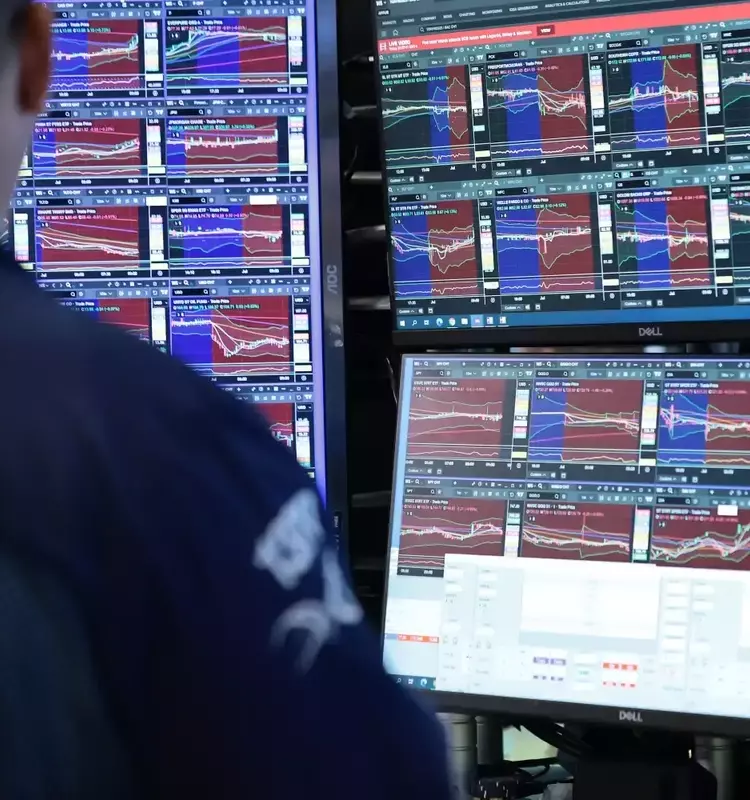
Today, global markets are navigating a complex landscape. While the Dow Jones Industrial Average ascended to an unprecedented high, the Nasdaq Composite faced downward pressure, primarily driven by a slump in semiconductor stocks. Fiserv's stock experienced a significant rally following reports of potential acquisition interest from major banks. Additionally, SpaceX commenced trading on the Nasdaq 100, marking a notable milestone for the company. Geopolitical tensions in the Strait of Hormuz led to an uptick in oil prices, and the 10-year Treasury yield also saw an increase. These varied movements underscore a market environment increasingly shaped by monetary policy uncertainties and persistent geopolitical risks, prompting investors to closely scrutinize economic indicators for future direction.
The week began with positive momentum for major stock indexes, largely fueled by strong performances from companies tied to artificial intelligence. Shares of Western Digital, Advanced Micro Devices, and Qualcomm all saw significant gains, contributing to a collective rise across the Nasdaq, S&P 500, and Dow. Notably, the Dow achieved both intraday and closing records, surpassing the 53000 mark. This robust start highlighted the market's enthusiasm for AI-related investments, as these companies continued to attract substantial investor interest and drive overall market expansion.
However, the positive sentiment for chip stocks was tempered by a notable decline on Tuesday. This downturn was triggered by a 7% drop in Samsung's shares during South Korean trading, despite the company announcing strong quarterly results. Samsung's preliminary report indicated robust revenue and operating profit, exceeding analyst expectations. Nevertheless, investors appeared to be seeking even more substantial, AI-driven growth figures, leading to the unexpected sell-off. This ripple effect extended to other major chip manufacturers, with Micron Technology, Marvell Technology, and AMD all experiencing significant declines at the opening bell. The broader semiconductor sector, as reflected by the VanEck Semiconductor ETF, also saw a considerable dip, indicating a sector-wide reaction to Samsung's performance.
In other market news, Fiserv shares surged following a report suggesting that several prominent banks had explored acquiring its payments network. According to a late Monday report from The Wall Street Journal, institutions such as JPMorgan Chase, Bank of America, Wells Fargo, and PNC Financial Services had considered making an offer. While some of these banks have reportedly since abandoned the idea, the initial interest spurred a rally in Fiserv's stock. The motivation behind such an acquisition would be to enable banks to circumvent existing limitations on fees charged to merchants for debit card transactions. This strategic move could allow banks to potentially reallocate funds towards enhancing reward programs for debit card users. In premarket trading, Fiserv's shares climbed 5%, while the stocks of the four mentioned banks also saw slight increases.
SpaceX, the aerospace company founded by Elon Musk, officially debuted on the Nasdaq 100 index today. The company's shares experienced a modest decline of less than 1% in premarket trading, following a similar dip yesterday. Despite this, the stock remains approximately 7% above its initial public offering price from nearly a month ago, though it has retreated from its peak of $225 achieved shortly after its market entry. The inclusion of SpaceX in high-profile indexes like the Nasdaq 100 is generally anticipated to boost its stock performance. This expectation is rooted in the fact that investment funds tracking these indexes are compelled to purchase shares of newly added companies, and a growing number of fund managers are reportedly planning to launch new funds specifically tied to this index. While this marks a significant index addition for SpaceX, it may be the last high-profile one for some time, with potential future inclusion in the S&P 500 remaining a long-term possibility.
Looking ahead, investors may shift their focus to the upcoming lock-up expiries for SpaceX shares. These periods typically prevent company insiders and early investors from immediately selling their holdings after an IPO. While the expiration of a lock-up period does not guarantee immediate selling, it opens the door for such activity. The first series of SpaceX lock-up expirations is expected to occur following the company's inaugural earnings release, anticipated in late July or early August. The volume of shares that could be affected by these expirations will partly depend on the stock's performance, with stronger trajectories potentially influencing the number of eligible shares.
Overall, the financial landscape remains in flux, influenced by a blend of technological advancements, corporate strategies, and global events. Investors are keen to interpret these signals, ranging from fluctuating commodity prices and bond yields to the performance of leading tech giants and emerging market players. The interplay of these factors will continue to shape market trends, demanding careful analysis and strategic adaptation from all participants.
