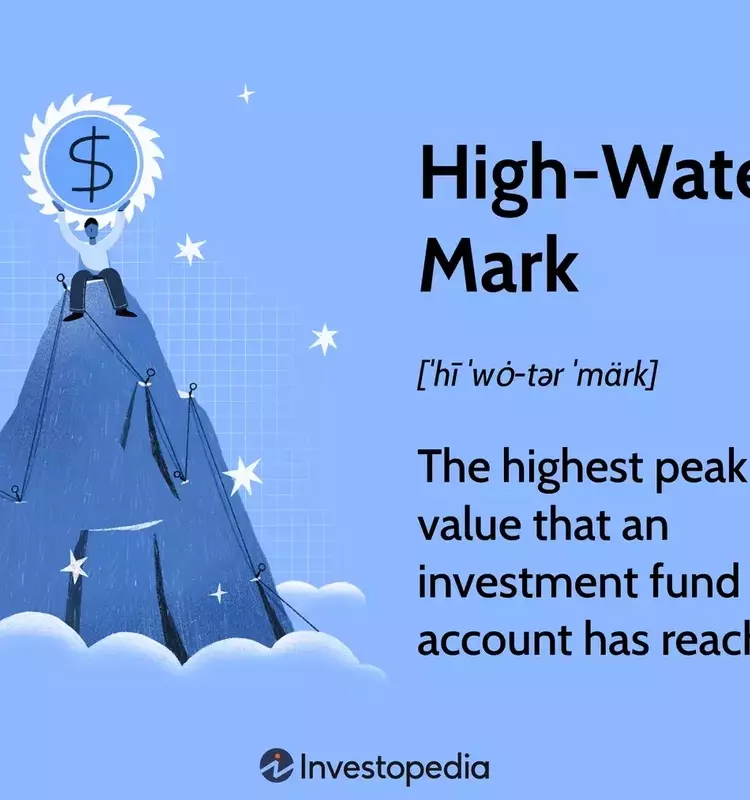
In the realm of investment funds, the 'high-water mark' serves as a crucial benchmark, denoting the maximum value an investment fund or portfolio has attained. This principle is fundamental in regulating the performance fees allocated to fund managers. Its primary function is to ensure that these managers only receive performance-related compensation when the fund's value exceeds its historical peak. This safeguard is designed to prevent investors from incurring fees for gains that merely recover prior losses, thereby aligning the interests of managers with those of their investors by motivating consistent, high-level performance.
This framework is particularly vital in mitigating the issue of 'double fees,' wherein investors might otherwise be charged multiple times for the same quantum of performance. By requiring a fund to surpass its high-water mark before new performance fees are levied, the system ensures fairness and transparency in fee structures. Moreover, it introduces a unique advantage for new investors, often referred to as a 'free ride' phenomenon, where they can benefit from an underperforming fund's recovery up to its previous peak without incurring performance fees. This nuanced approach balances manager incentives with robust investor protection, fostering a more equitable investment landscape.
Understanding the High-Water Mark Principle
The high-water mark functions as a protective measure for investors, ensuring they are not unfairly penalized with performance fees for periods of subpar fund performance. More significantly, it acts as a guarantee, preventing investors from being charged performance-based fees twice for the identical level of investment growth. This mechanism is critical in managed investment scenarios, particularly within hedge funds, where performance fees are a substantial component of manager compensation. By establishing a clear threshold—the highest value previously reached—the high-water mark dictates that managers must overcome any subsequent dips in fund value and then achieve new highs before they can claim additional performance bonuses.
This concept is distinct from a 'hurdle rate,' which specifies the minimum return a hedge fund must achieve before any incentive fees can be charged. While both are related to fund compensation, the high-water mark focuses on the historical peak value to prevent repeated charges on recovered losses, whereas the hurdle rate sets a minimum performance bar for fee eligibility. Thus, the high-water mark ensures that managers are incentivized not just to perform well, but to surpass previous successes, fostering a long-term perspective on fund management and safeguarding investor capital against redundant fees during recovery phases.
Application of High-Water Mark and Investor Benefits
Consider a scenario where an investor allocates $500,000 to a hedge fund, which typically charges a 20% performance fee. If the fund generates a 15% return in its initial month, the investment value increases to $575,000. Consequently, the investor owes a performance fee of $15,000 (20% of the $75,000 gain). At this juncture, the fund's high-water mark for this investor is established at $575,000. This example illustrates the immediate impact of successful performance on fee calculation, setting the stage for future fee considerations based on this new peak.
Should the fund experience a 20% decline the following month, reducing the account balance to $460,000, the high-water mark's significance becomes evident. No performance fees are charged as the fund recovers from $460,000 back to $575,000. Only gains surpassing the $575,000 high-water mark will trigger new performance fees. If, in an exceptional third month, the fund achieves a 50% profit, increasing the account to $690,000, the investor would owe an additional $23,000 (20% of the $115,000 gain above the high-water mark of $575,000), totaling $38,000 in performance fees including the initial $15,000. This mechanism prevents the investor from paying fees on the recovery of losses, highlighting the essential role of the high-water mark in ensuring fair compensation for fund managers and protecting investor capital from repetitive charges.
