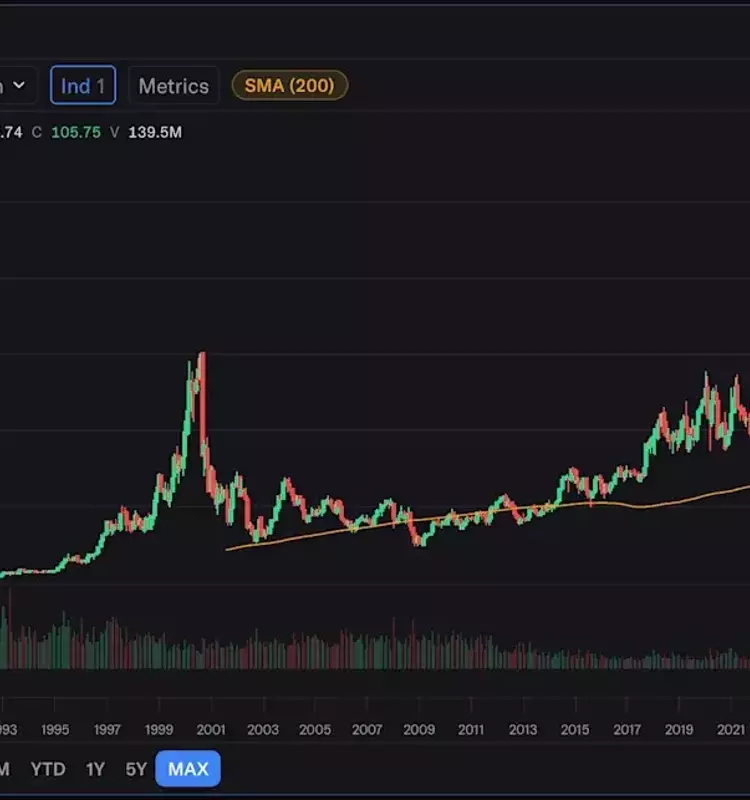
Intel's shares are experiencing an extraordinary period of growth, reaching valuation levels unprecedented in its history, even when compared to the speculative boom of the dot-com era. The semiconductor giant's stock has not only outperformed but has also maintained a significant distance above its 200-day moving average, a key technical indicator watched by institutional investors for assessing long-term market trends. This robust performance is largely attributed to the company's strategic advancements and renewed market confidence, propelling its stock value upwards by a staggering 200% this year alone.
The 200-day moving average serves as a critical benchmark for market analysts and large-scale investors, indicating the long-term health and direction of a stock. When a company's stock consistently trades above this average, it signals a strong upward trend, often attracting further institutional investment. Intel's current position, with its stock price significantly exceeding this vital technical threshold, underscores a powerful market endorsement of its recent endeavors and future prospects. This phenomenon is particularly noteworthy given that it surpasses the company's performance metrics even during the frothy market conditions of the late 1990s and early 2000s.
The resurgence in Intel's market appeal is deeply rooted in its operational improvements and strategic leadership. Under the guidance of CEO Lip-Bu Tan, the company has made substantial strides in refining its next-generation 18A manufacturing process. Furthermore, the successful deployment of its advanced Core Ultra Panther Lake processors has been a significant catalyst, bolstering investor confidence in Intel's technological prowess and competitive edge in the fiercely contested semiconductor industry. Analysts, such as Frank Lee from HSBC, have highlighted the core business's strength and the anticipated success of foundry engagements slated to materialize in the latter half of 2026 and extending into 2027.
Adding to this positive momentum are recent reports indicating strategic partnerships with major technology firms, including Apple and Google. These collaborations involve designing and manufacturing chips within the United States, suggesting a pivotal role for Intel in the domestic semiconductor supply chain. Coupled with substantial investments received last year from the U.S. government and Nvidia, these developments have collectively elevated market sentiment towards Intel. However, despite this strong upward trajectory, it's important to acknowledge that the stock has experienced some sell-offs from its peak in late June, mirroring a broader market pullback in the chip sector, reminding investors that even the most robust stocks are subject to market fluctuations.
The journey of Intel's stock this year has been nothing short of extraordinary, with its valuation soaring to unprecedented heights. This impressive rally reflects a renewed belief in the company's strategic direction and technological innovation. While the market has shown immense enthusiasm, epitomized by the stock's significant outperformance against historical benchmarks, it also underscores the inherent volatility of the market, even for industry leaders. The narrative of Intel's comeback is compelling, showcasing how operational excellence and strategic partnerships can drive significant shareholder value and redefine a company's standing in the global tech landscape.
