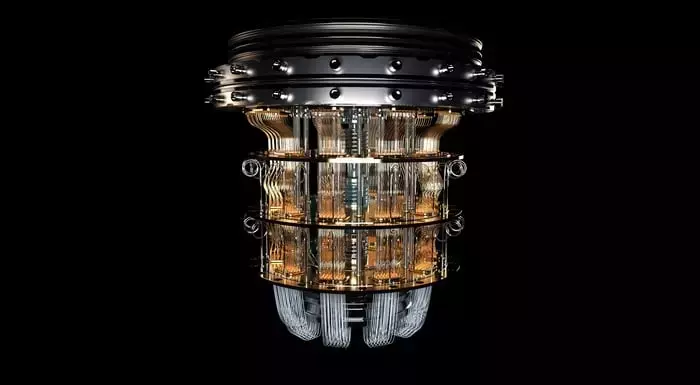
IonQ is making significant strides in the burgeoning field of quantum computing, a sector poised to redefine technological capabilities. The company's unique trapped-ion approach offers unparalleled accuracy, setting it apart from many competitors. This advanced fidelity is crucial as the industry grapples with the inherent challenges of quantum computation, particularly in minimizing error rates. By establishing an early lead in this critical area, IonQ seeks to position itself as a foundational technology provider, much like Nvidia did with its GPUs in the AI revolution. The potential for quantum computing to enhance artificial intelligence is immense, promising breakthroughs in complex problem-solving and energy efficiency, especially when integrated with traditional computing architectures. However, for IonQ to truly become a market leader, it must navigate the path to commercial viability and widespread adoption, ensuring its cutting-edge technology translates into tangible, impactful applications across various industries.
IonQ: Charting a Course to Quantum Dominance
In a landscape increasingly dominated by artificial intelligence, the pursuit of more powerful and efficient computational methods has become paramount. Nvidia, through its specialized Graphics Processing Units (GPUs), achieved remarkable success over the last decade by providing the essential hardware for parallel processing, meeting the surging demand for AI computing. This has led to a phenomenal growth, transforming a $10,000 investment into millions. Today, the focus shifts to quantum computing, a transformative technology believed to hold the key to unlocking even greater AI capabilities.
IonQ, distinguished as the first publicly traded pure-play quantum computing enterprise, has garnered considerable investor attention. The company’s core innovation lies in its trapped-ion technology, which boasts world-record accuracy in qubit fidelity tests. While traditional computers operate with an error rate of approximately one in a quintillion calculations, current quantum machines struggle with rates closer to one in 100,000. IonQ’s achievements, with a 99.999% fidelity for 1-qubit and 99.97% for 2-qubit gate operations, place it an order of magnitude ahead of its rivals, who typically achieve fidelity in the 99% to 99.9% range. This significant lead in accuracy could be the decisive factor in accelerating the commercialization of quantum computers. Although trapped-ion technology currently exhibits slower processing speeds compared to superconducting qubit systems favored by other competitors, its superior accuracy might be more appealing to early adopters prioritizing reliability over sheer speed.
The strategic imperative for IonQ is to secure a dominant market position during the nascent stages of quantum computing's commercial adoption. Nvidia's early lead in GPU technology, coupled with robust software ecosystems, allowed it to capture over 90% of the data center market for AI workloads, despite the presence of alternative chip manufacturers like AMD. IonQ aims to replicate this success by being the leading technology provider when quantum computing transitions from experimental to mainstream. The potential impact extends to hybrid quantum-classical AI systems, where IonQ’s quantum processors could synergistically combine with conventional hardware, such as Nvidia’s GPUs, to significantly enhance performance and drastically reduce energy consumption – a critical factor for hyperscale AI operations. However, investors are advised to temper expectations, as the applicability of quantum computers, while revolutionary for certain tasks, is narrower than that of traditional computing. Nevertheless, if IonQ successfully commercializes its technology ahead of the competition and establishes market dominance, it holds the promise of substantial returns for patient stakeholders.
The emergence of IonQ in the quantum computing space highlights a pivotal moment in technological evolution. Its pursuit of accuracy over speed in quantum operations reflects a shrewd understanding of foundational technological development. Should IonQ succeed in pioneering a commercially viable quantum computer, it could indeed mirror Nvidia’s trajectory, profoundly impacting AI and various other fields by offering unprecedented computational power. This journey, however, demands sustained innovation and strategic market penetration, promising an exciting, albeit challenging, future for the company and the broader tech industry.