Japanese Yen's Decades-Long Interest Rate Correlation Ends, Apollo Reports
Finance

Japanese Yen's Decades-Long Interest Rate Correlation Ends, Apollo Reports

authorBy Lisa Jing
DateAug 06, 2026
Read time3 min

For many years, a specific economic indicator, the difference between US and Japanese interest rates, reliably signaled the direction of the Japanese Yen (JPY). However, according to Apollo Global Management, this long-standing relationship has recently dissolved. Torsten Slok, the Chief Economist at Apollo, highlights that since April 2025, the yen's movement is no longer primarily driven by this interest rate differential but rather by Japan's escalating debt burden. This fundamental shift disrupts a decades-old rule that currency traders relied upon.

The traditional "yen carry trade" involved investors borrowing yen at minimal interest rates and investing in dollar-denominated assets that offered significantly higher returns, profiting from the spread. This mechanism ensured a direct correlation: a widening interest rate gap weakened the yen, while a narrowing gap strengthened it. Apollo's data clearly illustrated this synchronicity from January 2021 until the abrupt change. Slok attributes this divergence to the widespread US tariffs introduced on April 2, 2025, which led to increased market volatility and rendered the carry trade unprofitable.

The core issue is that even a brief, sharp appreciation of the yen can negate an entire year's worth of carry trade profits, compelling traders to reduce their exposure despite a persistent wide-interest rate gap. Further complicating matters, the Bank of Japan, on July 31, maintained its policy rate at approximately 1%, albeit with one board member advocating for a higher rate of 1.25%. Such hawkish dissent signals that the profitability of borrowing in yen may further diminish, impacting market sentiment.

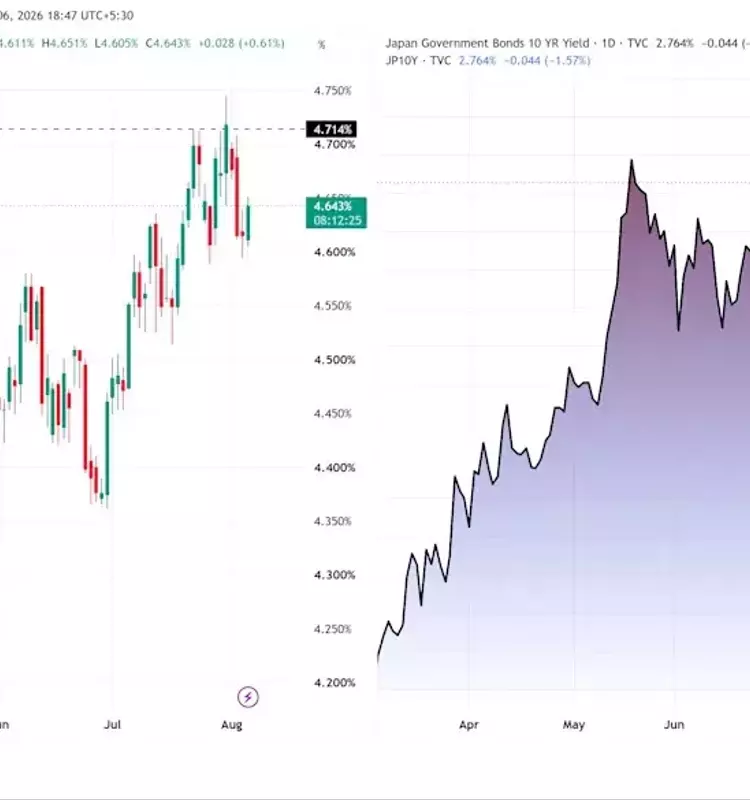
The breakdown of this historical correlation is particularly evident when examining recent yield data. On August 6, the US 10-year Treasury yield stood at 4.64%, while Japan's 10-year bond yield was 2.76%, resulting in an approximate 1.8% gap. This gap is considerably smaller than the nearly three percentage points observed when the US tariffs were imposed. Conventionally, a reduced US yield advantage should bolster the yen; instead, the currency depreciated significantly, reaching about 164 yen per dollar in late July, its lowest level in forty years, before stabilizing around 157.9 yen per dollar.

A closer look at Japan's financial situation reveals the new dominant factor: its national debt. The fiscal 2026 budget, totaling a record ¥122.31 trillion ($774.5 billion), allocates a substantial ¥31.28 trillion ($198.08 billion) to debt servicing, also a new high. Critically, the government now projects a long-term interest rate of 3.0%, a significant increase from 2.0% just a year prior, indicating an anticipation of higher borrowing costs. Given the central government's debt, which reached ¥1,343.8 trillion ($8.51 trillion) by March 31, even minor fluctuations in yields can have substantial financial repercussions. Prime Minister Sanae Takaichi maintains that the debt-financed spending will lead to a primary balance surplus, the first since 1998, despite relying on ¥29.58 trillion ($187.3 billion) in new borrowing.

The market's previous reliance on interest rate differentials as a primary indicator for the yen's performance has given way to a new reality, where Japan's fiscal health and burgeoning national debt are the principal drivers. This profound shift, as articulated by Apollo's Chief Economist Torsten Slok, suggests that until market volatility subsides, the yen will remain tethered to Tokyo's financial outlook rather than Washington's interest rate policies. This re-evaluation of the yen's determinants has significant implications for global currency markets and investment strategies.

More Articles
Finance
U.S. Oil Production Trends: A Deep Dive into EIA's Latest Forecasts
U.S. oil production experienced a decline in May, primarily due to a significant drop in the Gulf of Mexico, despite a slight increase in New Mexico. Future forecasts predict a period of stagnation followed by a modest recovery, influenced by evolving WTI prices and regional drilling activities. This analysis draws on EIA's Petroleum Supply Monthly data and STEO projections.
By Nouriel RoubiniAug 06, 2026
Finance
Hartford International Opportunities Fund Navigates Dynamic Global Equity Landscape in Q2
The Hartford International Opportunities Fund (I Share) experienced underperformance relative to the MSCI ACWI ex USA Index during the second quarter, despite a strong rebound in international equities. This rebound was fueled by improved risk appetite, robust corporate earnings, and sustained investment in AI. While selection within financials and materials provided some positive contributions, weak stock picks in the industrials and utilities sectors primarily drove the fund's relative underperformance against its benchmark.
By Lisa JingAug 06, 2026
Finance
Sanofi: Navigating Challenges and Opportunities in the Pharmaceutical Landscape
Sanofi, a prominent pharmaceutical company, faces market scrutiny following recent pipeline setbacks. Despite these challenges, its flagship drug Dupixent remains a key growth driver, targeting €25 billion in sales by 2030, though it faces biosimilar competition post-2031 and significant litigation risks. New pharmaceutical launches and pipeline assets are expected to counteract the decline of older products, aiming for €10 billion in 2030 sales and potential margin expansion to 40%. An analyst suggests a bull call spread strategy for Sanofi, anticipating a substantial return if the stock rises by 28-29%, while acknowledging the importance of managing risk associated with the Dupixent lawsuit.
By Michele FerreroAug 06, 2026
Finance
Unlocking the Potential of Humanoid Robotics: A Deep Dive into Technology and Investment
This article explores the intricate engineering behind humanoid robots, dissecting the three core components essential for their functionality: the 'brain' for spatial awareness, the 'body' for human-like movement, and 'energy' for sustained operation. It highlights how their human-mimicking design enables seamless integration into human environments, making them ideal for diverse applications from household chores to industrial tasks. The piece also touches upon the burgeoning humanoid market and offers insights into investment avenues, particularly through indices like the ROBO Global Robotics and Automation Index.
By Morgan HouselAug 06, 2026
Finance
Meta Platforms: A Deep Dive into its AI Transformation and Future Outlook
This analysis re-evaluates Meta Platforms, Inc. (META), upgrading its rating to "Strong Buy." The article highlights Meta's significant transformation into a diversified AI-driven entity, extending beyond its traditional advertising business. It explores how Meta utilizes AI to enhance ad revenue, optimize pricing strategies, and improve operational efficiency. Furthermore, it details the company's initiatives in launching new AI-powered products and services for its vast 3.6 billion user base. Despite substantial capital expenditures and projected negative free cash flow through fiscal year 2028, Meta's robust ad business, which saw a 27% year-over-year growth and record average revenue per person, alongside its innovation in AI and new enterprise offerings, underpins a bullish investment perspective. The author, an experienced risk management business analyst, emphasizes a data-driven approach to investment analysis.
By Suze OrmanAug 06, 2026