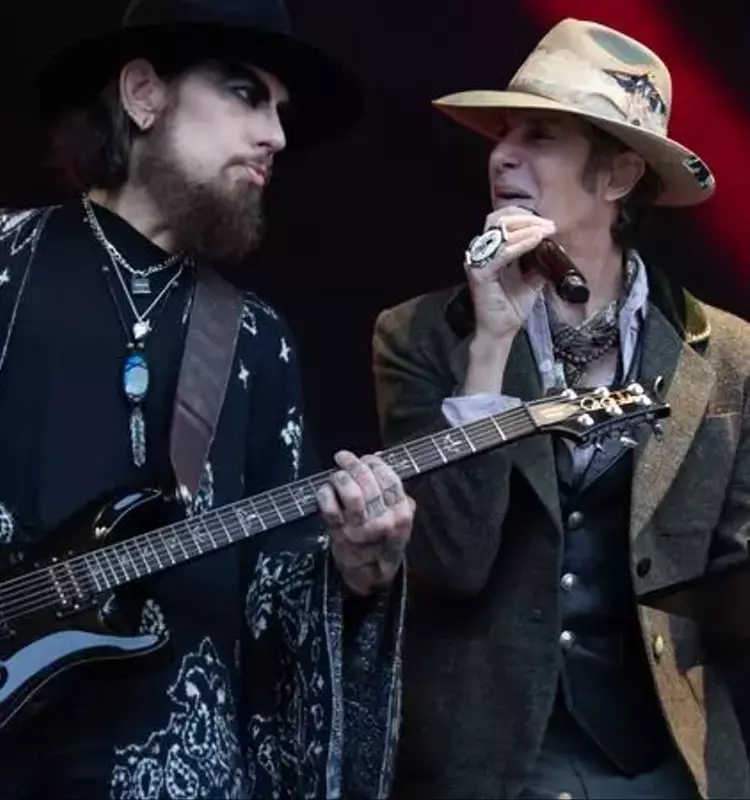
Legal Tangle Ensues Between Jane's Addiction Members Over Onstage Altercation and Tour Cancellation
A deep chasm has emerged within the legendary rock band Jane's Addiction, as frontman Perry Farrell has initiated a comprehensive legal action against his bandmates, guitarist Dave Navarro, bassist Eric Avery, and drummer Stephen Perkins. This move comes as a direct counter to an earlier lawsuit filed by Navarro, Avery, and Perkins, who alleged various misconducts against Farrell. The core of this bitter dispute revolves around an incident that transpired during a concert in Boston and the subsequent abrupt halt of the band's much-anticipated reunion tour, leaving fans and the industry in a state of bewilderment.
The initial legal challenge from Navarro, Avery, and Perkins cited accusations against Farrell ranging from assault and battery to the intentional infliction of emotional distress, negligence, breach of fiduciary duty, and breach of contract. Their complaint specifically highlighted a tumultuous onstage confrontation between Navarro and Farrell during a Boston performance, an event they claim directly led to the band's current fractured state and the termination of their tour engagements.
Responding with his own legal offensive on July 16 in Los Angeles County Superior Court, Farrell, alongside his wife, Etty Lau Farrell, and the band’s touring entity, Wilton's Hilton Inc., has levied charges of assault and battery, intentional and negligent infliction of emotional distress, and breach of contract against his fellow musicians. Farrell's legal team has articulated a narrative of persistent harassment and undermining by Navarro, Avery, and Perkins, characterizing it as a 'years-long bullying campaign.' This alleged campaign involved attempts to disrupt his vocal performance by playing their instruments at excessive volumes, forcing Farrell to dangerously amplify his in-ear monitors.
Farrell’s complaint zeroes in on the Boston show, specifically Friday, September 13, 2024, as a critical turning point. He asserts that Navarro's "top volume" playing was intentionally disruptive and painful, pushing him to a 'breaking point.' Farrell clarified that his physical reaction—a body check against Navarro—was not an act of aggression but a desperate attempt to signal Navarro to reduce his volume. He maintains that Navarro and Avery’s subsequent backstage reaction, described as a 'menacing charge' and 'aggressive assault' against both Farrell and his wife, was a disproportionate and unwarranted escalation of the situation.
Beyond the personal altercations, Farrell's lawsuit also contends that Navarro, Avery, and Perkins unilaterally decided to cancel the Jane's Addiction reunion tour without his consultation, leaving him 'blindsided' by what he describes as 'ill-conceived decisions utterly lacking in legal authority.' He emphasizes his readiness and willingness to continue the tour, driven by a desire to avoid disappointing the devoted fanbase who had purchased tickets for the remaining dates. Farrell alleges that the decision to cancel rested solely with the defendants, who proceeded without his input or agreement, causing significant emotional distress and financial damages.
Perry and Etty Lau Farrell are seeking substantial compensation for physical injuries resulting from the alleged assault and battery, as well as for severe emotional distress and mental suffering, in addition to medical and related expenses. This legal confrontation underscores the deep-seated discord within Jane's Addiction, painting a bleak picture of internal strife that has not only affected the band's immediate future but also cast a shadow over their long-standing legacy.
The unfolding legal saga within Jane's Addiction highlights a complex web of personal and professional grievances that have escalated into formal litigation. With both sides presenting accusations of assault, emotional distress, and breach of contract, the outcome of these lawsuits will not only determine the future of the band's touring and collaborative potential but also bring to light the profound challenges that can arise even among established musical collectives.