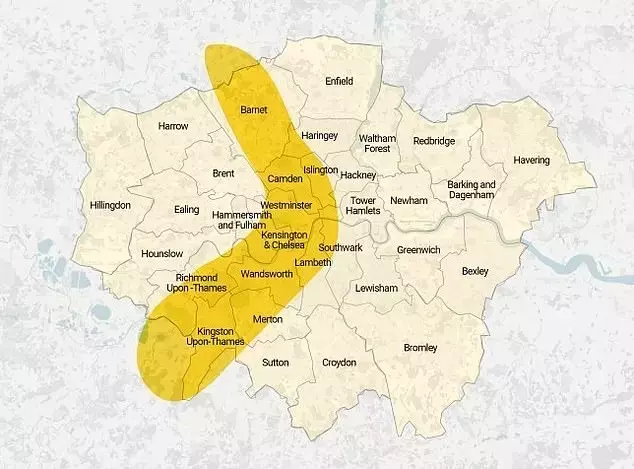
A new study from Rightmove suggests a significant divergence in what constitutes London's most desirable residential locations, challenging the popular 'London banana' concept. This research indicates that while certain affluent areas within the 'banana' remain attractive, a broader array of more accessible and affordable neighborhoods, metaphorically shaped like a 'pear,' are actually drawing the highest volume of home-seekers. This phenomenon points to a growing emphasis on practical considerations such as cost and value among those looking to purchase property in the capital, rather than solely focusing on traditionally prime districts.
The notion of the 'London banana' gained traction after a controversial diagram circulated online, purporting to delineate the city's most pleasant and secure zones based on housing costs and crime statistics. However, this theory faced considerable skepticism, particularly from residents of well-regarded areas like Chiswick, Dulwich, and Stoke Newington, which were excluded from the 'banana's' supposed boundaries. Rightmove's recent data further disputes this, highlighting that a mere two of the top ten most inquired-about London locales for potential buyers fall within the 'banana's' confines. Many of these popular areas are located several miles beyond, forming a pattern that more closely resembles a 'pear,' especially when accounting for distant locales such as Romford, situated approximately fourteen miles northeast of Charing Cross.
According to Colleen Babcock, a property specialist at Rightmove, the primary allure of these emerging 'pear' regions lies in their greater affordability, a characteristic often absent in the 'banana's' high-end postcodes. This suggests that while viral trends may capture public imagination, the reality of buyer demand is driven by tangible opportunities and better value. The top spot for home buyers, for instance, is the Docklands in East London, with an average asking price notably lower than the city's overall average. Hackney and Islington follow, with the latter being one of the few 'banana' areas to make the top ten, alongside Battersea. However, the majority of the 'pear' locations, including Sutton, Croydon, Walthamstow, and Romford, offer significantly more budget-friendly options.
Matt Thompson, a sales director at Chestertons, a London real estate agency, notes the dynamic nature of the current London housing market. He observes that while some traditional prime areas continue to be sought after, buyers are increasingly willing to expand their search radius to find properties that meet their needs and budget. This shift is partly attributed to first-time buyers entering the market at a later age (around 33 in London, according to TSB) and often seeking larger family homes from the outset, thus making more affordable outer London areas more appealing. Thompson also points out that these previously overlooked areas have evolved, now boasting desirable amenities, albeit leading to a certain homogeneity across different neighborhoods.
Dominic Agace, CEO of Winkworth, an estate agency with numerous London offices, acknowledges that individual preferences largely define what constitutes a 'desirable' area. Historically, Western London was favored due to industrial developments in the east, which led to smog being carried away by prevailing winds. However, this is no longer the case, and many young people are now drawn to East London for its lower costs and vibrant cultural scene, prioritizing these over traditional architectural charm or established parklands. Agace suggests that Rightmove's 'pear' map might even forecast future desirable areas, as these currently more affordable locations attract a younger demographic, fostering the vitality that could eventually place them among London's most sought-after neighborhoods.
The evolving preferences in London's property market reflect a pragmatic response to economic realities, with affordability becoming a central driver for many aspiring homeowners. The emergence of the 'London pear' as a preferred residential model over the 'London banana' underscores a fundamental shift in what buyers prioritize: value, space, and a vibrant local community, even if it means venturing beyond the city's traditionally recognized affluent enclaves.