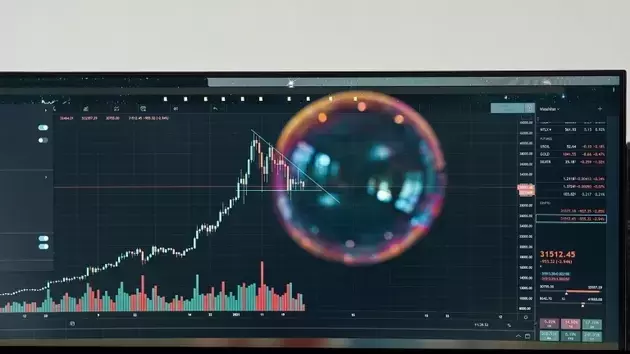
The financial markets are currently displaying multiple red flags that historically precede significant downturns, prompting serious concerns among investors. Elevated Shiller PE ratios, unprecedented levels of margin debt, and a noticeable decline in free cash flow among prominent technology companies like Alphabet and Tesla are all contributing to a growing sense of unease. Furthermore, the semiconductor sector's ballooning market capitalization is reminiscent of past speculative bubbles, suggesting that the current market environment may be characterized by unsustainable growth fueled by excessive optimism rather than fundamental strength. These converging indicators paint a picture of an overheated market potentially on the brink of a correction.
One of the most striking warning signs is the Shiller PE ratio, which measures cyclically adjusted price-to-earnings. This metric, currently at historically high levels, has often served as a reliable predictor of future market performance. A high Shiller PE ratio suggests that asset prices are significantly overvalued relative to their long-term earnings, implying that future returns may be subdued or even negative. Compounding this concern is the record-high margin debt, which indicates that investors are increasingly borrowing money to purchase stocks. While margin debt can amplify gains during a bull market, it also magnifies losses during a downturn, posing a systemic risk to market stability.
Adding to the apprehension is the financial performance of tech giants. Alphabet (GOOG) recently reported its first negative free cash flow since its initial public offering, a staggering $5.9 billion, primarily due to a massive $15 billion increase in capital expenditures aimed at artificial intelligence development. Similarly, Tesla (TSLA) experienced a negative free cash flow of $1.1 billion, with its capital expenditures tripling. This trend of deteriorating cash generation, driven by aggressive spending on AI and other advanced technologies, raises questions about the sustainability of these companies' growth models and their ability to deliver consistent shareholder value in the long run.
The semiconductor sector's expanding influence on the overall market is another critical area of concern. Its market weighting has surged from a mere 4% to an astounding 20%, a rapid increase that mirrors the speculative excesses seen in previous market bubbles. This concentration of capital in a single sector, often driven by a narrative of transformative technology like AI, creates a vulnerability where any negative shift in sentiment or fundamentals within this sector could trigger a broader market correction. The historical parallels are clear: such intense focus on a narrow group of assets has rarely ended well for investors.
The confluence of these market signals—elevated valuations, high leverage, and a shift in corporate financial health, particularly within a rapidly expanding technology sector—warrants a cautious approach from investors. The current landscape suggests that underlying economic realities may not support the prevailing market optimism, making it imperative for market participants to re-evaluate their positions and consider strategies to mitigate potential risks in what appears to be an increasingly fragile environment.
