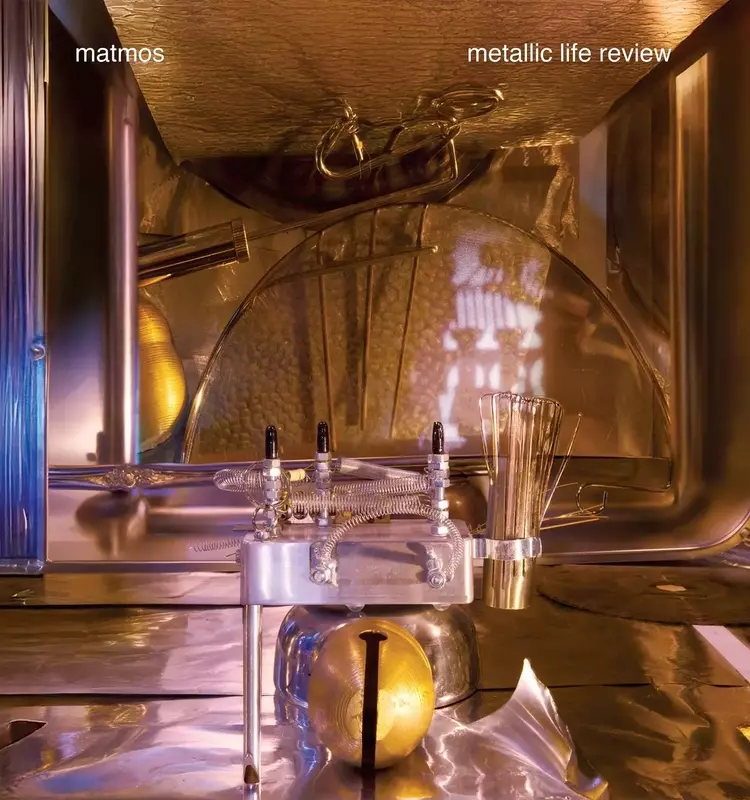
Matmos, the avant-garde electronic duo, has once again pushed the boundaries of musical composition with their latest release, \"Metallic Life Review.\" This album marks a fascinating continuation of their long-standing practice of extracting unique sounds from unconventional sources, this time focusing exclusively on the vast sonic landscape offered by metallic objects. The project is not merely an auditory exploration but also weaves in subtle thematic elements, prompting listeners to contemplate existence and memory through the lens of a \"life review.\"
This innovative work follows in the footsteps of their critically acclaimed \"Plastic Anniversary,\" which similarly transformed everyday materials into intricate soundscapes. However, \"Metallic Life Review\" distinguishes itself by its profound engagement with the inherent musicality of metal. Far from being a chaotic compilation of industrial noises, the album deftly showcases the spectrum of sounds that can be coaxed from various metallic forms, from the jarring clang of \"The Rust Belt\" to the unexpectedly soulful creaks of a Norwegian door hinge. The album also takes a significant compositional leap, moving beyond mere sound collage to forge a cohesive and immersive listening experience.
Sonic Alchemy: Transforming Metal into Music
Matmos's \"Metallic Life Review\" is an audacious sonic journey that redefines our perception of sound. The duo, renowned for their inventive use of found objects, dedicates this album to the acoustic potential of metal. They meticulously record and manipulate sounds from a diverse array of metallic items, ranging from humble cheese graters and nitrous oxide canisters to more conventional instruments like gongs, cymbals, and glockenspiels. This innovative approach allows them to craft intricate soundscapes that are both challenging and captivating, revealing the hidden musicality within the everyday and the industrial. The album's compositions are not merely experimental but are carefully structured, showcasing a deep understanding of rhythm and melody that transcends the raw nature of their sound sources. This album echoes the spirit of their previous works, demonstrating their consistent commitment to exploring the untapped sonic possibilities of the world around us.
The album’s creative process involves the extensive sampling of a vast array of metallic objects, some collected over the band’s entire career, resulting in a rich sonic tapestry. Tracks like \"The Rust Belt\" pulsate with the raw, percussive energy characteristic of industrial sound, yet Matmos manages to imbue these seemingly harsh sounds with a compelling rhythmic drive. Conversely, pieces like \"Norway Doorway\" demonstrate a surprising melodicism, transforming the jarring squeaks of a door hinge into something reminiscent of a soulful saxophone through clever contextualization and layering with other instruments, such as Thor Harris's percussive contributions. Similarly, \"Steel Tongues\" showcases how the rattling of a cemetery gate can lose its ominous quality when set against a lullaby-like melody played on a glockenspiel by Owen Gardner. This transformative ability to find beauty and musicality in unexpected places is a hallmark of Matmos's artistry. Their inspiration draws from industrial pioneers like Einstürzende Neubauten, but also from avant-garde composers like Harry Partch, who crafted delicate and complex pieces from artillery shells and bomber nose cones, demonstrating Matmos's wide-ranging influences and their capacity to synthesize them into something uniquely their own.
Compositional Innovation and Thematic Resonance
Beyond its unique sound sources, \"Metallic Life Review\" represents a significant evolution in Matmos's compositional approach. The album's centerpiece, a twenty-minute, multi-part title track, illustrates this shift. Unlike their usual method of piecing together pre-recorded segments on a laptop, this ambitious track was born from live, in-studio improvisation, echoing the raw spontaneity of Throbbing Gristle's \"Heathen Earth.\" This departure from fixed digital grids allows for a more organic and fluid development, building percussive intensity, transitioning into contemplative moments with church bells, and ultimately culminating in a powerful, noisy crescendo. This reflects a deeper engagement with the performance aspect of their music, allowing the inherent qualities of the metallic instruments to guide the creative process in real-time, resulting in a more visceral and dynamic listening experience for the audience.
The album's title, \"Metallic Life Review,\" initially appears to be a conceptual framework that might be overshadowed by the sheer weight of its metallic sonic palette. However, it takes on a profound, even poignant, significance as the recording process concluded. The phrase \"life review\" refers to the autobiographical panorama that flashes before one's eyes at the moment of death, and this deeply personal connotation unexpectedly resonated with the tragic passing of collaborators Susan Alcorn, a renowned pedal steel guitarist, and David Lynch, to whom \"The Chrome Reflects Our Image\" is dedicated, both in January 2025. This unforeseen turn of events imbues the album with an additional layer of meaning, transforming it into a poignant, albeit makeshift, memorial. Matmos, through this work, engage in a therapeutic process of self-reflection and remembrance, honoring their journey, their friendships, and their artistic inspirations. The album becomes a brilliant, mirror-like surface reflecting their career and influences, demonstrating how sound, even from inanimate objects, can evoke deep personal and collective narratives.