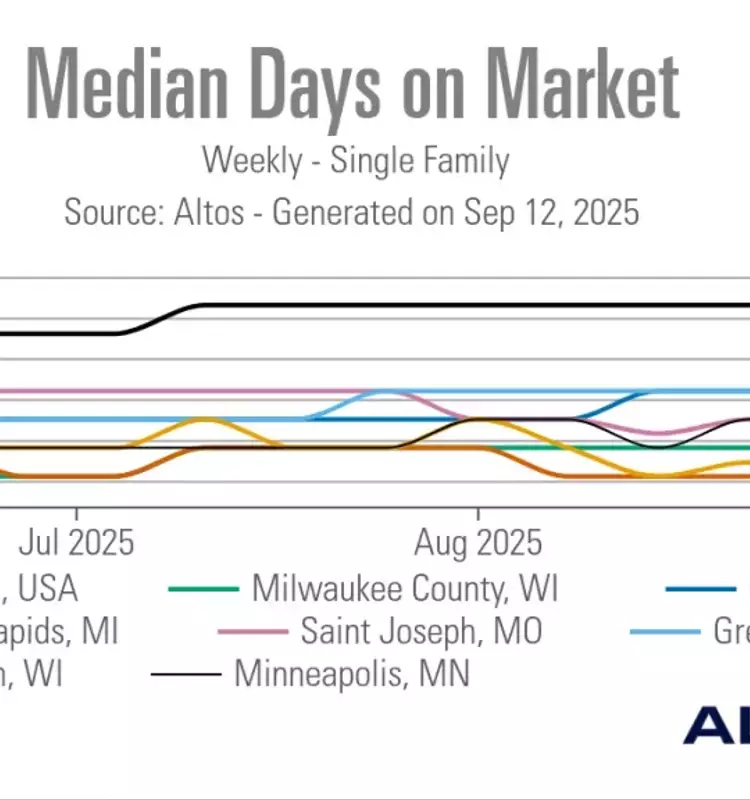
Midwest Housing Markets Outperform National Average in Speed of Sales
Loan

Midwest Housing Markets Outperform National Average in Speed of Sales

DateSep 12, 2025
Read time3 min

Midwestern housing markets are exhibiting notable resilience, contrasting with national trends of extended property sales timelines. Data indicates that homes in prominent Midwestern urban centers are selling at a pace up to 83% quicker than the country's average.

An in-depth examination of housing market statistics from September 2025 reveals a considerable difference in sales velocity. While the national median for single-family homes remains at 63 days on the market, the typical Midwestern property sells in approximately 23.8 days, representing a 56.5-day advantage. Grand Rapids, Michigan, exemplifies this trend, with homes selling in just 9.6 days, significantly outpacing the national rate. Minneapolis, Minnesota, closely follows at 9.9 days, and Milwaukee, Wisconsin, also demonstrates rapid sales, with properties typically moving within 14.6 days. This efficiency extends beyond individual cities, with states like Minnesota, Wisconsin, Michigan, Kansas, and Missouri all showing properties selling considerably faster than the national average, indicating a pervasive regional strength. Even the slower markets within the Midwest, such as Saint Joseph, Missouri, with a 43.3-day average, still outperform the national pace by a significant margin.

These accelerated market conditions carry crucial implications for various real estate stakeholders. Mortgage lenders, for instance, must adapt to streamlined approval processes to remain competitive, given that some properties transition from listing to pending in as little as seven days. Real estate professionals are advised to adjust their operational strategies, prioritizing immediate marketing and showing availability in cities like Milwaukee and Grand Rapids where buyer interest windows are compressed. Notably, this rapid sales pace is not merely a function of lower price points; cities like Milwaukee and Minneapolis maintain quick sales despite median home prices exceeding $500,000, underscoring the market's fundamental strength rather than just affordability. A 90-day trend analysis further solidifies this observation, suggesting that the Midwest's market advantage is structural and enduring, not merely a cyclical fluctuation. While national Days on Market figures have seen an increase, the Midwest has consistently sustained its accelerated selling pace, a divergence that is projected to continue, potentially widening, as seasonal factors typically impact coastal markets more severely than their Midwestern counterparts.

The sustained vigor of the Midwest housing market underscores a broader narrative of regional economic robustness and adaptability. This consistent performance, characterized by rapid sales and sustained property values, fosters a positive environment for homeowners, investors, and industry professionals. It highlights the importance of localized market analysis and strategic agility in navigating diverse real estate landscapes, ultimately contributing to stable growth and prosperity within the region.

More Articles
Trump Administration's Fannie Mae and Freddie Mac IPO Plans Spark Debate
The Trump Administration is moving forward with plans for an initial public offering (IPO) of Fannie Mae and Freddie Mac, aiming to partially privatize the government-sponsored enterprises (GSEs) currently under conservatorship since the 2008 financial crisis. While U.S. Department of Commerce Secretary Howard Lutnick suggested a possible IPO this year, emphasizing the value these assets hold for taxpayers, the proposal has drawn mixed reactions, particularly regarding potential mergers and their impact on market competition and systemic risk.
Sep 12, 2025
Mortgage Payments Soar by 47% in Five Years, Exceeding £1,000 for the First Time
Homeowners are grappling with a significant surge in mortgage payments, which have increased by 47% over the past five years, pushing the average monthly cost beyond £1,000. Data reveals that August saw average repayments reach £1,002.27, a substantial rise from previous years. This escalation is attributed to expiring fixed-rate deals and rising borrowing costs, putting immense pressure on household budgets across the nation. Many lenders are hiking rates, and forthcoming property tax changes are adding to market uncertainty.
Sep 12, 2025
MBA CEO Warns Against Fannie Mae and Freddie Mac Merger, Emphasizes Competition Benefits
Mortgage Bankers Association CEO Bob Broeksmit voiced strong opposition to a potential merger or stock offering for Fannie Mae and Freddie Mac. He argued that competition between the two government-sponsored enterprises is crucial for a healthy U.S. housing finance system, fostering innovation, improving service, and mitigating systemic risks. Broeksmit highlighted that a unified entity could lead to a monopoly, undermining the existing benefits for lenders and borrowers.
Sep 12, 2025
Jordana Leigh Joins Christie's International Real Estate Southern California
Jordana Leigh, a renowned figure in the luxury and celebrity real estate market, has officially joined Christie's International Real Estate Southern California. With a career sales volume exceeding $5 billion, Leigh brings extensive experience and a prestigious client list, including high-profile celebrities. Her move is expected to further enhance the brokerage's strong presence in the Southern California luxury market, aligning with her commitment to innovation and exceptional client service.
Sep 12, 2025
Home Equity Trends: Growth Stalls as Negative Equity Rises in Q2 2025
A new report reveals that the average U.S. mortgage holder boasts over $300,000 in home equity, a substantial increase since the pandemic. However, the second quarter of 2025 saw a slight decline in this figure, leading to a marginal rise in properties with negative equity. Despite regional variations, overall home equity levels remain historically high.
Sep 12, 2025