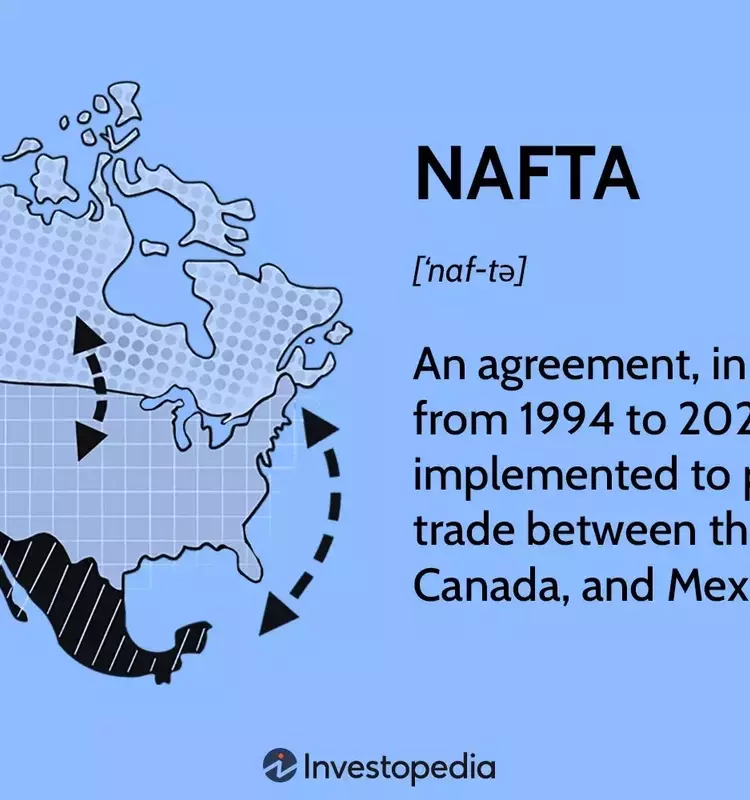
The North American Free Trade Agreement (NAFTA), effective from 1994 to 2020, aimed to boost trade by eliminating tariffs among the U.S., Canada, and Mexico. Replaced by the USMCA in 2020, the new agreement introduced stricter labor and environmental rules. While NAFTA significantly increased trade and investment, it faced criticism for job displacement and wage disparities, particularly in the U.S. manufacturing sector. The USMCA seeks to address these concerns by updating provisions on digital trade, labor rights, and intellectual property, reflecting the evolving economic landscape and aiming for more equitable growth across the region.
The North American Free Trade Agreement: Objectives and Development
The North American Free Trade Agreement (NAFTA) was a landmark accord designed to foster economic integration among the United States, Canada, and Mexico. Initiated in 1994, its primary objective was to dismantle trade barriers, including tariffs on a wide array of goods such as agricultural products, textiles, and automobiles. Over time, these tariffs were systematically phased out, culminating in their near-complete elimination by 2008. Beyond tariff reduction, NAFTA also sought to standardize trade regulations, improve working conditions, establish a secure market for North American products and services, and generally promote global commerce and collaboration. Proponents argued that by aligning Mexico's economy with those of the more developed U.S. and Canada, the agreement would stimulate Mexico's economic expansion and benefit all member nations through increased trade and reduced costs.
The genesis of NAFTA can be traced back to the George H.W. Bush administration's Enterprise for the Americas Initiative, building upon an existing free trade agreement between the U.S. and Canada from 1989. Negotiations to include Mexico began three years later. The Clinton administration, which oversaw NAFTA's implementation, projected substantial job creation in the U.S., anticipating 200,000 new jobs within two years and a million within five, driven by the belief that exports were a crucial engine for American economic growth. Mexico and Canada have since become vital trading partners for the U.S., accounting for a significant portion of its imports and exports. The agreement's framework included supplementary accords, the North American Agreement on Environmental Cooperation (NAAEC) and the North American Agreement on Labor Cooperation (NAALC), intended to prevent companies from exploiting weaker labor and environmental standards in any member country. Additionally, NAFTA established dispute resolution mechanisms and contained administrative, civil, and criminal penalties for violations of trade laws, aiming to create a stable and predictable trading environment.
Evolution to USMCA: Addressing Challenges and Modernizing Trade
Despite its successes in increasing trade and investment, NAFTA faced considerable criticism, particularly regarding job displacement and the widening wage gap between the U.S. and Mexico. Many manufacturing jobs, especially in the automotive and textile sectors, shifted to Mexico due to lower labor costs, although the extent to which NAFTA was solely responsible for these shifts remains a subject of debate. Critics also pointed to the failure of U.S. and Mexican wages to converge as expected, leading to continued Mexican immigration to the U.S. These concerns prompted a reevaluation of the agreement, culminating in its replacement by the United States-Mexico-Canada Agreement (USMCA) in 2020. The USMCA aimed to rectify perceived shortcomings and modernize the trade relationship, reflecting changes in the global economy and technology since NAFTA's inception.
The USMCA, which came into effect on July 1, 2020, retained many of NAFTA's foundational principles but introduced several key updates. It expanded the tariff ban to include new technologies and industries, such as digital music and e-books, and established copyright safe harbors for internet companies. Crucially, the USMCA integrated labor and environmental protections, previously separate side agreements under NAFTA, directly into the main text, making these provisions subject to the agreement's dispute settlement procedures. This change notably strengthened labor rights, particularly in Mexico, by establishing an independent investigatory panel to address violations and compelling Mexico to implement comprehensive labor reforms, including improving working conditions and increasing wages. The USMCA also introduced a sunset clause, requiring a review after six years and expiring after 16 years unless extended by all three parties, providing a mechanism for periodic re-evaluation and adaptation to future economic conditions. Additionally, the agreement updated rules of origin for automobiles, increased intellectual property protections, and revised provisions concerning pharmaceuticals and dairy markets, reflecting a concerted effort to create a fairer and more robust trade framework for North America.
