Mastering Market Volatility: Strategies for a Falling Knife Scenario
Understanding the "Falling Knife" Phenomenon: Definition and Implications
A "falling knife" vividly describes a financial asset experiencing a sudden and dramatic price plunge. This term acts as a stark warning to investors, highlighting the extreme danger of attempting to acquire an asset precisely when its value is plummeting, akin to trying to catch a sharp object mid-air. The allure of purchasing at what appears to be a rock-bottom price can be strong, but the associated risks are equally substantial.
The Dangers and Potential Rewards of Trading During a Sharp Downturn
The inherent danger of a falling knife lies in its downward momentum, which can continue far beyond initial expectations. However, for astute traders, these dramatic drops can also present unique opportunities. If an investor can accurately pinpoint the absolute lowest point of a downturn, substantial profits are possible as the asset's price eventually recovers. Similarly, adopting a short-selling strategy during the descent can be lucrative, provided the trader exits before any significant rebound. Even long-term investors might view a falling knife as an opportune moment to acquire fundamentally sound assets at a discount, as long as their investment thesis remains intact despite the short-term volatility.
Strategic Approaches to Navigating a Falling Knife Market
Successfully navigating a falling knife requires more than just identifying a rapidly declining stock; it demands a sophisticated understanding of market dynamics and a suite of analytical tools. Traders are strongly advised against impulsively buying into a falling market. Instead, they should diligently seek confirmation of a trend reversal through various technical indicators and chart patterns. This could involve observing several consecutive days of upward price movement or consulting tools like the Relative Strength Index (RSI) for signs of a robust uptrend before making a purchase. Such confirmations help mitigate the risk of premature entry and potential losses.
Exploring the Triggers Behind Sudden Price Declines
Several factors can precipitate a falling knife scenario. Corporate earnings reports often serve as catalysts; if financial results fall short of expectations, a company's stock can enter a steep decline until market equilibrium is re-established. Broader economic indicators, such as employment figures or policy decisions from bodies like the Federal Open Market Committee (FOMC), can trigger sharp market downturns if they suggest a negative economic outlook. Technical breakdowns, where an asset's price breaches crucial support levels, can also lead to rapid descents independent of fundamental news. Lastly, fundamental deterioration within a company, stemming from poor performance indicators, fraudulent activities, or reputational damage, can cause severe and sustained price drops.
A Practical Example: The Peril of Predicting Market Bottoms
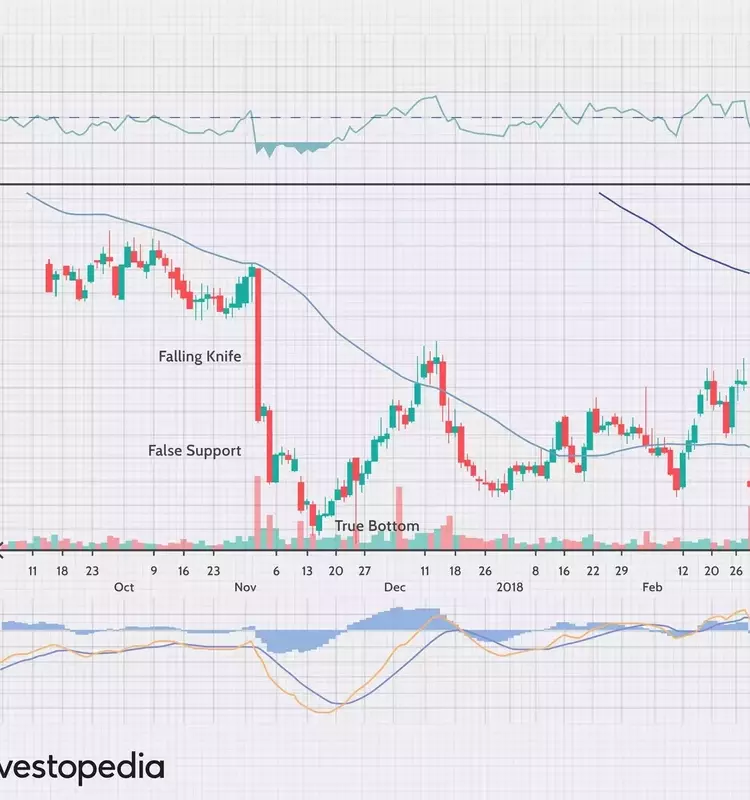
Consider a hypothetical stock chart where an asset, previously tracking its 50-day moving average, suddenly breaks away and begins a sharp decline. An investor attempting to buy at what they perceive to be an interim low, say at $8.50, might experience a brief stabilization before the price continues to fall to $6.00, resulting in significant losses. This example underscores the inherent difficulty and danger of trying to predict the exact bottom of a falling knife. Savvy traders, by contrast, might wait for clear signs of recovery, such as a confirmed uptrend from $6.00 to $10.00, before entering the market, thereby capitalizing on a more certain rebound.
Distinguishing Falling Knives from Price Spikes
While both terms describe abrupt market movements, a falling knife specifically refers to a sharp price decrease. A "price spike," on the other hand, broadly indicates a sudden and significant price change in either direction, though it is most commonly associated with a rapid upward surge.
The Complexities and Limitations of Falling Knife Trading
Despite the inherent risks, a sharp decline can sometimes signal a buying opportunity. However, capitalizing on these situations requires confirmation through indicators like a moving average convergence divergence (MACD) showing positive divergence. Ultimately, the "falling knife" is an imprecise chart pattern. It represents only one facet of a broader trading strategy that hinges on recognizing support breaches or genuine trend reversals. Trying to "catch" such an asset without robust confirmation often leads to substantial financial setbacks, highlighting the critical importance of careful analysis and strategic timing.
