Unlock Real Estate Riches: Mastering Net Operating Income
Understanding the Essence of Net Operating Income
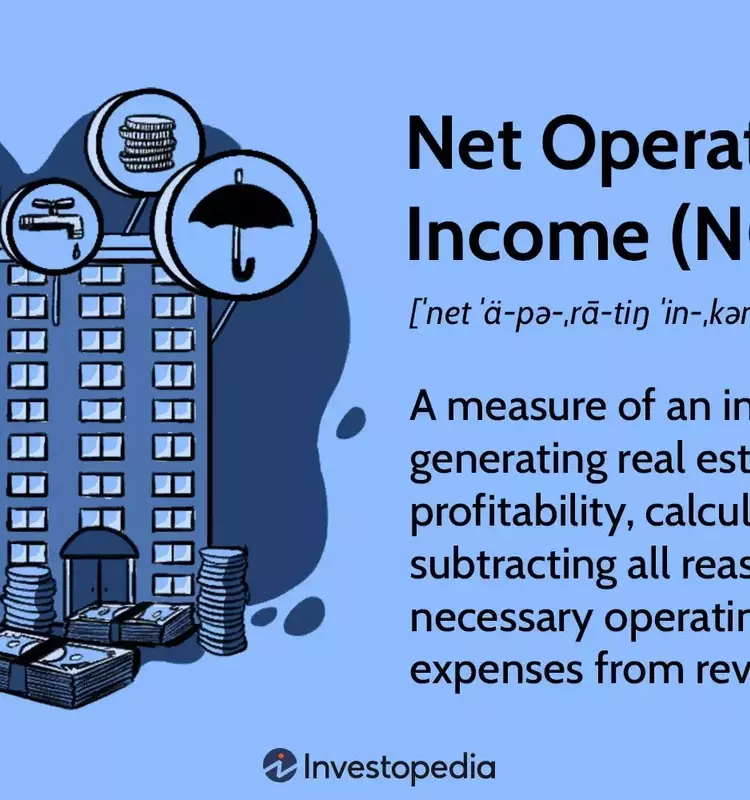
Net Operating Income (NOI) serves as a vital financial indicator, assessing the earning potential of revenue-generating real estate properties. It's determined by taking all earnings generated from a property and subtracting its essential operational expenditures. Notably, NOI represents a pre-tax figure, deliberately excluding principal and interest payments on loans, significant capital investments, depreciation, and amortization.
NOI's Illuminating Role for Property Investors
NOI critically examines the interplay between a property's total earnings and its complete operational outlays. Earnings include diverse sources such as rental payments, parking and storage fees, and income from on-site services like vending machines or laundry facilities. Operational outlays cover property upkeep, taxes, insurance premiums, property management charges, cleaning services, and utility costs. However, large-scale capital expenditures, like funding for a new building-wide air conditioning system, are not factored into NOI calculations.
NOI is instrumental in calculating the capitalization rate, which quantifies an investment property's profitability relative to its total acquisition cost. This rate, expressed as a percentage, helps investors objectively compare the potential returns across various properties.
For properties financed through loans, NOI also plays a key role in the debt coverage ratio (DCR). This ratio provides lenders and investors with insight into whether a property's earnings can adequately cover both its operational costs and debt obligations. Furthermore, NOI is utilized in determining the net income multiplier, cash return on investment, and overall return on investment.
An essential consideration: A property's capitalization rate is synonymous with its return on investment (ROI) in the real estate sector.
Dissecting the NOI Formula and an Illustrative Scenario
The formula for Net Operating Income is straightforward: Real Estate Revenue (RR) minus Operating Expenses (OE).
Consider a rental condominium with the following financial breakdown:
Revenue:
- Rental income: $20,000
- Parking fees: $5,000
- Laundry machines: $1,000
Total Revenues = $26,000
Operating Expenses:
- Property management fees: $1,000
- Property taxes: $5,000
- Repair and maintenance: $3,000
- Insurance: $1,000
Total Operating Expenses = $10,000
Based on these figures, the net operating income (NOI) is $26,000 - $10,000 = $16,000.
Exploring Real Estate Profit and Loss Dynamics
If a property owner generates $120,000 in revenues and incurs $80,000 in operational expenses, the resulting NOI is $40,000. Conversely, if expenses exceed revenues, leading to a negative total, this is termed a net operating loss (NOL).
Lenders and commercial financiers heavily depend on NOI to gauge a mortgaged property's income-generating capacity. NOI assists lenders in projecting a property's cash flows. For profitable properties, this metric also helps determine the loan amount they are prepared to offer. A mortgage application might be declined if a property indicates a net operating loss.
Property proprietors have some flexibility in managing operational costs, either by postponing certain expenses or accelerating others. NOI can also be enhanced by increasing rental fees and other charges while simultaneously reducing operational outlays. For instance, if an apartment owner waives a tenant’s annual $12,000 rent in exchange for property management services, valued at $30,000, the owner might deduct this cost from the revenue.
Distinguishing Net from Gross Operating Income
Net operating income estimates a property's potential earnings, but it does not account for financing costs like mortgage payments. NOI differs from gross operating income in that NOI is derived by subtracting operational expenses from gross operating income.
NOI's Application Across Diverse Sectors
The concept of NOI extends beyond real estate, finding application in other industries where it's known as EBIT (earnings before interest and taxes).
Defining an Optimal Net Operating Income Percentage
NOI is not a percentage but a quantitative figure that balances a property's revenues against its expenditures. It can be viewed in relation to the property's value, assuming a cash acquisition. In this context, a higher percentage of net operating income relative to the property's price signifies a more favorable investment.
