Witnessing History: The Sub-Two-Hour Marathon Achievement
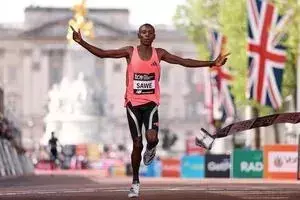
The Dawn of a New Era: Sabastian Sawe's Historic London Marathon Victory
A new chapter in athletic history was written when two African long-distance athletes accomplished what was once deemed impossible: completing a marathon in under two hours. Kenya's Sabastian Sawe emerged victorious at the London Marathon, clocking an astonishing 1 hour, 59 minutes, and 30 seconds. This phenomenal time eclipsed the previous men's world record by a remarkable 65 seconds, signaling a new benchmark in endurance running. Ethiopia's Yomif Kejelcha, making his marathon debut, also delivered an exceptional performance, finishing closely behind in 1:59:41.
A Trio of Champions: Redefining Marathon Speed
The event was not just a triumph for Sawe, but a collective display of extraordinary human capability. Uganda's Jacob Kiplimo secured third place with a time of 2:00:28. Notably, all three top finishers surpassed the previous world record held by Kelvin Kiptum, established three years prior. Sawe dedicated his victory to everyone present, emphasizing the shared experience of this historic moment. His strategic second-half surge, completing it in a swift 59:01, proved crucial. The final kilometers saw Sawe break away from Kejelcha, propelled by the enthusiastic cheers of the crowd lining The Mall, which he credited for providing significant motivation.
The Mythical Two-Hour Mark: A Historical Perspective
The marathon's origin is steeped in ancient Greek lore, believed to commemorate a soldier's run from Marathon to Athens to declare a military triumph. While the four-minute mile, famously broken by Roger Bannister in 1954, has seen its record lowered multiple times since, the two-hour marathon barrier represented a uniquely challenging frontier. For two decades, elite runners and sportswear innovators alike have fixated on this elusive target, signifying the ultimate test of human speed and endurance over the 26.2-mile distance.
Officially Unofficial: Eliud Kipchoge's Precedent and Sawe's Breakthrough
Although Kenya's running legend Eliud Kipchoge managed to break the two-hour mark in 2019, his 1:59:40 performance was not officially recognized as a world record. This was due to the unique, controlled conditions of the "1:59 Challenge," which included a specialized course and a rotating team of 41 pacemakers. Sawe's recent achievement, however, took place on a standard marathon course, making his time of 1:59:30 a legitimate new world record. Former London Marathon champion Paula Radcliffe commented on this pivotal moment, stating that "the goalposts have literally just moved for marathon running."
The Evolution of Marathon Records and Future Challenges
The progression of marathon records has been a gradual yet relentless pursuit. The first sub-2:30 marathon occurred in 1925, followed by the 2:15 barrier being broken 38 years later. At the close of the 20th century, the best men's marathon time stood at 2:05:42. Over the last quarter-century, a succession of Kenyan and Ethiopian athletes, including prominent figures like Haile Gebrselassie, Wilson Kipsang, and Kipchoge, have steadily chipped away at this record. With the two-hour barrier now officially breached, attention turns to other iconic track and field records, such as Usain Bolt's 9.58 seconds in the 100 meters, Mike Powell's 8.95 meters in the long jump, and Marita Koch's 47.60 in the women's 400 meters.
Technological Advancements: The Role of Cutting-Edge Footwear
The continuous improvement in marathon times is not solely attributable to enhanced training, nutrition, and technique. A significant factor has been the revolutionary advancements in running shoe technology. This includes the integration of carbon-fiber plates and innovative materials designed to create lighter, more responsive footwear. This evolution has sparked debates about "technology doping," particularly after Kipchoge's sub-two-hour attempt with Nike shoes. Sawe's record-breaking run, however, was accomplished in Adidas footwear, which has developed remarkably lightweight shoes—some men's size 9 models weighing a mere 3.4 ounces, less than half the weight of an average running shoe, according to the Wall Street Journal.
Tigst Assefa's Triumph: A Record in the Women's Race
The London Marathon also saw a new record established in the women's category, where Ethiopia's Tigst Assefa successfully defended her title. She surged ahead in the final 500 meters to win in 2:15:41, marking the fastest time ever recorded in a women's-only marathon. This impressive feat, though 16 seconds slower than Paula Radcliffe's 2003 mixed-race course record, was part of a historic moment where three women, including Kenya's Hellen Obiri and Joyciline Jepkosgei, ran under 2 hours and 16 minutes. Assefa expressed her excitement and satisfaction, attributing her success to dedicated training and improved speed.
Swiss Dominance: Wheelchair Race Victories
In the wheelchair races, Switzerland celebrated a double victory. Marcel Hug clinched his sixth consecutive men's title, and his eighth overall, demonstrating unparalleled dominance. Catherine Debrunner secured her second consecutive title in the women's race, prevailing over Tatyana McFadden in a fiercely contested finish, further highlighting the competitive spirit and athletic excellence at the London Marathon.