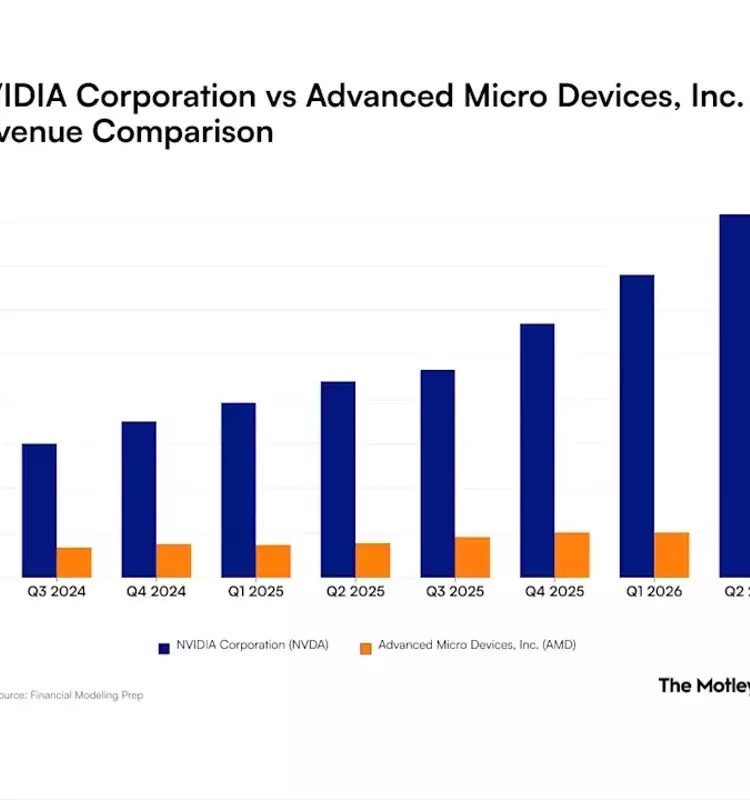
This article explores the distinct revenue patterns of NVIDIA and Advanced Micro Devices (AMD), shedding light on their performance within the competitive semiconductor landscape. NVIDIA has consistently demonstrated robust revenue expansion, largely fueled by its pioneering role in artificial intelligence (AI) chip development and its strategic foresight in the evolving tech sector. In contrast, AMD's revenue growth, while still significant, has shown more variability, with its sales to data centers being a key driver. The comparison underscores the importance of revenue as a fundamental indicator for investors, reflecting a company's success in attracting customers and expanding its business scale.
The analysis further delves into the factors contributing to these companies' financial health, particularly emphasizing their quarterly earnings. NVIDIA's strong net income margins and the successful launch of new platforms illustrate its continued market dominance. AMD, despite facing a more volatile revenue stream, has still achieved impressive sales growth, positioning itself as a formidable contender in the AI market, albeit behind NVIDIA's leading edge. Understanding these dynamics is crucial for investors evaluating opportunities in the fast-paced technology industry.
NVIDIA's Unparalleled Growth in AI and Semiconductor Innovation
NVIDIA has established itself as a frontrunner in the semiconductor industry, showcasing remarkable and sustained revenue growth. This consistent expansion is largely attributable to its superior offerings in graphics, computational, and networking solutions, which are foundational to advanced technological applications. The company's strategic vision and product innovation, exemplified by the full production rollout of its Vera Rubin platform and an impressive 72% net income margin for its fiscal first quarter, underscore its dominant market position. NVIDIA's ability to consistently deliver high-performance chips, especially for artificial intelligence, has cemented its leadership, allowing it to capture a significant share of the rapidly expanding AI market.
NVIDIA's success is not merely a matter of product sales but also of visionary leadership that accurately anticipates industry trends. CEO Jensen Huang's foresight in recognizing the potential of GPUs for AI and his subsequent delivery of the first AI supercomputer to OpenAI in 2016 marked a pivotal moment. This strategic move, coupled with his prediction of data centers evolving into AI factories, has propelled NVIDIA to an unmatched position. With its technology powering over 400 of the world's 500 fastest supercomputers, NVIDIA continues to lead in semiconductor innovation, driving its robust revenue trajectory through continuous advancements and a keen understanding of future technological demands.
AMD's Resilient Revenue Performance Amidst Market Dynamics
Advanced Micro Devices (AMD) generates its revenue through the development and sale of microprocessors, chipsets, and graphics processing units, competing directly with industry giants. While its revenue trajectory has been characterized by more fluctuation compared to NVIDIA, AMD has demonstrated resilience and significant growth in key areas. The company's fiscal first-quarter results revealed a 14% net income margin, and despite a less consistent quarterly revenue performance, its sales to data centers accounted for a substantial portion of its total revenue. This indicates a strong focus on high-growth segments, even as its overall market presence faces intense competition.
Despite NVIDIA's commanding lead in the AI chip market, AMD remains a formidable competitor, continuously innovating and expanding its product portfolio. The company's first-quarter sales of $10.3 billion represented an excellent 38% year-over-year increase, showcasing its strong market demand and operational efficiency. While AMD may not hold the same dominant position as NVIDIA in specific niche markets like AI supercomputers, its steady progress and substantial revenue growth affirm its status as a solid investment within the broader AI and semiconductor space. AMD's ongoing efforts to enhance its technology and expand its market reach ensure its continued relevance and competitive edge.
