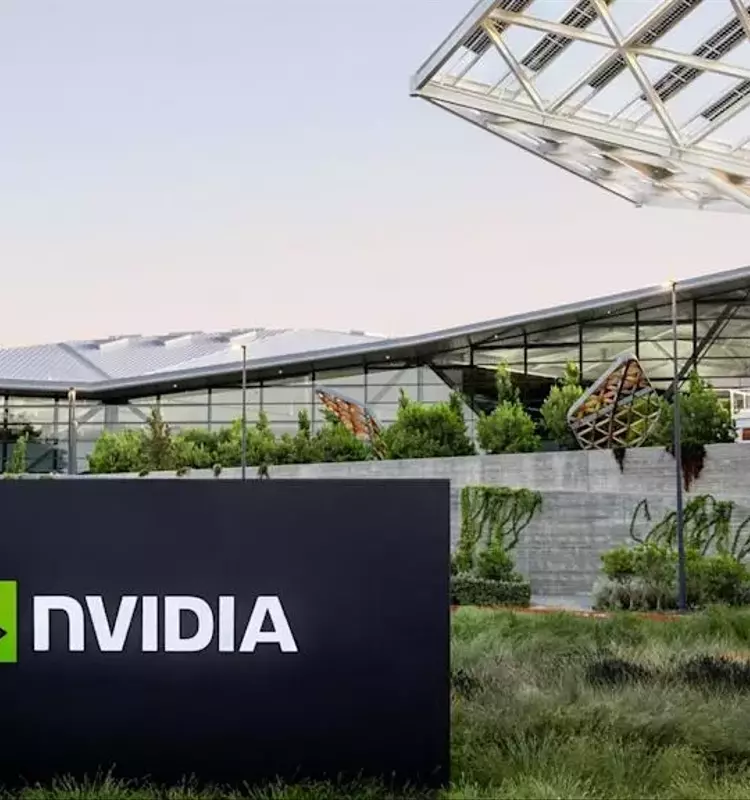
Nvidia, with a market capitalization nearing $5.5 trillion, has emerged as the globe's most valuable enterprise, primarily due to its flourishing data center segment where Graphics Processing Units (GPUs) power advanced artificial intelligence models. Looking ahead, the company's growth trajectory appears far from exhausted. While the data center's revenue is expected to continue its rapid ascent amidst a supercycle of capital expenditure, Nvidia is strategically evolving from a mere chip producer into a holistic architect of the entire AI infrastructure. Through focused investments, the company is fortifying the essential physical, optical, and wireless foundations required to scale AI technologies for large-scale operations and distributed networks.
A significant factor in Nvidia's future success is the anticipated continued momentum in its data center operations, which are projected to remain the primary growth driver over the next few years. The demand for accelerated computing shows no signs of abating, as major cloud providers increasingly deploy larger chip clusters for AI training, inference, and the emerging field of agentic AI. As AI models become more complex and parameter-intensive, the incremental benefits from each new GPU architecture are escalating. This trend is further amplified by the growth in networking revenue, indicating that data center expansions are not just advancing steadily, but are being supercharged by the comprehensive infrastructure Nvidia provides. This strategic shift is evident in Nvidia's capital allocation, which includes significant investments in companies like CoreWeave to fund the development of AI factories and in Lumentum and Coherent to advance photonics technology, crucial for high-speed, energy-efficient data movement. These deliberate actions underscore Nvidia's commitment to securing its supply chain, accelerating AI adoption, and unlocking new market opportunities across the AI value chain.
By expanding its influence into the wireless edge through a $1 billion investment in Nokia, Nvidia is integrating its accelerated computing platforms into Nokia’s radio access networks. This move aims to facilitate AI-native 5G-Advanced and 6G deployments, transforming cell towers into distributed AI compute nodes for edge inference and the Internet of Things. These collective investments strategically mitigate risks within Nvidia's data center ecosystem and accelerate demand across the entire infrastructure stack, establishing the company as an end-to-end AI platform provider. My projection indicates that by the close of 2028, Nvidia's forward price-to-earnings ratio will likely expand, reflecting its diversified leadership in AI infrastructure. This could potentially drive its market capitalization to approximately $10.5 trillion, doubling its current valuation. Nvidia's strategic infrastructure investments are not just bolstering its competitive advantage but are also positioning it to capture a disproportionately larger share of value as AI spending transitions from experimental projects to widespread enterprise deployment. By 2028, Nvidia is expected to be recognized not merely as the dominant GPU manufacturer, but as an indispensable platform fueling the global AI economy.
Nvidia's strategic expansion beyond its core chip manufacturing into comprehensive AI infrastructure development exemplifies visionary leadership and a commitment to innovation. This proactive approach not only secures its market position but also sets a benchmark for technological evolution, inspiring progress and fostering a future where advanced AI solutions are seamlessly integrated into every facet of society, thereby driving unprecedented growth and societal advancement.
