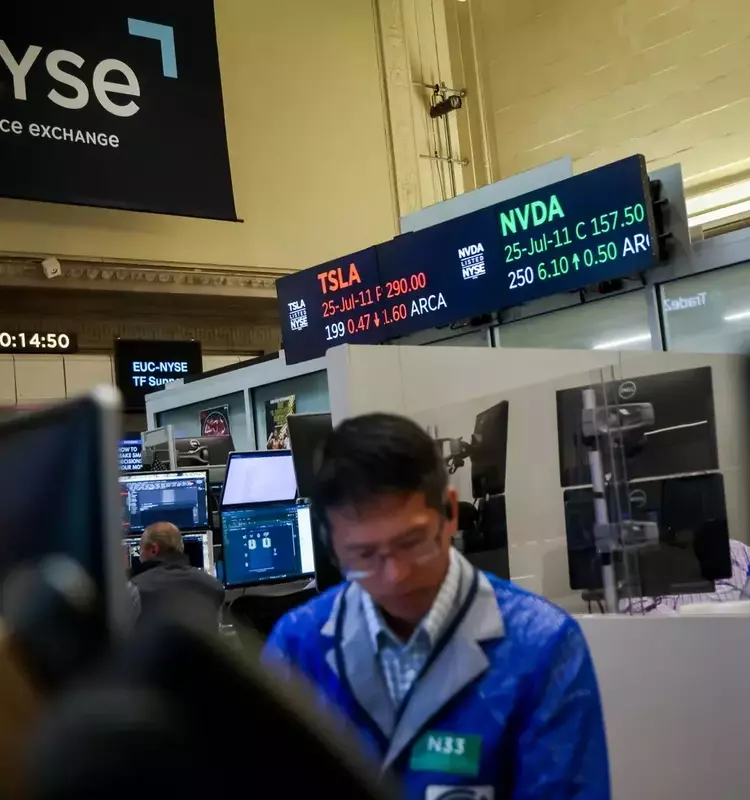
Nvidia, a prominent artificial intelligence (AI) chip manufacturer, has achieved an unparalleled level of influence within the S&P 500 index. As of 2026, the company accounts for a substantial 7.6% of the index's total market capitalization, a concentration not seen in over three decades. This highlights a significant shift towards the technology sector, particularly in AI-driven companies, and has profound implications for investment portfolios tracking this widely followed index.
Nvidia's remarkable ascent is a direct consequence of soaring demand for its advanced AI chips. Its market capitalization, hovering around $4.74 trillion, is equivalent to the combined value of the S&P 500's bottom 231 companies, nearly half of the entire index. This unprecedented weighting extends beyond the S&P 500 to other major investment vehicles. For instance, Nvidia represents nearly 7% of the Vanguard Total Stock Market ETF (VTI), over 10.23% of the Philadelphia Semiconductor Index (SOX), and 13.24% of the SPDR Technology Select Sector ETF (XLK).
The trend of market concentration isn't limited to Nvidia alone. The so-called 'Magnificent 7'—a group comprising Alphabet, Amazon, Apple, Meta, Microsoft, Tesla, and Nvidia—collectively command more than 40% of the S&P 500's market capitalization. This dominance has led to a scenario where investing in an S&P 500 tracking fund essentially means making a substantial bet on these tech giants. In 2025, Nvidia alone was responsible for approximately one-fifth of the Vanguard S&P 500 ETF's (VOO) gains, a trend that is projected to continue for a second consecutive year.
This escalating concentration has prompted many financial advisors to re-evaluate diversification strategies for their clients. The traditional approach of investing in market-cap-weighted indexes, while seemingly broad, now carries an increased risk due to the heavy reliance on a few high-performing companies. As a result, alternative investment strategies are gaining traction. For example, some advisors are recommending equal-weight S&P 500 ETFs, such as Invesco's Equal Weight ETF (RSP). These funds allocate an equal proportion of capital to each company in the index, thereby reducing the impact of any single stock's performance on the overall portfolio.
Historically, the performance of equal-weight ETFs like RSP can offer different risk-reward profiles. In July 2026, RSP had outperformed VOO, gaining about 12.2% year-to-date compared to VOO's 9.6%. Conversely, in 2022, when the broader market experienced a downturn, RSP's losses were less severe (11.6%) than VOO's (18.2%). This illustrates how equal-weighting can potentially provide a buffer during market volatility, offering a more balanced exposure to the S&P 500 by spreading investments more evenly across its constituents.
The remarkable surge in Nvidia's stock has propelled it to an unprecedented level of influence within the market-cap-weighted S&P 500 index. While its stellar returns have been a primary driver of the index's overall performance, this heavy concentration also introduces a heightened level of risk. Should Nvidia's shares experience a significant downturn, the repercussions could be widely felt across portfolios tracking the S&P 500. This evolving landscape underscores the importance of carefully considering investment strategies to ensure adequate diversification and manage potential risks in an increasingly concentrated market.
