Modern Portfolio Theory (MPT) provides a foundational framework for investors aiming to achieve optimal returns while managing risk. Developed by Harry Markowitz, MPT posits that a carefully constructed portfolio, rather than individual assets, is key to maximizing investment performance. This theory underscores the significance of diversification as a method to mitigate risk, suggesting that by combining various assets, investors can reduce the overall volatility of their holdings. While MPT has revolutionized investment strategies, it also faces criticisms regarding its real-world applicability, particularly concerning the identification of truly independent or risk-free assets and the practical number of securities needed for effective diversification.
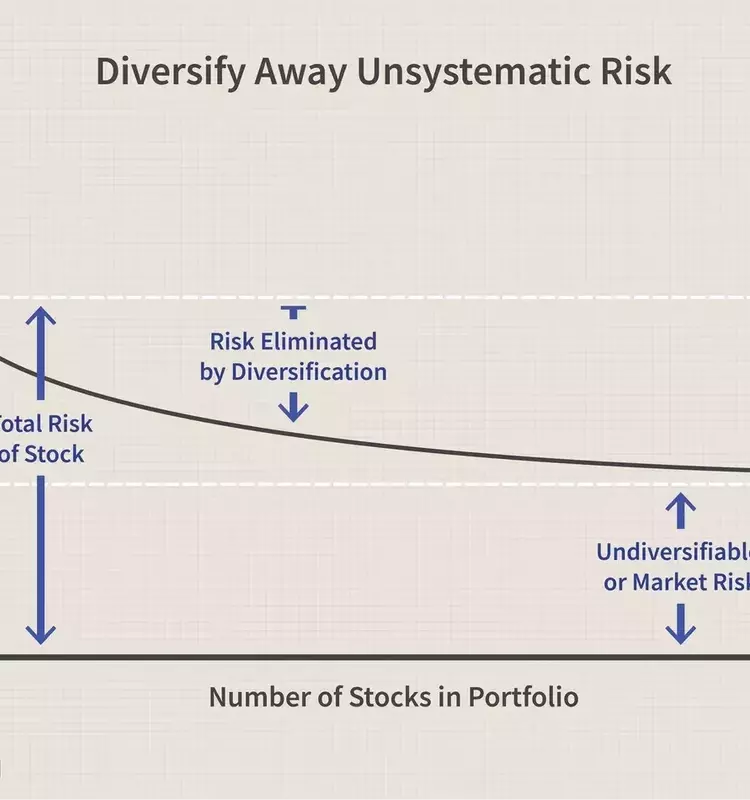
At its core, MPT, as introduced by Harry Markowitz in "Portfolio Selection" in 1952, challenges the traditional view of evaluating investments solely based on individual stock performance. Instead, it advocates for a holistic approach where the interaction between different assets within a portfolio is paramount. Markowitz’s groundbreaking work, which earned him a Nobel Prize in Economic Sciences alongside Merton H. Miller and William F. Sharpe in 1990, demonstrated that diversification allows investors to reduce what is known as “unsystematic risk.” This type of risk, specific to individual companies (e.g., management changes or operational declines), can largely be mitigated by increasing the number of diverse assets in a portfolio. However, MPT acknowledges that “systematic risk,” such as market-wide downturns or interest rate fluctuations, cannot be eliminated through diversification alone.
The concept of the “efficient frontier” is central to MPT. This theoretical boundary on a risk-return graph illustrates portfolios that offer the highest expected return for any given level of risk, or conversely, the lowest risk for any given level of return. Rational investors are expected to choose portfolios that lie on this frontier, with their specific risk tolerance determining their position along the curve. MPT further suggests that combining a portfolio on the efficient frontier with a risk-free asset, potentially through borrowing, could lead to even higher returns. However, the practical application of this principle encounters hurdles, such as accurately identifying genuinely risk-free assets (as even government bonds can be affected by inflation or interest rate changes) and the assumption of asset independence, which often breaks down during periods of market turmoil.
Despite its widespread adoption and influence on contemporary portfolio management and passive investing strategies (like index funds), MPT faces critiques regarding its assumptions. Critics point out the difficulty in convincing investors to embrace seemingly risky assets for overall risk reduction, the challenge of finding assets whose performances are truly independent, and the debate over the optimal number of stocks required for adequate diversification. While some studies suggest that a portfolio of around 30 stocks can achieve significant diversification benefits, others, like investment guru William J. Bernstein, argue that even 100 stocks might not be enough to fully diversify unsystematic risk. Ultimately, while MPT offers a powerful theoretical framework, the practical success of an investment portfolio still heavily relies on the investor’s skill, dedication, and adaptability to real-world market dynamics.
