Oracle's Stock Trajectory: Price Prediction and Growth Catalysts
Finance

Oracle's Stock Trajectory: Price Prediction and Growth Catalysts

authorBy Strive Masiyiwa
DateJun 18, 2026
Read time3 min

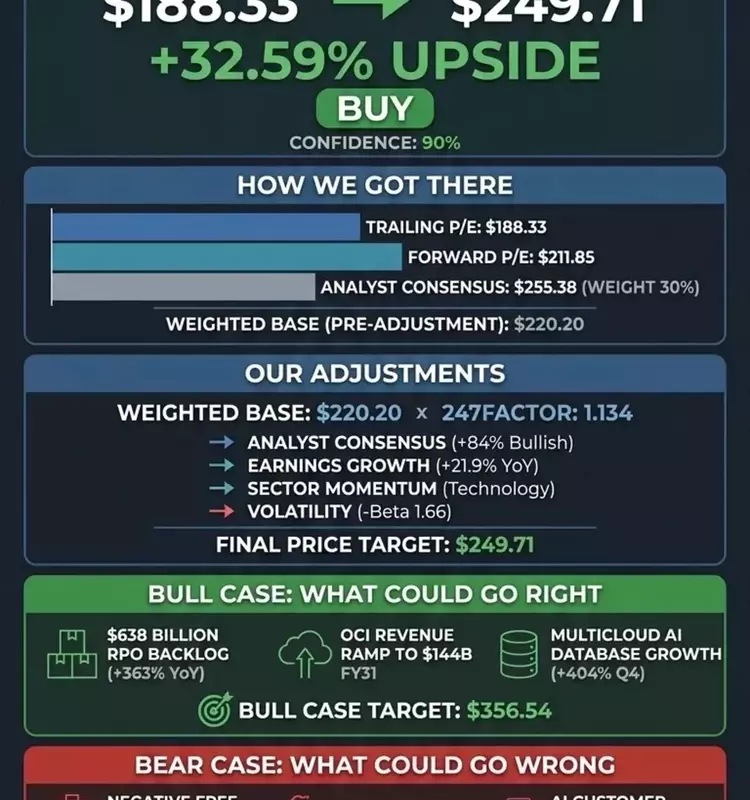
Oracle's stock, trading at $188.33 as of June 16, 2026, is poised for substantial growth, with a projected price target of $249.71 within the next 12 months, representing a 32.59% upside. This optimistic forecast is anchored in several key factors: an impressive $638 billion backlog, a rapidly expanding cloud infrastructure segment, and an anticipated surge in future earnings. Despite recent market fluctuations and concerns over capital expenditure leading to negative free cash flow, the underlying strengths in Oracle's business, particularly its commitment to AI, suggest a promising trajectory for investors.

Oracle has experienced considerable volatility in the market over the past year. Its shares have seen a 9.89% decline and an 8.49% drop in the last week, sitting 26% below its 52-week peak of $343.01. However, the company's fourth-quarter fiscal year 2026 earnings report, released on June 10, 2026, revealed strong performance in its core cloud business. Total revenue reached $19.184 billion, with non-GAAP earnings per share at $2.11. Cloud infrastructure revenue alone soared by 93% to $5.787 billion, and its Remaining Performance Obligations (RPO) dramatically increased by 363% year-over-year to $638 billion. The primary concern for investors has been the negative free cash flow of $23.686 billion, largely due to capital expenditures reaching $55.663 billion.

The bullish sentiment for Oracle is largely driven by the expected conversion of its extensive RPO into recognized revenue. Chief Financial Officer Safra Catz has outlined an ambitious plan for Oracle Cloud Infrastructure (OCI) revenue to grow from $18 billion in FY2026 to an impressive $144 billion within five years. Furthermore, management has confirmed a revenue target of $90 billion for FY2027, with non-GAAP earnings per share projected at $8.05. The multi-cloud AI database segment also witnessed remarkable growth, with revenue increasing by 404% in the fourth quarter. Oracle Health, bolstered by the new AI Cerner release, is anticipated to achieve double-digit growth. Should the current growth rates persist, some models predict Oracle's stock could even reach $356.54 within 12 months, signaling a potential total return of 89.32%.

Conversely, potential challenges exist, forming the basis of a bear case. Oracle's balance sheet shows significant total liabilities amounting to $218.703 billion, with plans to raise approximately $40 billion in FY2027 through debt and equity. The software license revenue experienced a 6% decline in Q4, and the risk of AI customer concentration is a genuine concern. Nevertheless, proponents argue that $75 billion of the RPO is linked to prepaid or customer-supplied GPU arrangements, which helps alleviate Oracle's capital burden. Even in a more conservative bear scenario, the stock is projected to trade at $211.13, still 12.11% above its current levels.

Looking ahead, Oracle's ability to convert its vast Remaining Performance Obligations into revenue on schedule and maintain OCI growth above 60% will be critical. While the company's long-term prospects appear strong, sustained high capital expenditures without corresponding cash generation could put pressure on its valuation. The future performance will heavily depend on AI capital expenditure discipline, GPU supply chain stability, and the pace at which customers migrate to cloud services.

More Articles
Finance
Meridian Corporation's Worsening Financial Health
Meridian Corporation, despite its appealing valuation, faces significant financial hurdles. The company's asset and credit quality have noticeably deteriorated, with non-performing assets and loans far exceeding acceptable levels. This decline has directly impacted profitability, evidenced by a substantial drop in annualized return on assets (ROA) and return on equity (ROE), both now below industry averages. While shares trade near book value and below competitors, the negative trends in credit and subdued earnings potential suggest a limited upside for investors.
By Robert KiyosakiJun 18, 2026
Finance
Trump's Q1 AI Portfolio Investments Revealed
Former President Trump's first-quarter 2026 financial disclosures indicate significant investments in artificial intelligence (AI) infrastructure and government technology stocks. These strategic purchases, made during a market dip in March, included NVIDIA, Advanced Micro Devices, Broadcom, Palantir Technologies, and Axon Enterprise. The investments highlight a focus on companies integral to AI development and those benefiting from federal contracts, signaling a calculated approach to capitalize on emerging technological trends and government spending priorities.
By Mariana MazzucatoJun 18, 2026
Finance
Software Sector Faces Renewed Pressure: Key Support Levels to Watch for IGV
The Software Sector ETF (IGV) has experienced a significant downturn, losing over 17% since early June and erasing its year-to-date gains. This decline signals a shift in investor preference towards more traditional industries over software. While some segments like cybersecurity and data analytics show resilience, legacy software and cloud computing continue to face challenges. Despite the broader weakness, IGV is approaching critical support levels. Given the strong fundamentals and technical positions of many of its top holdings, the ETF is expected to maintain this support. I am maintaining a "buy" rating on IGV, planning to increase my position at these key levels and selectively invest in high-conviction software companies.
By Mariana MazzucatoJun 18, 2026
Finance
Advanced Energy Industries: A Rising Star in AI Infrastructure
Advanced Energy Industries, Inc. (AEIS) has shown robust growth, driven by increasing demand in data centers and significant investments in AI infrastructure. The company's focus on a high-margin product mix and operational efficiencies is expected to boost its profitability. Despite a recent surge in stock value, its current valuation is considered reasonable, given its strategic positioning in the AI and semiconductor sectors and a positive double-digit growth forecast.
By Suze OrmanJun 18, 2026
Finance
Muni ETFs See Record Inflows Amid Low Volatility and Attractive Yields
Muni (municipal bond) ETFs are experiencing unprecedented inflows, driven by their remarkably low volatility, strong risk-adjusted returns, and compelling tax-advantaged yields. Investment-grade munis have demonstrated significantly lower volatility compared to major equity indices, while maintaining robust Sharpe ratios. These factors, combined with attractive tax-equivalent yields, make munis a highly appealing option for investors seeking stable income and capital preservation in the current market climate.
By Suze OrmanJun 18, 2026