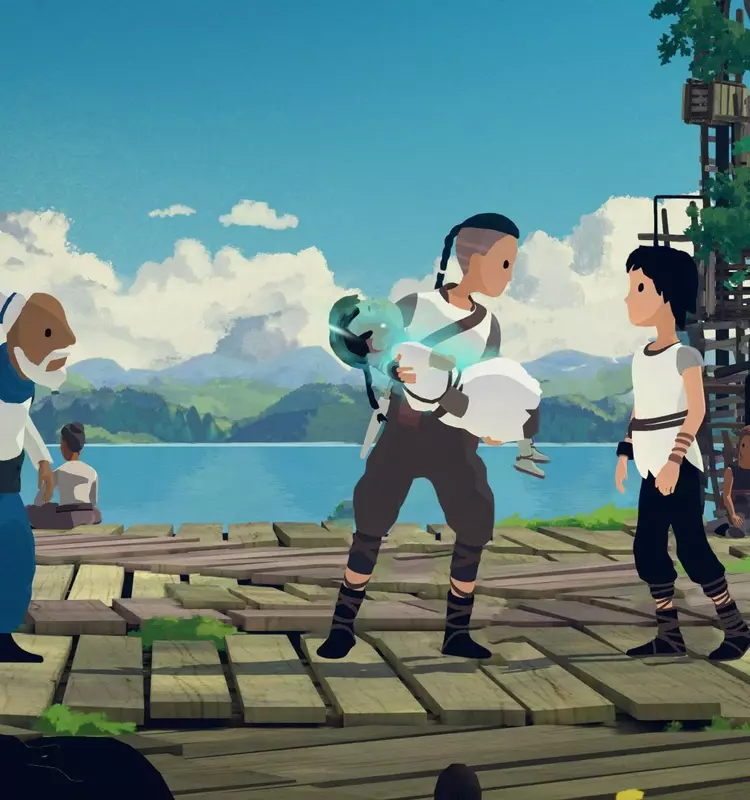
In a world increasingly accustomed to constant information, Wishfully Studios boldly ventures into the realm of silent narrative with their upcoming game, 'Planet of Lana 2: Children of the Leaf.' Eschewing conventional dialogue for a unique 'gibberish language' and a haunting musical score, the game challenges players to interpret meaning through subtle cues and immersive soundscapes. This innovative approach, championed by co-director Klas Martin Eriksson, aims to foster deeper player engagement and elevate the art of visual storytelling in video games.
Planet of Lana 2: Crafting Emotion Through Unspoken Words and Melodies
The highly anticipated sequel, 'Planet of Lana 2: Children of the Leaf,' is poised to redefine narrative in the gaming world. Wishfully Studios has made a deliberate choice to step away from traditional spoken dialogue, instead opting for a captivating 'gibberish language' that evolves with the game's intricate storyline. This unique linguistic development began with the simple commands Lana, the young protagonist, uses to direct her feline-like companion, Mui, during puzzle-solving sequences. As the narrative deepens, so too does this invented language, conveying a spectrum of emotions and intentions without uttering a single decipherable word. Co-director Klas Martin Eriksson enthusiastically described the creative process as a joyful journey of balancing spreadsheets and scripts, meticulously refining sounds to achieve the perfect emotional resonance. Despite the absence of facial expressions, the characters' body language and tonal inflections communicate profound meaning, immersing players in their journey. Furthermore, the game's musical score, composed by Takeshi Furukawa, plays an integral role in shaping the narrative. Eriksson highlights music as a universal language, capable of conveying complex emotions. The iconic five notes of the 'Progeny theme,' for instance, evoke a specific emotional landscape, and their distorted variations signal moments of imbalance and disruption within the game's universe. This ingenious blend of visual storytelling, an evolving fictional language, and a powerful musical score promises an unparalleled and deeply engaging experience for players. 'Planet of Lana 2: Children of the Leaf' is set to launch on March 5th across PlayStation 4, PlayStation 5, Windows PC, Xbox One, Xbox Series X, and Nintendo Switch.
This pioneering approach to game development by Wishfully Studios offers a compelling counter-narrative to the prevailing trend of exposition-heavy storytelling in media. By intentionally removing the crutch of explicit dialogue, the creators compel players to become more active interpreters of the narrative, encouraging a heightened sense of observation and emotional connection. This method not only deepens immersion but also champions a more artful and subtle form of communication. It serves as a powerful reminder that some of the most profound stories can be told not through what is said, but through what is felt, seen, and heard.
