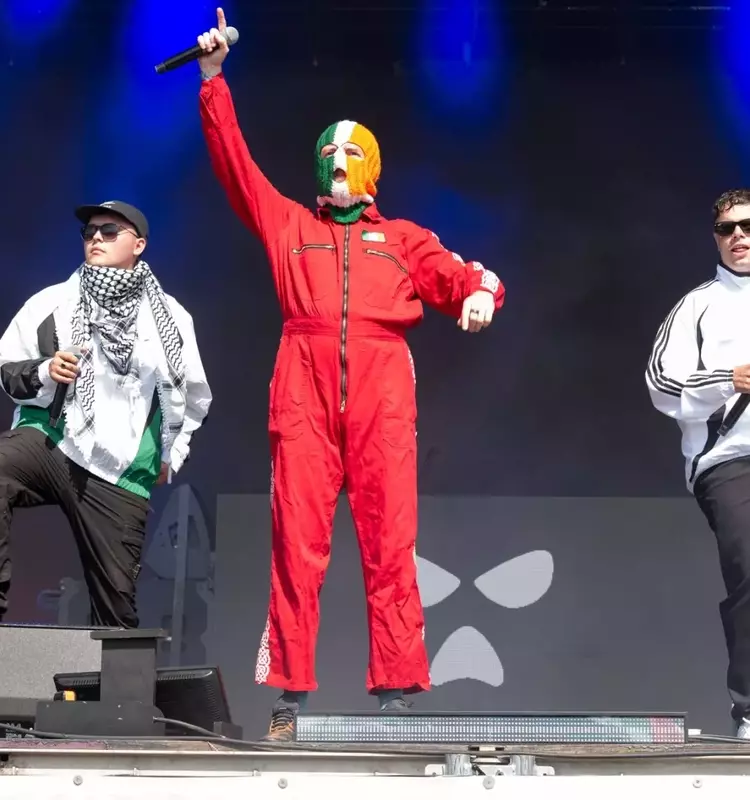
The British police force that initiated an investigation into the Irish rap group Kneecap following their Glastonbury Festival performance last month has opted to discontinue the probe. This decision, reported by the BBC, stems from a lack of sufficient evidence to secure a conviction for any alleged offense. Kneecap's set at the festival drew attention for its outspoken support for Palestine and strong criticism of British Prime Minister Keir Starmer, reigniting debates surrounding freedom of expression and political activism within the arts. The group has consistently maintained that their performance was a demonstration of unity and solidarity, dismissing the investigation as a form of political intimidation.
During their Glastonbury appearance, Kneecap reiterated their unwavering support for the Palestinian cause, a stance they have maintained across various performances, including at Coachella in April. Their actions at Glastonbury included strong condemnations of what they termed a “genocide” perpetrated by Israel in the region, alongside explicit chants targeting Prime Minister Starmer. These actions occurred amidst an ongoing conflict in Gaza, where the Health Ministry reports significant casualties and widespread starvation following Hamas's October 2023 attacks on Israel.
The police inquiry by Avon and Somerset Police commenced shortly after the Glastonbury event. However, on July 18, the BBC confirmed that the police, acting on advice from the Crown Prosecution Service, would not pursue further action. The official statement from the authorities cited “insufficient evidence to provide a realistic prospect of conviction for any offense.” In response, Kneecap characterized the entire investigative process as “political policing intimidation,” asserting that their stage presence represented a “celebration of love and solidarity.” They also highlighted that "Every single person who saw our set knew no law was broken, not even close.”
Prior to Kneecap's scheduled performance at Glastonbury, Prime Minister Keir Starmer publicly suggested that the band should be prevented from performing. Starmer’s comments indicated a belief that certain expressions were inappropriate, though he also acknowledged an ongoing legal case related to the matter. This highlights the political sensitivity surrounding the band's messaging and the broader implications for artists engaging in political commentary.
Adding to the controversy, Kneecap member Mo Chara, identified as Liam Óg Ó hAnnaidh, has been facing a terror charge in the U.K. since May. This charge alleges that he displayed the Hezbollah flag and chanted phrases like “Up, Hamas, up Hezbollah,” and “The only good Tory is a dead Tory” at a concert in November 2024. Both Hamas and Hezbollah are proscribed organizations in the U.K., and public support for them is considered a criminal offense. Despite these serious accusations, Ó hAnnaidh and Kneecap have vehemently denied the allegations, suggesting that video footage was intentionally taken out of context. They further posited that the charge itself was a retaliatory measure against their vocal advocacy for Palestine and their opposition to the conflict in Gaza, along with their criticism of the U.K. and U.S. governments' involvement in funding and supplying the conflict. Mo Chara is currently out on bail and is scheduled for a court appearance on August 20.
The band's performance at Glastonbury also included a moment where Móglaí Bap, another member of Kneecap, commented on Mo Chara’s legal situation. He controversially encouraged audience members to “start a riot” outside Westminster courts on August 20, the date of Mo Chara’s hearing, sarcastically remarking that this comment was for the Daily Mail. However, he quickly issued a retraction, emphasizing, “I don’t want anybody to start a riot. No riots, just love and support and more importantly support for Palestine, because that’s what it’s all about.” This statement underscored the band’s overarching message of solidarity and support for the Palestinian cause, positioning it as the central theme of their contentious performances.
The resolution of the police investigation into Kneecap's Glastonbury performance underscores the intricate balance between artistic freedom and legal boundaries, especially when political expression is at play. The authorities' decision to drop the case due to insufficient evidence reinforces the challenge of prosecuting speech-related incidents that, while provocative, may not meet the threshold for criminal activity. This outcome provides a degree of vindication for the group, allowing them to continue their advocacy and musical careers without immediate legal impediment arising from this particular incident. It also highlights the continued scrutiny and public discourse surrounding the Israeli-Palestinian conflict and the role of artists in global political movements.