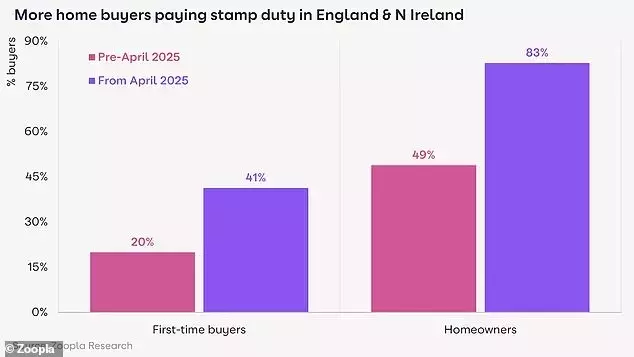
The British housing market is navigating a complex landscape, characterized by a significant increase in the proportion of homebuyers now subject to stamp duty, alongside a notable surge in market activity driven by more flexible mortgage lending criteria. This evolving dynamic presents both challenges, such as higher initial costs for purchasers, and opportunities, as enhanced borrowing power stimulates demand. While overall house price appreciation has moderated, regional disparities persist, reflecting the varied impact of these intertwined financial and regulatory shifts on different parts of the country.
Property Landscape Undergoes Transformation Due to Tax and Lending Adjustments
In a significant development for the United Kingdom's property sector, recent findings from the property website Zoopla, released on a late July afternoon, indicate a dramatic rise in the number of individuals acquiring homes who are now subject to stamp duty. Since the alteration of tax regulations in April, a staggering 83 percent of prospective buyers currently face this levy, a sharp increase from the pre-April figure of 49 percent. This amplified tax burden translates to an additional cost of up to £2,500 for those moving homes, and potentially an extra £11,250 for first-time buyers, prompting a greater inclination among buyers to negotiate reduced prices to offset these increased expenditures.
Despite the heightened financial pressure from stamp duty, the housing market has experienced a resurgence in activity. This renewed vigor is primarily attributed to recent modifications in mortgage lending regulations, which now permit borrowers to access larger loan amounts. In the four weeks concluding June 20th, a robust 11 percent increase in buyer interest for residential properties was observed, coupled with an 8 percent surge in agreed sales compared to the corresponding period last year.
This upswing is largely a direct consequence of adjustments to lenders' affordability assessments. Regulatory changes have enabled high street financial institutions to ease their 'stress tests,' which evaluate a borrower's capacity to meet mortgage obligations even if interest rates escalate. Consequently, borrowers are now being assessed against more favorable hypothetical rate scenarios, effectively allowing the average homebuyer to borrow approximately £35,000 more. This shift was further bolstered by an alteration in the rules governing the proportion of mortgages banks can issue at more than 4.5 times the borrower's income, a policy adjustment championed by Chancellor Rachel Reeves.
However, this heightened market activity has not translated into accelerated house price growth across the board. In June, average house prices saw a modest year-on-year increase of 1.3 percent, a slight deceleration from the 1.4 percent observed in May and 1.6 percent in April 2025. This contrasts with the peak growth of 2.1 percent recorded in December 2024, when buyers capitalized on reduced stamp duty incentives. The current average house price stands at £268,400, representing a modest annual increase of £3,350.
Zoopla further notes a record inventory of homes available, with an average of 37 properties listed per estate agent branch. This surplus, particularly evident in Southern England, contributes to a 'buyer's market,' effectively tempering price increases. Richard Donnell, an executive director at Zoopla, commented that while demand and sales are healthy, the increased supply prevents rapid price inflation. He anticipates a 1 percent rise in prices for 2025, a downward revision from the initial 2 percent forecast at the year's commencement.
Geographically, disparities in house price performance are also apparent. Southern English regions experienced the weakest growth in June, with the South East recording a mere 0.2 percent and the South West 0.3 percent. Central London's WC postcode, encompassing areas such as Bloomsbury and Covent Garden, saw a 5 percent decrease, while West London (W postcode) experienced a 1.5 percent decline. Coastal towns like Truro, Torquay, and Exeter also registered notable price falls. Conversely, areas in Ireland, Scotland, and Northern England demonstrated robust growth, with Belfast leading at 6.1 percent, followed by Halifax and Falkirk at 4.2 percent and 3.6 percent respectively.
David Powell, chief executive of Andrews Property Group, highlighted the market's ongoing adjustment since the withdrawal of stamp duty incentives in March 2025, noting its resilience despite slower price growth. He also pointed out the increasing number of properties on the market, which he believes impacts consumer confidence.
From a journalist's perspective, this confluence of policy shifts and market responses underscores the intricate balance within the housing sector. The government's attempts to stimulate the market through mortgage relaxations appear to have succeeded in boosting transaction volumes, yet the simultaneous increase in stamp duty payments presents a direct financial challenge to many. This situation creates a paradoxical environment where affordability, in terms of borrowing capacity, improves, but the upfront cost of homeownership remains a significant hurdle. It raises questions about the long-term sustainability of such a market, especially if the supply of homes continues to outpace genuine, sustainable demand. The regional variations in price growth further emphasize the need for nuanced policy approaches that address the diverse economic realities across different parts of the country rather than blanket measures. Future reporting will undoubtedly focus on how these trends evolve and their ultimate impact on the average citizen's ability to achieve homeownership.