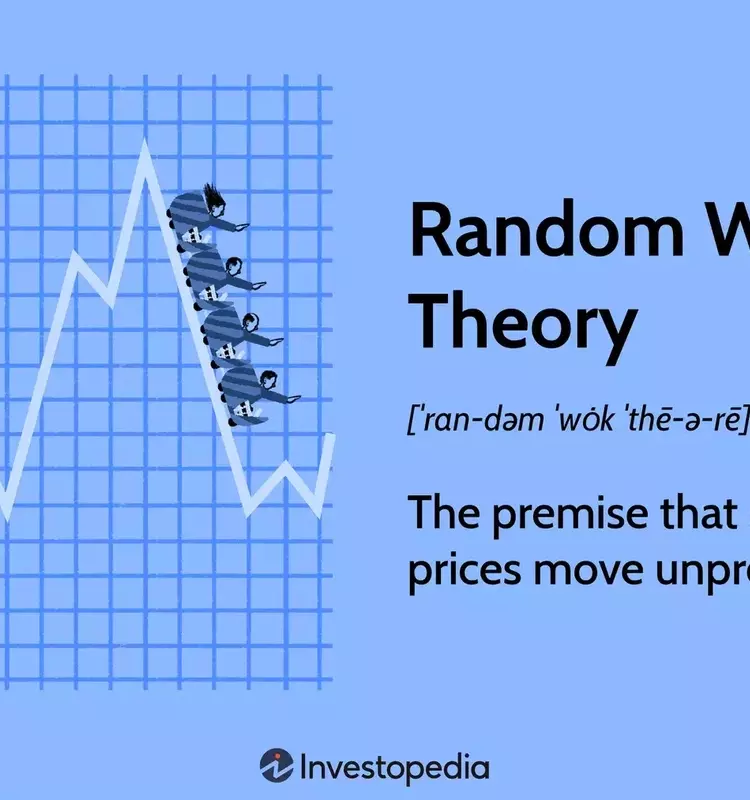
Random Walk Theory asserts that financial markets are inherently unpredictable, with asset price movements occurring randomly and independently of past trends. This principle aligns with the Efficient Market Hypothesis, which states that all available information is immediately reflected in asset prices, making it impossible for investors to consistently achieve above-average returns through active trading strategies. Instead, proponents advocate for a passive, diversified investment approach.
Despite its widespread acceptance in academic circles, the theory faces opposition from various market participants. Critics, including technical analysts and value investors, argue that market behavior is not entirely random and can be influenced by identifiable patterns, fundamental analysis, or even behavioral biases. However, the core message of Random Walk Theory encourages investors to adopt a long-term perspective and avoid attempts to time or outsmart the market.
The Essence of Random Walk Theory
Random Walk Theory states that security price fluctuations are purely random, making them inherently unpredictable. This core idea is foundational to the efficient market hypothesis, which suggests that current market prices already incorporate all publicly available information. As new information emerges, prices adjust instantaneously, eliminating any opportunity for investors to profit consistently from past price data or predictive models. Economist Burton Malkiel, through his influential work, championed this perspective, advocating for passive investment strategies such as buying and holding diversified portfolios over speculative trading. This approach emphasizes minimizing transaction costs and behavioral biases, asserting that efforts to pick winning stocks or time market entries and exits are ultimately futile and often lead to underperformance relative to a broad market index.
This theory has profound implications for investment strategy, promoting a disciplined, long-term view rather than short-term opportunism. It implies that an investor's best course of action is to invest in a broad, diversified portfolio, such as an index fund, and maintain it regardless of market volatility. Malkiel's arguments against active management stem from the belief that most professional money managers cannot consistently beat the market after accounting for fees and trading costs. The random walk model suggests that any perceived patterns or predictability in stock prices are merely illusions, random occurrences that do not signify underlying trends. Therefore, investors are encouraged to remain patient, focus on their financial goals, and resist the temptation to react to daily market noise, which is seen as random and irrelevant to long-term wealth creation.
Challenging the Random Walk: Criticisms and Alternatives
Despite its influence, Random Walk Theory is met with significant skepticism from various market practitioners who argue that financial markets are not entirely random. Critics highlight that the theory oversimplifies market dynamics by neglecting factors such as investor psychology, market manipulation, and the impact of significant economic news or regulatory changes. These elements can introduce non-random patterns and trends in asset prices, making them, to some extent, predictable. For instance, technical analysts rely on historical price charts and trading volumes to identify recurring patterns that they believe offer insights into future price movements. Similarly, fundamental investors assert that thorough analysis of a company's intrinsic value can reveal undervalued stocks, allowing skilled investors to outperform the market consistently, a feat exemplified by figures like Warren Buffett.
Moreover, the assumption of equal information access among all market participants, a cornerstone of the Efficient Market Hypothesis underpinning Random Walk Theory, is often contested. In reality, large institutional investors or those with privileged insights may possess superior information, leading to information asymmetries that can create market inefficiencies. Mathematician Benoit Mandelbrot also presented a powerful critique, suggesting that stock prices do not conform to a normal distribution and exhibit long-term dependencies better described by fractal geometry. His work emphasizes the occurrence of extreme events, or "black swans," which Random Walk Theory struggles to account for, highlighting the role of chaos theory in understanding market volatility. These counter-arguments suggest that while markets may appear random at times, underlying structures and influences can offer opportunities for informed investors to potentially outperform.
