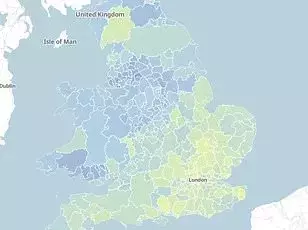
Recent data spotlights a significant downturn in property values across numerous communities in England and Wales, with nearly 140 areas witnessing a minimum 10% reduction in average house prices since before the pandemic. This comprehensive decline is particularly pronounced in certain urban centers, challenging previous market trends and highlighting a new landscape for homeowners and prospective buyers.
UK Property Market Shifts: A Detailed Look at Declining House Prices
A recent in-depth investigation has brought to light the specific areas in England and Wales where residential property values have seen the most precipitous drops. The analysis, which scrutinizes Land Registry sales figures across approximately 7,000 distinct geographical units, or Middle Layer Super Output Areas (MSOAs), indicates that almost 140 neighborhoods have experienced at least a 10% decrease in average house prices compared to pre-2020 levels. The most dramatic fall was observed in Somers Town, a vibrant district in North London situated near Kings Cross and Euston stations. Here, average property prices plummeted by an astonishing 49.9%, from an average of £1.3 million in 2019 to £675,000 this year. This substantial reduction signifies a profound shift in the local property landscape.
Following closely, the Borough and Southwark Street vicinity within the capital recorded a median price reduction of 44.9%, with values falling from £1.14 million in July 2019 to £625,000 by July of the current year. The iconic Abbey Road neighborhood also saw a considerable decline of 44.3%. Westminster's St John's Wood North experienced a 41% decrease, while Islington's Barnsbury West area registered a 39.2% drop, completing the list of the top five areas with the steepest price depreciation. Interestingly, of the 20 MSOAs with the most significant price decreases since July 2019, only one, Spennymoor East & Ferryhill West in County Durham, was located outside London.
Experts attribute these market corrections to a confluence of economic and policy changes. The Chancellor's recent fiscal adjustments, including a crackdown on non-domicile tax schemes and an increase in the surcharge for additional property purchases from 3% to 5%, have significantly impacted the demand from affluent international buyers, particularly in central London. Furthermore, the sharp rise in interest rates, which have more than quadrupled from 0.75% in 2019 to 4% presently, has exacerbated the situation. Lucian Cook, head of residential research at Savills, highlighted that London's higher house price-to-income ratios make it especially vulnerable to interest rate fluctuations. As borrowing costs ascend, mortgage repayments become more burdensome, effectively pushing potential buyers out of the market and compelling sellers in high-cost areas to reduce prices to facilitate transactions.
Conversely, regions with more affordable housing, such as the Midlands, North, and Scotland, have shown greater resilience and even growth, including a notable 162.2% increase in Old Trafford, Manchester, where average prices soared from £114,500 pre-pandemic to £300,000. This indicates a divergence in market performance, with affordability playing a crucial role. Despite the localized declines, some London boroughs, like Camden and Bromley, surprisingly registered overall annual increases in average house prices, demonstrating a complex and varied market dynamic within the capital. The property market is currently navigating a period of significant adjustment, with regional disparities and policy changes reshaping its future trajectory.
This comprehensive analysis of fluctuating house prices across England and Wales offers a stark reminder of the dynamic and interconnected nature of economic factors, government policies, and local market conditions. The data underscores the importance of a nuanced understanding of regional housing markets, moving beyond broad national averages. For policymakers, it highlights the immediate impact of fiscal and monetary decisions on property ownership and affordability. For potential buyers and sellers, it emphasizes the need for diligent research and cautious planning, as localized trends can diverge significantly from the wider market narrative. The ongoing shifts suggest a recalibration of property values, potentially fostering greater accessibility in some areas while posing new challenges in historically expensive locales. It’s a compelling testament to how macro-economic levers can intricately reshape the micro-realities of homeownership.