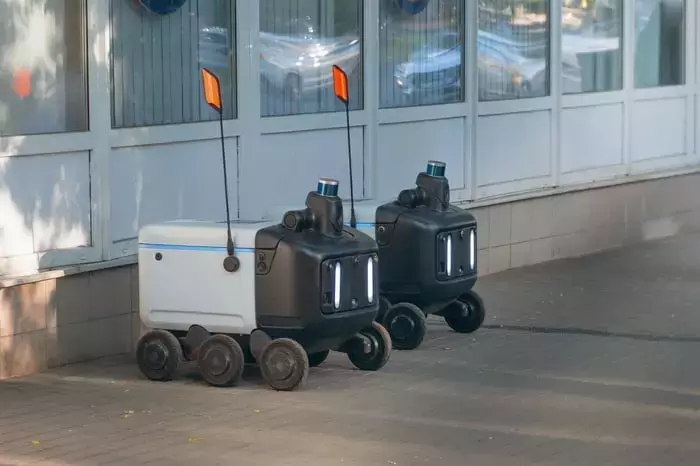
Serve Robotics, a pioneer in autonomous last-mile delivery solutions, finds itself at a crossroads. Following Nvidia's decision to sell its entire stake in late 2024, the company's stock experienced a significant decline. However, a deeper analysis reveals a compelling long-term opportunity driven by its innovative technology and a substantial partnership with Uber Eats. The market for autonomous logistics is projected to reach an impressive $450 billion by 2030, positioning Serve Robotics for potentially explosive growth. The company's current high valuation, coupled with its limited revenue generation, presents a complex picture for prospective investors.
Despite the recent stock performance, the fundamental vision of Serve Robotics remains strong. Its Gen3 robots, equipped with Level 4 autonomy and powered by Nvidia's Jetson Orin platform, are designed to revolutionize local deliveries. These robots can navigate footpaths without human intervention, offering a cost-effective alternative to traditional human-driven delivery services. Serve Robotics envisions a future where per-delivery costs could drop to as low as $1, making autonomous delivery an attractive option for restaurants and retailers. The company's expanding presence in major U.S. cities and its ambitious deployment plans underscore its potential to capture a significant share of the burgeoning autonomous delivery market.
Autonomous Delivery: Transforming Last-Mile Logistics
Serve Robotics is at the forefront of revolutionizing last-mile delivery, addressing the inefficiencies inherent in current human-centric logistics. The company's Gen3 autonomous robots are engineered to handle small commercial deliveries, operating safely on footpaths with Level 4 autonomy. This advanced capability, underpinned by Nvidia's Jetson Orin platform, allows the robots to function independently, minimizing the need for human oversight. Since its pilot program launch in 2022, Serve's robots have successfully completed over 100,000 deliveries for 2,500 restaurants, demonstrating the technology's viability and growing acceptance.
The strategic partnership with Uber Eats is a cornerstone of Serve Robotics' growth strategy. Under this agreement, 2,000 Gen3 robots are being deployed across various cities, with 400 already operational by mid-2025 and an additional 400 planned for the third quarter. This widespread deployment in key urban centers like Los Angeles, Miami, Dallas, and Atlanta, with Chicago next in line, highlights the company's commitment to scaling its operations. By significantly reducing the cost per delivery, Serve Robotics aims to disrupt the traditional delivery model, offering a more efficient and economical solution that could capture a substantial portion of the projected $450 billion autonomous delivery market by 2030. This shift towards autonomous solutions represents a transformative trend in urban logistics.
Navigating High Valuations and Future Growth Prospects
Serve Robotics' financial trajectory presents a contrasting view of immense potential juxtaposed with current operational realities. While the company's revenue remains modest, with just $642,000 reported in the second quarter, projections for rapid growth are compelling. Industry analysts anticipate a revenue increase to $3.6 million this year, a near doubling from 2024. More significantly, management forecasts an impressive $80 million in annual revenue once all 2,000 Gen3 robots are fully operational, which is expected by next year. This potential for exponential top-line growth is a key factor attracting investor interest.
However, the journey to profitability is marked by significant expenses. Serve Robotics incurred a net loss of $33.7 million in the first half of 2025, building on a $39.2 million loss in the previous year. Although the company possesses a substantial cash reserve of $183 million, ensuring operational runway for the immediate future, sustained losses necessitate eventual profitability or additional funding rounds. This financial landscape contributes to the stock's current high price-to-sales (P/S) ratio of 429, making it appear significantly more expensive than many of its industry peers. Despite the steep valuation, if management's ambitious revenue forecasts materialize, the forward P/S ratio could decrease to a more attractive 10, signaling a long-term growth opportunity within a massive addressable market. Investors must, however, exercise caution, as these projections are contingent on the successful scaling and adoption of its autonomous delivery services.