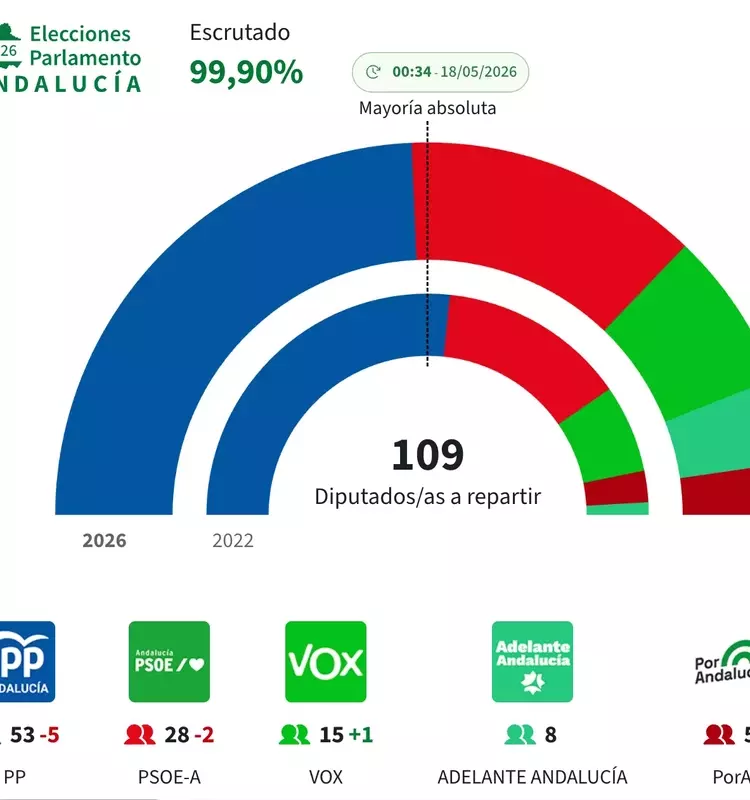
The Socialist Party of Spain experienced its most substantial electoral loss to date in Andalusia, amplifying the existing political and economic pressures on Prime Minister Pedro Sanchez as the next general election looms. The conservative People's Party secured a leading position, yet without an outright majority, requiring collaboration with the far-right Vox party to form a government. This regional shift reflects broader European trends of rising support for right-wing and far-right parties, fueled by public discontent over immigration, economic stagnation, and unemployment. Concurrently, Spain faces domestic fiscal challenges, a high unemployment rate, and strained international relations, notably with the United States, all contributing to a complex political and economic landscape.
Details of the Political Shift in Andalusia and its Wider Implications
On Sunday, May 21, 2026, the political landscape of Andalusia, Spain's most populous region, underwent a significant transformation. The Socialist Workers' Party (PSOE), historically dominant in the area, saw its representation shrink to 28 seats, losing two. In contrast, the conservative People's Party (PP), led by Juanma Moreno, secured 53 out of 109 available seats, establishing itself as the leading force. However, falling short of the 55 seats required for an absolute majority, the PP must now negotiate with the far-right Vox party, which obtained 15 seats, positioning it as a critical kingmaker in the formation of a coalition government. Moreno has expressed confidence in a clear mandate from Andalusians to continue the region's development.
This electoral outcome in Andalusia is indicative of a broader political current sweeping across Europe, where right-leaning and far-right parties are gaining ground. This trend is largely attributed to public frustration over issues such as mass immigration, sluggish economic growth, and persistent unemployment. Examples include Reform UK's strong performance in local British elections on May 7, 2026, and the Alternative for Germany's gains in German regional elections. Manuel Gavira, a Vox politician from the Parliament of Andalusia, highlighted the "historic opportunity" to address what he termed as "impoverishment" and the "replacement of native-born citizens with foreigners." Both the PP and Vox strongly opposed Prime Minister Sanchez's policy of granting legal status to half a million undocumented immigrants, with Vox leaders denouncing it as an "Islamization" and "migratory invasion" of Spanish society.
Despite outperforming Spain's national GDP growth in 2024 and the initial three quarters of 2025, Andalusia remains the nation's poorest autonomous region, contributing approximately €200 billion (13.4%) to the national GDP. The region's unemployment rate stood at 16.1% in the first quarter of 2025, significantly above the national average, with youth unemployment at a staggering 34.4%. The risk-of-poverty rate in Andalusia is also the highest in Spain, at 30.5%. These socio-economic challenges formed a crucial backdrop for the election, with PP and Vox campaigning on stringent immigration policies and advocating for a "national priority" that favors Spaniards in accessing public services. Meanwhile, the left-wing Adelante Andalucía party increased its seats from two to eight, with its leader, José Ignacio García, noting their success in preventing the PP from securing an absolute majority.
Nationally, the PP has maintained a lead in polls for over a year, benefiting from corruption allegations involving former socialist officials and even Prime Minister Sanchez's spouse, who faces charges from a far-right group. Sanchez's minority government lost the crucial support of the Catalan pro-independence party, Junts, in October 2025, leading to governance without a stable majority. Economically, Spain's first quarter of 2026 saw robust growth of 0.6%, outpacing many eurozone economies, with an annual growth of 2.7%. However, this economic strength is tempered by a rising unemployment rate, which climbed to 10.83% in the first quarter of 2026, and ongoing fiscal issues. The International Monetary Fund (IMF) warned in March 2026 that political fragmentation could jeopardize fiscal policy, especially given the government's failure to pass a national budget for two consecutive years.
Adding another layer of complexity are Spain's escalating tensions with the United States. In March 2026, then-President Donald Trump threatened to sever trade ties with Spain after Sanchez denied U.S. forces access to jointly operated military bases at Rota and Morón in Andalusia for strikes against Iran. Spain's subsequent closure of its airspace to U.S. planes further strained bilateral relations. Despite the U.S. being Andalusia's fifth-largest goods export partner in 2024, with €3.1 billion in trade, Sanchez defiantly stated Spain would not compromise its principles out of fear of retaliation. This diplomatic rift, coupled with domestic political and economic uncertainties, creates a challenging investment environment, with the IMF highlighting risks from geopolitical tensions and internal political fragmentation.
This electoral shift in Andalusia serves as a stark reminder of the volatile nature of contemporary European politics. The rise of right-wing and far-right movements, driven by concerns over national identity, economic security, and immigration, is reshaping traditional power structures. For Spain, the outcome in Andalusia not only signals immediate political and fiscal challenges for the ruling Socialist Party but also underscores deeper societal anxieties that resonate across the continent. The intricate interplay of regional election results, national political stability, economic indicators, and international relations creates a complex scenario that demands careful navigation. As journalists and observers, we are compelled to recognize how these local electoral victories can cascade into broader national and international implications, signaling a potential new era of governance and policy-making shaped by evolving public sentiments and geopolitical realities.
