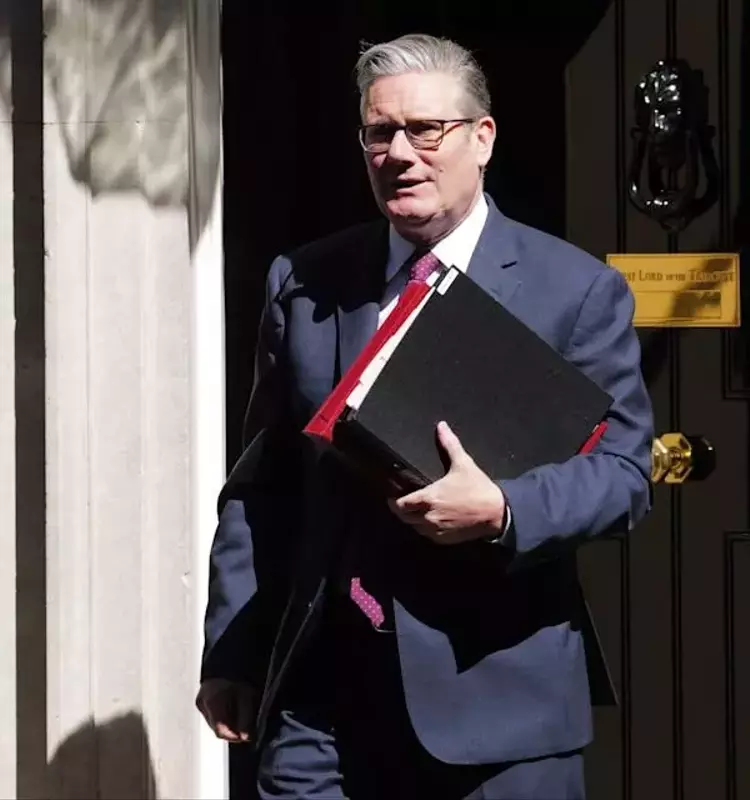
The British bond market recently experienced a substantial shock, pushing long-term bond yields to their highest point in nearly three decades. This upheaval is largely due to escalating political uncertainty surrounding Prime Minister Keir Starmer's position, which has rekindled investor anxiety regarding the UK's financial stability. The value of the pound also diminished, while leading UK banking institutions witnessed significant share price drops, fueled by speculation of impending tax hikes under a new governmental structure. This economic turbulence underscores the delicate balance between political stability and market confidence, especially as the nation grapples with broader economic pressures.
On Tuesday, the gilt market faced widespread declines, with the 30-year yield briefly reaching 5.81%, a peak not observed since 1998. Concurrently, the pound depreciated by 0.7% against the dollar, settling at $1.3517. Financial giants such as NatWest Group Plc and Lloyds Banking Group Plc were among the hardest hit in the UK stock market, as analysts contemplated the prospect of increased taxation for the banking sector under a potential new government. Despite Prime Minister Starmer's efforts to quell rumors of his resignation during a Cabinet meeting, investors remained focused on the implications of a change in leadership for the bond market.
A primary apprehension among investors is that any successor from the Labour Party might adopt more left-leaning policies, potentially relaxing the existing fiscal regulations that have controlled borrowing. With the British economy already contending with the pressures of elevated energy costs and rampant inflation, the current fragmented political landscape has emerged as an additional source of market unease. Experts like Matt Cairns, head of fixed income strategy at Rabobank, note that the ongoing political turmoil reinforces the perception that a credible strategy to stabilize the nation's finances is lacking, regardless of who holds power. This suggests that gilts will likely continue to face pressure, irrespective of immediate political outcomes.
Later in the trading session, gilts recovered some of their losses, with the 30-year yield adjusting to 5.76% by 11:08 a.m. in London, after an initial surge of 14 basis points. The performance of UK equities, including a 0.5% dip in the FTSE 100 Index and a 1.1% fall in the mid-cap index, generally mirrored global market trends. While bond markets worldwide have recently experienced sell-offs due to persistently high oil prices, the UK's substantial debt, internal political strife, and a sluggish economy have rendered it particularly susceptible to such volatilities. Chancellor of the Exchequer Rachel Reeves has previously highlighted that debt servicing costs consume approximately one pound out of every ten spent by the government.
As borrowing costs continue to escalate, the government's financial burden is expected to intensify. According to Bloomberg Economics, the recent 20 basis-point increase in the 10-year yield since Friday is projected to add an estimated 2 billion pounds to the national debt interest bill by the close of the decade. Among the possible Labour leadership candidates, Health Secretary Wes Streeting is widely regarded as the most market-friendly. He has advocated for stronger trade ties with the European Union as a means to bolster the British economy and has expressed discomfort with the current level of taxation, suggesting that individuals and businesses are shouldering too much. Roger Lee, head of equity strategy at Cavendish, believes that even if Starmer steps down, political uncertainty will persist. He suggests that to stabilize the gilt market, the government might need to reaffirm its commitment to fiscal rules, with Streeting appearing to be the only candidate prepared to do so.
Angela Rayner, another potential contender, has attempted to assuage investor concerns by pledging the Labour Party's commitment to strict public finance management. However, she previously spearheaded a Cabinet rebellion against Chancellor Rachel Reeves' proposals to reduce welfare spending and has faced scrutiny over her personal tax affairs, leading to her removal from the deputy prime minister role last year due to issues with property tax payments. Manchester Mayor Andy Burnham is also anticipated to challenge for leadership, despite not currently being a Member of Parliament. He has criticized the government's economic policies, asserting that the country is overly reliant on bond markets. Last year, Burnham proposed increasing government borrowing by 40 billion pounds to fund the construction of more council homes, a suggestion quickly dismissed by Starmer's administration who warned of the risk of alarming the bond market.
For the investment community, these recent events evoke memories of the market instability in 2022, triggered by former Prime Minister Liz Truss's mini-budget, which led to a record low for the pound and a sharp rise in gilt yields. Since then, the gilt market has become a central theme in UK political discussions. Starmer and Reeves have shaped their agenda around self-imposed fiscal rules, aiming to assure investors of their prudent borrowing practices. This stance, however, has limited the government's ability to fund public services as generously as many within the Labour Party desire, leading to dissatisfaction among lawmakers.
