Unlocking Business Performance: The Power of Accounting Profit
Defining Accounting Profit: A Fundamental Business Metric
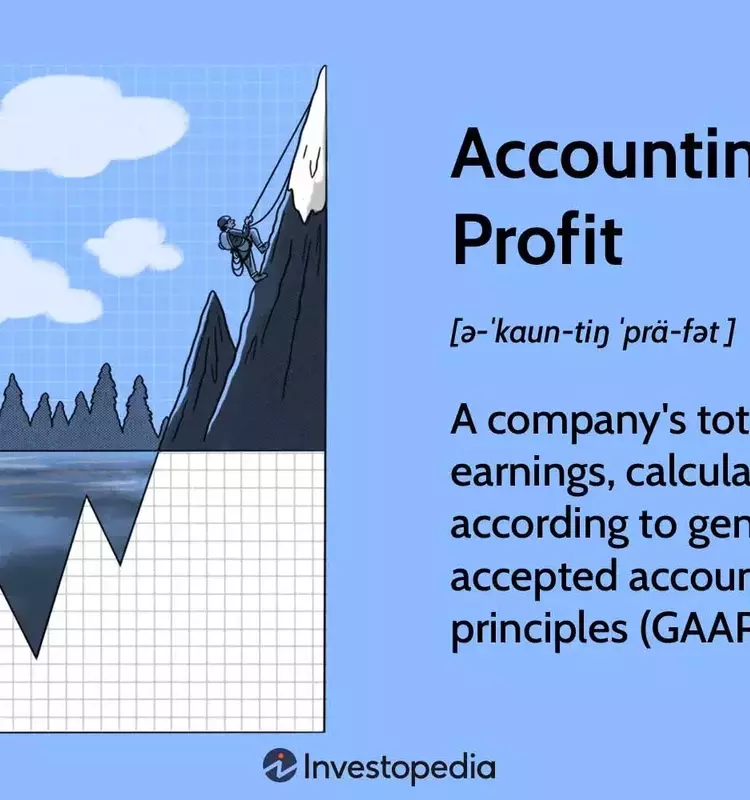
Accounting profit, often known as bookkeeping profit or financial profit, signifies a company's total earnings. It is meticulously computed following generally accepted accounting principles (GAAP) and encompasses all explicit expenses incurred during business operations, such as operational costs, depreciation, interest payments, and taxes.
The Mechanism of Accounting Profit: Calculating Financial Health
Profit serves as a crucial indicator of a company's financial well-being. Businesses frequently release various profit figures in their financial reports, some adhering strictly to all revenue and expense items as detailed in income statements, while others represent management's nuanced interpretations. Accounting profit, specifically, quantifies the money remaining after all monetary costs are subtracted from total revenue, effectively revealing the funds left after covering explicit business expenditures. These explicit costs include wages, inventory, raw materials, transportation, marketing, production, and overhead expenses.
Accounting Profit Versus Economic Profit: A Tale of Two Perspectives
Both accounting profit and economic profit subtract explicit costs from revenue. The key divergence lies in economic profit's inclusion of implicit costs. Implicit costs represent the opportunity costs a company foregoes when allocating resources to one venture over another. Examples include company-owned property, equipment, and the value of an owner's self-employment resources. For instance, if an individual invests $100,000 to launch a business and generates $120,000 in revenue, the accounting profit is $20,000. However, if their implicit cost—the salary they would have earned elsewhere—is $50,000, their economic profit would be a loss of $30,000. While accounting profit reflects actual financial outcomes and is used for tax purposes, economic profit is primarily a theoretical tool for managerial decision-making.
Accounting Profit Against Underlying Profit: Beyond the Bottom Line
Companies often supplement accounting profit with their own perspectives on profitability, such as underlying profit. This popular metric typically excludes one-time or infrequent events like natural disasters, restructuring charges, or the sale of assets. These non-recurring items are often excluded because they do not reflect the ongoing operational costs and revenues of the business, allowing stakeholders to focus on a more consistent measure of performance.
Illustrative Example: Calculating Accounting Profit in Practice
Consider a manufacturing company selling widgets at $5 each. In January, it sells 2,000 widgets, generating $10,000 in total revenue. With a production cost of $1 per widget, the cost of goods sold (COGS) is $2,000, resulting in gross revenue of $8,000. Subtracting monthly employee expenses of $5,000 yields an operating profit (or EBITDA) of $3,000. If the company has no debt but incurs $1,000 in monthly straight-line depreciation for assets, its earnings before taxes (EBT) would be $2,000. Applying a corporate tax rate of 35% on this EBT, the company's accounting profit is calculated as $1,300 ($2,000 - ($2,000 * 0.35)).
