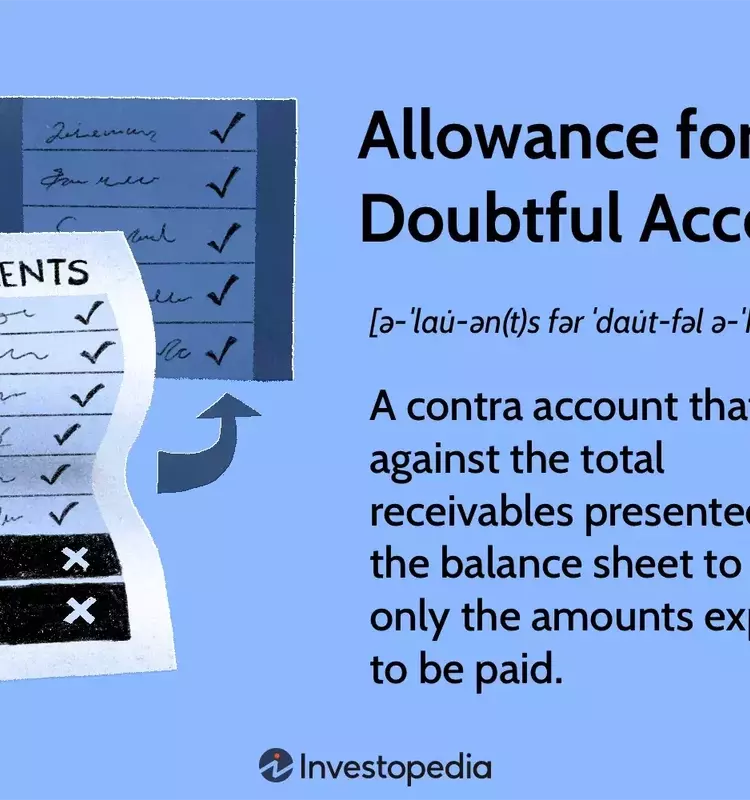
Understanding the Allowance for Doubtful Accounts
Finance

Understanding the Allowance for Doubtful Accounts

authorBy Fareed Zakaria
DateMay 08, 2026
Read time2 min

When businesses extend credit to their clients, an inherent risk exists that some payments may not be received. To accurately reflect their financial standing, companies establish a financial reserve known as the "allowance for doubtful accounts." This provision helps predict future credit losses from invoices that customers are unlikely to settle. By proactively estimating these uncollectible amounts, businesses can present a more truthful representation of their financial health.

This accounting mechanism serves a dual purpose: it adheres to the matching principle of accounting, which dictates that expenses should be recognized in the same period as the revenues they generate, and it enhances the precision of financial statements by acknowledging the genuine risks linked to future customer payments. Several strategies are employed to estimate these uncollectible funds, including applying a percentage to credit sales, analyzing the age of accounts receivable, categorizing customers by risk, utilizing historical data, or even focusing on individual accounts. This proactive approach ensures that financial records are both transparent and aligned with generally accepted accounting principles (GAAP).

The process of managing the allowance for doubtful accounts involves several steps: initially establishing the allowance, making necessary adjustments as new information becomes available, and eventually writing off specific accounts deemed uncollectible. For instance, if a company expects $75,000 of its outstanding invoices to go unpaid, it would record this amount as both a "bad debt expense" and an increase in the "allowance for doubtful accounts," thereby reducing the reported value of total receivables. Should economic conditions worsen or payment patterns shift, these allowances can be adjusted. When an account is definitively uncollectible, it is removed from both the receivables and the allowance, ensuring that the initial expense recognition prevents any new charges. This method, although seemingly subjective, provides a far more accurate and conservative financial outlook than simply assuming all invoices will be paid.

Embracing the allowance for doubtful accounts is not merely a technical accounting requirement but a strategic business imperative. It allows companies to transform the uncomfortable reality of potential non-payments into a manageable financial process. By anticipating these credit risks, businesses are better positioned to make informed decisions regarding credit extensions and collection strategies. This foresight ultimately contributes to a more robust and honest financial ecosystem, benefiting both the company and its stakeholders.

More Articles
Finance
Understanding the Book-to-Market Ratio: A Key Financial Metric
The book-to-market ratio is a crucial financial metric used to evaluate a company's stock by comparing its book value to its market value. This ratio helps investors identify whether a stock is undervalued or overvalued by the market. A high ratio suggests potential undervaluation, making it a valuable tool for investors focused on identifying value stocks.
By Robert KiyosakiMay 08, 2026
Finance
The Real Costs of Public Offerings
Many companies choose to remain private due to the significant financial and legal challenges associated with going public. This article delves into the various expenses involved, from regulatory compliance to the initial public offering (IPO) process itself. Underwriting fees represent a major portion of these costs, often varying with the size and complexity of the IPO. Both fixed and variable costs play a role, impacting smaller companies disproportionately despite larger overall costs for bigger entities.
By Fareed ZakariaMay 08, 2026
Finance
Understanding Marginal Propensity to Save (MPS) and Its Economic Impact
Marginal Propensity to Save (MPS) refers to the proportion of any additional income that individuals choose to save rather than spend. This crucial economic concept, central to Keynesian theory, directly influences the effectiveness of economic multipliers. Generally, as income levels rise, so does MPS, impacting how fiscal policies affect overall economic activity. MPS is inversely related to the Marginal Propensity to Consume (MPC), with their sum always equating to one, offering a comprehensive view of how new income is allocated between saving and spending.
By Lisa JingMay 08, 2026
Finance
The Human Factor: POET Technologies' Setbacks and Future Outlook
This article discusses the recent missteps by POET Technologies, highlighting the significant impact of human error on investment outcomes. It details how an inadvertent NDA violation by the CFO led to a major order cancellation and delays in addressing tax issues. Despite these corporate governance challenges, the author maintains a 'Buy' rating, anticipating the company will learn and mature from these experiences.
By Lisa JingMay 08, 2026
Finance
The Dynamics of Corporate Conglomerates: Structure, Evolution, and Impact
This article explores the nature of conglomerates, which are large corporations made up of diverse, often unrelated businesses under a single parent company. It delves into their historical development, how they are formed, and the advantages and disadvantages they present. The discussion includes examples of both domestic and international conglomerates, highlighting their operational models and market influence.
By Morgan HouselMay 08, 2026